Friday, April 30, 2010

Connecting The Dots


image from Mark Drabenstott, printed in The Daily Yonder

Here are some connections, commentaries and new leads that we're following here at The Art Of The Rural:

-- If our post on the fictitious town of Ogden Marsh, Iowa was of interest, then check out The Rural Blog and it's new department covering Rural Representations and Reviews. The current editorial by John James Snidow considers the FX television show Justified and Appalachian myths:
About halfway through the first episode of FX’s new show Justified, a Confederate-flag-wearing, rocket-propelled-grenade-launching, minority-hating, ex-con, ex-miner, good-old-boy of a Kentuckian pulls out a Mason jar full of a clear liquid and smiles. And the audience knows without being told, just as you know reading this right now, that it’s not gin, it’s not vodka and no, that jar is definitely not water. It’s moonshine.
--  We have more to say about the moonshine, so stay tuned. Until then, did you know that the hipster community has turned to the white lightning? It's an emerging industry, it has given birth to a new book on the subject. Again, more soon.

-- Out of our Farmville Files, and out of the continuing questions of how members of the rural diaspora might return home, we would like to recommend this report by Mark Drabenstott: Past Silos and Smokestacks: A Rural Development Proposal. A selection, with excellent visual data (as seen above) can be found at The Daily Yonder.
Today, that industry is going away, and much of the rural Midwest’s economic vitality is going with it. The current recession is only accelerating a decline that has its roots in a rapidly globalizing market for industrial products. Traditional manufacturing jobs are leaving the rural Midwest. And so are many of its best-educated and most talented young people.
The rural Midwest could have an economic future as bright as its vibrant past. But it is basing its twenty-first-century future on a twentieth-century playbook. This is not a recipe for success. Towns and counties compete with neighboring towns and counties for jobs and investments. Industrial recruitment—“smokestack chasing”—is the norm. Economic development agencies spend millions on infrastructure and tax breaks to lure companies from afar instead of creating new jobs at home. Boosters sell the rural Midwest as a cheap place to make things, ignoring the region’s many other economic assets—its natural resources, its hard-working people, its central location, its schools and universities, and its scientific base, among others —that could all be leveraged into a competitive new economy.
--Hal Cannon and Taki Telonidis of The Western Folklife Center are blogging about their project "In the Footsteps of John Lomax:"
The Western Folklife Center has been asked to produce a story for National Public Radio on the folk music collecting of John Lomax. This coincides with the 100th anniversary of the publishing of his first collection, Cowboy Songs and Other Frontier Ballads, in November of 1910. We are working with a New York folklife organization called City Lore and hope to produce other stories on the journeys of early folklorists to discover the soul of America through its folklore. On this week-long journey through Texas and Louisiana, we go to the place Lomax grew up and saw, first-hand, the cattle drives after the Civil War. We visit the Elephant Saloon at the Stockyards in Fort Worth where he collected cowboy songs and where Don Edwards sang those same old songs in the 1970s. As we journey along the same paths Lomax took we contrast the world he lived in with that of contemporary America.
-- Jen Gilomen, one of the filmmakers behind Deep Down, also made a very fine film worth checking out: Delta Rising. Here's the trailer:

Thursday, April 29, 2010

Los Reyes de Albuquerque


a selection from a photograph by Genevieve Russell 

As the debate over Arizona's new immigration policy rages across the country, we should remember that hispanic americans have been contributing to all aspects of the southwestern life for generations--long before much of the current population even had a mailbox in Arizona or New Mexico.

This idea was brought again to my attention when I had a chance to watch this outstanding public radio/online documentary:  Los Reyes de Albuquerque. A collaboration between Paul Ingles and photographer Genevieve Russell (of StoryPortrait Media), the documentary is a lush collage of photographs, video and music that tells the story of the legendary Los Reyes de Albuquerque and the Martínez family of musicians. Enrique Lamadrid wrote an excellent feature on the group for Smithsonian Folkways magazine; here's his introduction to the legacy of Mr. Martínez and his family:
In New Mexico, the name Roberto Martínez is synonymous with royalty. Los Reyes de Alburquerque (The Kings of Albuquerque) is a Nuevo Mexicano–styled mariachi group he founded with Ray Flores, Miguel Archibeque, and other friends in 1962. For nearly a half-century, Los Reyes has performed all over the region and the nation in a wide variety of venues both humble and grand—from schools, nursing homes, and the live local talent shows of the 1960s to community dances, concerts, feast days, state fairs, and festivals, including several appearances at the Smithsonian Folklife Festival. These public performances as well as the group's exposure on Spanish-language radio stations generated a demand for recordings, and dozens of them, from 45s to cassettes to CDs, have been issued on the homegrown M.O.R.E. (Minority Owned Record Enterprises) label founded by Roberto Martínez. The collection is now part of the Smithsonian Folkways with many albums available. Their music features mariachi favorites in familiar arrangements of guitarra, requinto, vihuela, guitarrón, violín, and trompeta (guitar; soprano, rhythm, and bass guitars; violin; and trumpet), but what distinguishes Los Reyes is the lyrical New Mexican violin as well as Martínez's original compositions. 

Don Roberto is also the patriarch of one of New Mexico's most prominent musical families. His five children (Roberta, Doris, Lorenzo, Debra, Roberto Jr.) and several grandchildren (Sheila and Larry) have all played with the group, and many young musicians got their start with Los Reyes as well. Two stars emerged from this family constellation: the late Debbie "La Chicanita" Martínez, whose meteoric singing career was tragically ended by deafness and illness, and Lorenzo, whose violin has introduced a new generation to the resonant instrumental music of the past.
While documentary does great work to convey the beauty of this music, it's also a love story and a story of family. It traces Mr. Martínez's childhood in Chacon, New Mexico through his service in the Air Force and his courtship of wife Ramona and the beginnings of a musical career that would take influences from both sides of the border to create a music that is distinct to New Mexico. The documentary will be embedded below, but a larger HD version is located on the filmmakers' site, along with some galleries of photos and more information on the project. Though we say this a lot around here, this documentary and its companion site are well-worth visiting, so find a comfortable chair and settle in.

Los Reyes de ABQ Documentary – 22 Minutes from StoryPortrait Media on Vimeo.

Wednesday, April 28, 2010

Spring Brook Farm, "Tarentaise," and More Pork Than You Have Ever Seen In One Place


By Ian Halbert

Mary and I have finally settled into our new home in Watertown, saddled with all the concerns and frets that plague the first-time homeowners: money, money and money. But despite these worries, Mary, in her great generosity of spirit, opened our coffers, even while knee-deep in boxes and packing tape, to pay my entry fee into a premier food event here in Boston: Cochon 555.

The idea is simple: 5 chefs, 5 pigs, 5 wines. The wines get a little lost in the shuffle, as 5 talented chefs are each given a heritage breed pig from a local farm and week to make as much from the pig as he can. The chef who proves the most resourceful and creates the most tasty dishes is crowned the “Prince of Porc.”

In keeping with the theme, a local butcher, Ryan Farr from 4505 Meats in Great Barrington, MA, broke down a pig, in a live butchery demo:


In sum, it was a fantastic evening with food you can’t really imagine and I can’t really describe. (For a better account of the event, with more visuals, descriptions of the food and the chefs who participated, another attendee has posted a vlog at You Tube. The purpose of the event is to raise awareness for heritage breed pork, family farms and a program called Farms for City Kids.

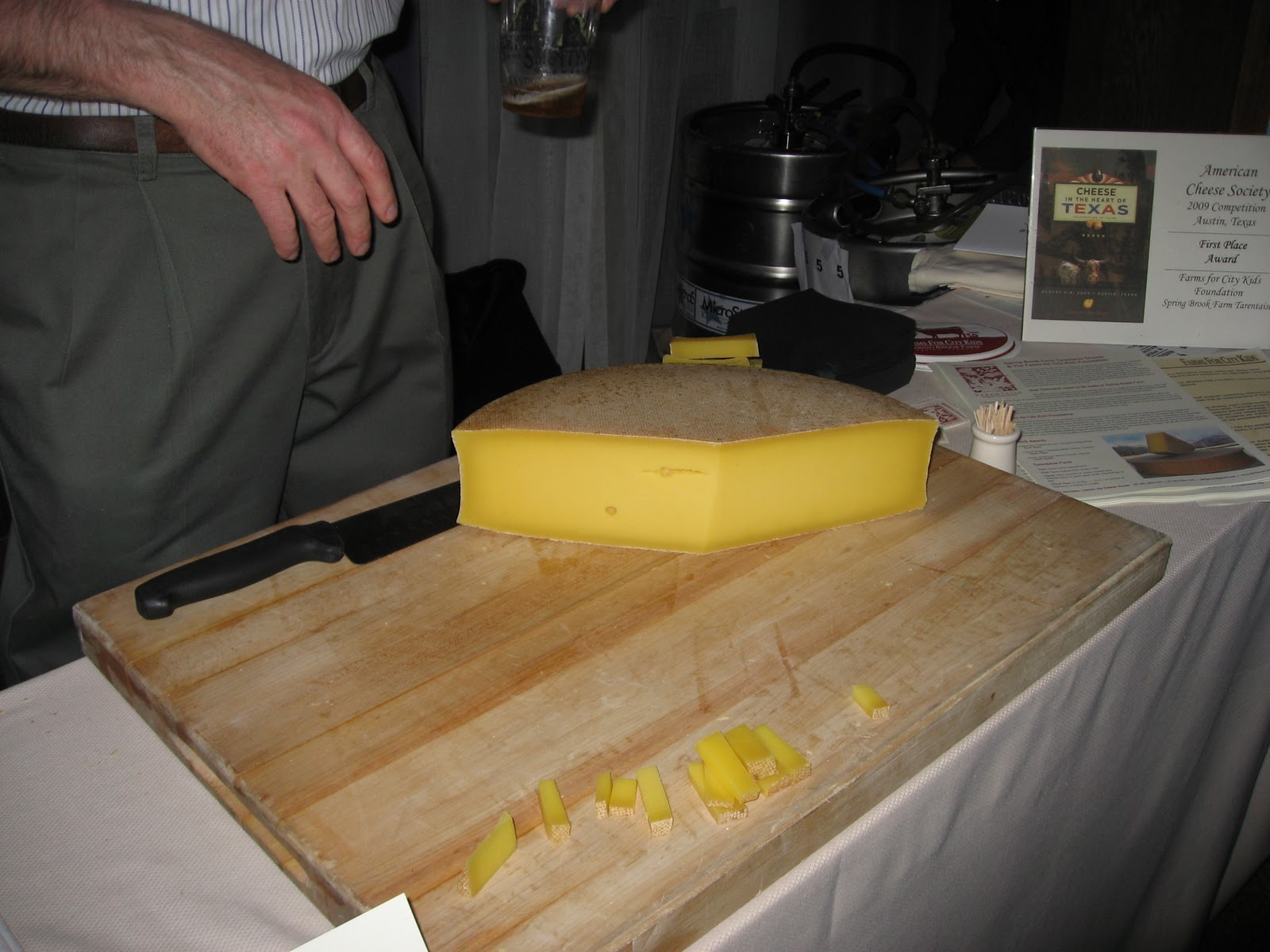
While at the event, I was lucky enough to meet and talk with Jeremy Stephenson, the head cheesemaker at Spring Brook Farm. I was lured to his table by the large wheels of his “Tarentaise” cheese ¬– an aged cow’s milk cheese in the Alpine tradition. It is a refined cheese, subtle and delicious, reminiscent of Comte or Gruyere. The initial bite is unassuming – then the aftertastes come to the forefront, settle on your palate and you find yourself eating more than your fair share of free samples. (For more description of the cheese, Anne Saxelby, owner of the famous NYC Essex Street Market Saxelby Cheesemongers, has a marvelous post about the qualities and excellence of Jeremy’s Tarentaise at her online almanac. )


But Jeremy’s table had more than cheese to offer. Spring Broom Farm is the home of the Farms for City Kids Foundation, an organization which hosts urban youth on the farm, incorporating academic study and farm life. Jeremy and I talked at length about the program and what positive impact it can have for the kids lucky enough to experience a week on the farm. Such experiences can be revelatory: seeing where food comes from or seeing it made is a powerful experience. When I first began to cook, I was floored by the simplicity and elegance of mayonnaise – before I had ever whisked oil and egg yolks together, mayonnaise was something in a jar from Hellmann’s. In my great shame, I freely admit my ignorance that mayonnaise was in fact something one could make with little effort and less knowledge.

There is something mystical about food, how time and salt, heat and moisture, or emulsification and mixing can render what was once humble into something glorious and transcendent. I cannot help but think that kids who may have only ever had Velveeta or Kraft Singles will leave Spring Brook Farm with their world-views forever altered – after all they will have seen a Jersey heifer’s milk taken from teat to “Tarentaise.” (Speaking of which ... why not buy some cheese from Jeremy?)

The program at Spring Brook Farm takes the kids through all the various activities on the farm:
Students rotate team-structured tasks daily between the dairy barn‚ small animal barn‚ greenhouse‚ garden and dormitory. By achieving hands-on project success‚ students build interpersonal‚ leadership and problem-solving skills.
In addition to this hands-on work, the kids also enter into a unique contract the first night of their stay:
During their first night on the Farm‚ each student class creates a Community Contract that states how they will live for the week. Care and respect—for each other‚ for yourself‚ for the environment and for the animals—are the cornerstones of our program.
Again, these kinds of activities can have a profound impact on young students, who likely have never seen themselves as particularly responsible to or for their food or their environment, at least not in such a direct manner.

There is much to be hopeful about in this new food landscape, where the energy all trends back toward the farm and local food resources. Still, I can’t but feel that we need something of a bridge between the constituent communities of the food system – the chefs, farmers, producers, distributors and consumers. For those of us in the cities with enough disposable income, “locally sourced” and “heritage bred” have become inextricably linked to the fruit of some pretty remarkable talents; chefs like Jamie Bissonnette, Tony Maws and Barry Maiden, and the others who competed at the Cochon 555 event make food very few of us are capable of reproducing. They are doing their part in showing us what farm-fresh food is capable of, and leading the way by insisting on using it in their restaurants. Still, in an environment where the farm has been elided with the food of world-class talents, fetishism reigns supreme – at Cochon 555 it is a porcine fetish; as discussed here before, in the DIY community, it is a pickle fetish. I hope that at the other side of this latest return to the farm we will have achieved the goal of making local, fresh and whole foods once again the norm for the American table, rather than the rarefied and exclusive province of those who have the resources and time to make a romance of it. People like Jeremy Stephenson and the program at Spring Book Farm offer hope that the bridge is already being built.

Monday, April 26, 2010

North Dakota Rural Arts Initiative


Tin Can Pile, US 10, Casselton, North Dakota.  Photograph by Jim Dow.

The Museum of Modern Art is undoubtedly one of the finest arts institutions in the world, and, if you are enthusiastic about the arts, its reach is difficult to escape. It's hard not to go to arts events, to read arts magazines and blogs, or even to go out on the town, and not see a reference in one form or another to the wonderful and ubiquitous presence of MOMA. But what if our nation had MORA, a Museum of Rural Art? I've been thinking lately about how such an endeavor would differ in form and function from what we conventionally expect from a museum space. 

The first step in such a venture would have to be to re-orient the viewer to the art, and to de-centralize the experience: to bring art out of (for many in the audience) hard-to-reach urban centers and into real-life communities, where the imaginative value of the artwork might have a chance to cross-pollinate with local ideas and local practice. The North Dakota Museum of Art is way ahead of the curve in this regard. They are currently featuring touring exhibitions that are bringing art into rural regions of the state. Their Rural Arts Initiative has worked for four years to place these exhibits in schools and community buildings, all the while integrating it into lesson plans and local dialogues. The Museum provides this service for no charge, and its educators and staff take an active role in all stages of the process. In their own words this Initiative
works to encourage and empower rural school students and their teachers to actively participate in learning through the arts. Rural School Initiative came about in direct response to feedback from educators and families working in rural areas. Major challenges such as inadequate funding for art education, few museums and great distances have not allowed the visual arts to flourish in rural areas as much as other forms of art such as music and theatre, which accompanied early settlers as they moved west.
Some of this flourishing is evident in the current exhibition Marking The Land: Jim Dow in North Dakota. A resident of Boston, where he is a professor art, Mr. Dow has spent  a great deal of time in North Dakota since the early 1980's, and the work on view in the interactive gallery speaks to the ways in which a searching and compassionate artistic eye can trump any of the questions in being an "outsider" to the region: the photographs do indeed offer, in the Museum's words "a stirring photographic tribute to the complex and unyielding landscape of North Dakota."

Mr. Dow's work is just the beginning. There's much more fine work to explore on the Museum's site, including Snow Country Prison: Interned in North Dakota. This exhibition of photograph tells the story of how Fort Lincoln in Bismark became an internment camp for German and Japanese citizens. There's so much more worth commenting on in this exhibit and throughout the Museum site; it's well worth visiting and revisiting.

Friday, April 23, 2010

Going Deep Down


Deep Down: A Story From The Heart of Coal Country had its broadcast premiere last night on Kentuck Educational Television. It's a film by Jen Gilomen, (Delta Rising) Sally Rubin (The Last Mountain) and produced by David Sutherland, the filmmaker behind two absolutely outstanding documentaries: The Farmer's Wife and Country Boys. Here's their eloquent description of the context behind the project, which premieres at a moment when the EPA is taking many long-overdue steps to halt the spread of Mountain Top Revoval:
Any exploration of power production in America will lead to Appalachia, a region that has supplied our nation with coal for over a century. As America’s energy consumption rises, the extraction and burning of coal to meet these demands has dramatically altered the Appalachian landscape, economy, and culture. The Tennessee Valley Authority, for example, is assessing the potential of mining an estimated 82 million tons of coal from the Royal Blue Wildlife Management Area. (By comparison, only 3 million tons were mined in the entire state in 2002.) In Appalachia, coal is the number one industry, with an enormous influence on local economies and people. At the same time, few Americans know about mountaintop removal mining (MTR), nor have any knowledge that their own demand for power is directly impacting the mountains, water, and sky. As we increase our energy usage, we also become more and more removed not only from the natural places that have provided this energy, but from the human beings whose lives we dramatically alter by consuming those resources. The crossroads we find ourselves facing as a nation is one that pervades our land and sky, and it can only be addressed by the cumulative efforts of millions of tiny personal changes. Therein lies the potential for a human story, like the stories we have found in Appalachia, to make a million tiny changes, to reconnect us as humans to the suffering we have caused as well as our own power to prevent it in the future.

Simultaneously, Appalachia as a region deserves our attention as a place of history, complexity, and change. A century of Appalachian scholars and journalists have attempted to eradicate the persisting stereotypes of the Appalachian “hillbilly.” In a society where making fun of a person’s way of speaking or ridiculing their poverty is normally considered unacceptable, mainstream television programs and films continue to portray stereotyped and homogenous images of Appalachia, if they portray them at all. As our advisor Dr. Chad Berry of Berea College so eloquently puts it, “there is not an Appalachian culture, there are Appalachian cultures.” Similarly, we pride ourselves as Americans in being a diverse society, but often neglect the rural poor in the study and depiction of that diversity. It is time for us to look back to this “forgotten” region, to allow its people to teach us and to teach each other about these cultures that the mainstream media has almost entirely overlooked.

By asking us to trace the power lines from our homes to people far removed from our daily lives, Deep Down inspires Americans to preserve Appalachia and our shared legacy.
Here's a trailer for the film:


There are many more aspects to explore on the Deep Down site, including their People Power series of video vignettes--where folks engaged with this issue can tell their own story, in their own words. Here's one example about life underneath the power plants, told by Elisa Young of Racine, Ohio:


And don't forget the music:


For the more technologically-savvy, the producers also established a Virtual Mine on Second Life, where participants can explore a Mountaintop Removal site and learn more about the issue. Also, as always, visit Coal Tattoo for more on these issues and to hear more about the latest in the ongoing investigation in Montcoal.

Wednesday, April 21, 2010

An Almanac For Moderns: The First Swallow


April Twentieth

Some one is forever telling us that one swallow does not make a summer. But what good is the first swallow, skimming on his side through the April afternoon, if it cannot raise a vaunted hope or encourage us to defy the gloomy and the unco circumspect! If they are right, those folk who are forever deriding the first man to try a thing, forever predicting disaster and living cautiously for a perfectly hypothetical old age, then let me, pray, be wrong. May I still, when I can count my hairs, be given grace and fortitude in the chill spring weather to say when first I see the wild spiral of the swallow that winter is over and done.


More information on our Almanac For Moderns project and the work of Donald Culross Peattie can be found here.   

Monday, April 19, 2010

The Equine Sculpture of Rachel Wilson


As the Kentucky Derby is approaching in a few weeks, we're at the point in the year where--at least for a few hours--a dozen horses will awe an entire nation. For all of those viewers who can't visit a stable themselves, the artist and sculptor Rachel Wilson has created some gorgeous work that captures these  animals' fluidity and grace.

A native of southwestern Missouri, Ms. Wilson's sculptures plumb the area between folk art and modern art, between the representational style of Thomas Hart Benton and the abstract works as Alberto Giacometti and Andy Goldsworthy. It's no surprise, then, that these sculptures are a reflection both of her study of modern art and of her experiences as a farmer. Below, Linda Leicht of the Springfield News-Leader, describes the genesis of the project and the artist's process:
She decided she would create an "assemblage" out of natural materials on the farm.
"It really started out of necessity," she said. "We were outside already, and I always seem to find something creative I can do."

Now, even her little ones have been working on their own sculptures. Cost was a additional incentive.

"We've been through some tight times with farming," said Wilson, a "city girl" from Webb City who now loves the farming life with her husband, Kyle, a third-generation farmer.

Now, it's a family event. Kyle Wilson drives the pickup truck, and she and the kids "pick up sticks."
Those sticks are pretty special — they are big, shapely, hard and resistant. "As far as I can tell, it lasts for just about forever," she said of the wood.

Hedge — or Osage orange trees — were planted in the hedge rows and used for fencing. The Wilsons have dug up hedge fence posts placed years earlier that are still green and untouched by rot or bugs. It's easy to find the fallen branches, especially after the ice storms of 2007 and 2008.

"I don't take anything off living trees," she insists. "I'm kind of a tree-hugger, I guess."
Ms. Wilson's art is stunning in the way that it displays an intuitive understanding of the horse, bringing to life its posture, its gait--even its musculature--all through the unbendable arc of an osage branch. It's also a fantastic model for how the arts can actively contribute to the success of a family farm and how, on a broader scale, rural communities can use their local assets to foster artistic and economic sustainability. Rachel Wilson's site contains many more pictures of her horses, as well as her other sculptures. Also, here's a video that helps reveal the artist's work: