Here's Clyde Joy singing "Echoes from the Hills" as recorded by Al Hawkes at
Event Records, Westbrook, Maine, 1957. Joy, who built the Circle 9 Ranch
in New Hampshire, pioneered the New England country sound and continued
to perform at the annual Deerfield Fair until three years before his
death at age 92. Our next installment of North Country will pick up the
story of Event Records and its impact on a regional musical style.
• "Rural
art museums face distinct challenges when it comes to building
audiences for exhibitions and programs," writes Paul D’Ambrosio,
president of the New York State Historical Association. “Unlike our
counterparts located in urban areas or population centers, rural art
museums must compel their audience to travel a good distance to partake
of their offerings, and they must tailor their exhibitions and programs
to the particular patterns favored by those travelers. At the same time,
they must do so while building a donor and sponsorship base that is
likewise not local or at least only seasonal.” TheFenimore Art Museum of rural Cooperstown, NY, found a solution through regional collaboration and interdisciplinary thinking.
Photograph from the Aldo Leopold Foundation Archives
• “Rising
before daylight and perched on a bench at his Sauk County shack in
Depression-era Wisconsin, [Aldo] Leopold routinely took notes on the
dawn chorus of birds. Beginning with the first pre-dawn calls of the
indigo bunting or robin, Leopold would jot down in tidy script the bird
songs he heard, when he heard them, and details such as the light level
when they first sang. He also mapped the territories of the birds near
his shack, so he knew where the songs originated.”
Using these astounding records, two University of Wisconsin-Madison researchers have managed to recreate the sounds that surrounded Leopold seventy years ago, compiling the various calls and sounds described and compressing them into one five-minute audio track. Listen here.
Artist
and science illustrator Jane Kim is on a mission to educate travelers
and everyday commuters about the wildlife around them. Following the
routes of America’s endangered migratory animals, Kim pulls off the
highway to transform the sides of old barns and houses into murals of
the animals who seasonally pass by. View Kim’s Kickstarter video here.
• "We’re Here, We’re Queer, Y’all" is a must-read New York Times editorial addressing regional stereotypes. Professor Karen Cox also edits thePop South site and tweets at @SassyProf.
• Standing Bear’s Footsteps crafts workshops and classes for the youth of the Ponca Tribe in Nebraska and Oklahoma. Available on the project’s website is a collection of brief interviews conducted and filmed by Southern Ponca students in a digital media course. In this clip, "Mikhael Laravie, a 7th grade participant in Standing Bear's Footsteps Youth Media Camp, interviews his grandmother Lola Laravie asking about her childhood growing up on a farm in Nebraska."
In the twin cities of Lewiston-Auburn, Maine, a young girl named Rita listens to Patsy Montana records in the bedroom she shares with her sisters. Her parents are millworkers, among the hundreds of French Canadians who have come to the towns to work in the textile and shoe factories along the Androscoggin River. Rita herself was born in Quebec, but while growing up in Maine during the 1930s, she falls in love with the country and western barn dance shows she hears broadcast on local stations. The Katahdin Mountaineers are the most popular act in the state, merging regional Franco-American dance reels with the sounds of being streamed into the state via radio and records, from places to the south.
Across the country, radio barn dance shows were gaining in popularity as transmitters began beaming local sounds beyond their immediate area. West Virginia’s WWVA, situated in the Ohio Valley surrounding Wheeling, had a greater reach up the East Coast than even Nashville’s Opry on WSM. By the 1940s, WWVA’s Wheeling Jamboree could be heard nightly through northern New England and into Atlantic Canada. Southern musicians made popular by the Wheeling Jamboree began travelling into New England to perform for fans, and Northern musicians saw WWVA as the next step to stardom.
Young Rita, now a professional singer in her own right under the stage name Betty Cody, began performing around Maine as a member of the Hal Lone Pine Show. Lone Pine (born Harold Breau, near Bangor) and his newer brand of flashy, stage-show country quickly caught the attention of radio and live show audiences throughout the state and into the Maritimes. With Lewiston-born guitarist Ray Couture, the trio began penning songs that showed off Betty’s vocal range, Hal’s swagger, and Ray’s tense, evocative guitar.
Playing on the biggest radio stations in Maine and the Maritimes, selling out shows, and touring the region didn’t satisfy the Lone Pine musicians for long. Betty and Hal, now married with small children, moved the band to Wheeling to become a part of the WWVA Jamboree. Strangely enough, by moving out of Maine and to a station with a 50,000 watt transmitter, they were able to increase their popularity back home because the Jamboree was one of the most popular nightly shows in Maine and eastern Canada. Their performances on WWVA also landed them an RCA recording contract and tour through the Southern states. For Betty, this newfound acclaim also brought her the attention of Nashville, the Opry, and manager Colonel Parker -- but that interest did not extend to Lone Pine or the rest of the band. Nashville wanted Betty, without Lone Pine.
But Betty turned it all down. She had already returned her sons to Maine to live with family and she grew weary of life on the road. Relations with Hal were strained, as she became seen as the star of their duo, and he was known to occupy himself outside of their marriage with some frequency. Once their RCA and WWVA contracts ran out, Hal and Betty returned to Maine while Ray, their original guitarist, stayed on in Wheeling for another forty years.
Once again, the smallness of Maine crept in on Hal and Betty and after only a brief stay, they gathered up the children and moved the family to the country circuit of Canada. Teenage Lenny, through watching his parents on stage and early lessons given by Ray Couture, played guitar with a virtuosity beyond his age. He joined up, and tried to support his father’s efforts by playing lead, but grew tired of the limitations he found as a country musician. Enamoured by Winnipeg’s jazz scene, Lenny tried to improvise in his live performances, which enraged Hal. To Hal, a professional country musician put on the same show, the same way, with the same level of perfection every single time. Lenny was bored and he broke away.
With his relationship to his father torn, Lenny moved to Nashville and reconnected with Chet Atkins, who had worked with his parents on their RCA sessions years before. Through Chet’s advocacy and Lenny’s unusual gift, he pursued his interest in merging styles while becoming one of the most sought after session and solo musicians in 1960’s Nashville. Recording contracts and tours followed, which sometimes brought Lenny back to Maine -- where he could visit his brothers and mother, who had left Hal behind in Canada for good. Betty, like many Franco-American Mainers, returned to steady employment in Lewiston’s textile mills. She remarried. On weekends, she performed solo shows at a local ski resort. Without his family, Hal moved back to West Virginia to rejoin the Wheeling Jamboree, until he passed away unexpectedly in 1977.
Lenny had settled in Los Angeles by the early ‘80s, making a living as a musician and teacher while his reputation in jazz circles grew. Tragically, he was found dead in his swimming pool in 1984 -- his death ruled a homicide, unsolved to the present day.
Betty Cody still lives in her apartment above a shop in Lewiston, Maine. She has been known to perform at country fairs in the summer in recent years.
Today we offer a Readings selection from Robert Frost: his 1923 poem "The Egg And The Machine."
This work anticipates a perspective that would gain even greater momentum after World War II, as American citizens -- many who benefitted the comforts of industrial Empire -- began to lament a lost connection with the land, and with agricultural tradition.
As Thomas Hardy would also register, the railroad at once eroded local culture while also allowing for easier commerce (economic, intellectual) with urban areas. To view rural place, or rural traditions, as a "better" or "more honest" than urban life was to engage in a distorting pastoral vision that ignored the intricate links between city and country. This compulsion, still alive and well today, damns the rural to "the past," and allows people to pick and choose which elements of rural life to celebrate.
Robert Frost, a master of ambiguity and layers of meaning, seems to allude to much of this in his poem (he would no doubt love how The Lexicon of Sustainability illuminates these levels of knowledge) -- even the perfectly-rhymed couplets suggest a harmonious pairing that the poem's narrative sets out to complicate. "I am armed for war," the speaker concludes. But, Frost leaves us to consider, at what cost?
The Egg And The Machine
He gave the solid rail a hateful kick. From far away there came an answering tick And then another tick. He knew the code: His hate had roused an engine up the road. He wished when he had had the track alone He had attacked it with a club or stone And bent some rail wide open like switch So as to wreck the engine in the ditch. Too late though, now, he had himself to thank. Its click was rising to a nearer clank. Here it came breasting like a horse in skirts. (He stood well back for fear of scalding squirts.) Then for a moment all there was was size Confusion and a roar that drowned the cries He raised against the gods in the machine. Then once again the sandbank lay serene. The traveler's eye picked up a turtle train, between the dotted feet a streak of tail, And followed it to where he made out vague But certain signs of buried turtle's egg; And probing with one finger not too rough, He found suspicious sand, and sure enough, The pocket of a little turtle mine. If there was one egg in it there were nine, Torpedo-like, with shell of gritty leather All packed in sand to wait the trump together. 'You'd better not disturb any more,' He told the distance, 'I am armed for war. The next machine that has the power to pass Will get this plasm in it goggle glass.'
We return this week with an update from poet, editor, and stonemason Bob Arnold. As we wrote last year, Mr. Arnold and his wife Susan -- publishers of the internationally-respected Longhouse Press -- have endured the destruction and aftermath of Hurricane Irene from their home in rural Vermont.
Bob Arnold recently published an update on the state of his region's environmental (and cultural) recovery in his excellent blog A Longhouse Birdhouse. What's striking about his essay is what it reveals about how this disaster and its disruptions have opened up a window through which to view decades-long social transformation in Vermont. These lessons, as he eloquently writes, reveal elements of a larger cultural malaise, but also speak volumes about a kind of Vermonter that is passing from view, and the newcomers who have very different senses of entitlement in regards to history, place, and community life.
"Community" is often a gilded word, a kind of academic-pastoral term we use to analyze, and in some cases romanticize, the real workings of people in a place. In a kind of honest and clear-eyed perspective that we find in Mr. Arnold's poetry, we learn how the elements of "community" can also be both ignorant and menacing, a far cry from our more idyllic conceptions of the word.
Below is a brief excerpt from Mr. Arnold's essay; his reflections are bolstered by the encounters and anecdotes preceding it. If folks have been following the media's coverage of the one-year anniversary of Irene, I encourage a full read of the scene on the ground from this poet's perspective:
We are now in a world that can be easily
driven out of hand. There are no more wise and wily grandmothers and
grandfathers pivoting in a neighborhood their sound tidings and ample
advice. No matter how we turned out ourselves, we had our grandparents,
or someone's, to show us the difference between good and evil.
For
the forty years I've lived here, I've run into much more dicier and
heated problems and disturbances on this road with neighbors and others
with differing minds. The difference is they were country folk who walk
with an ethic and almost a code as to manners and outcome. The majority
don't wish to cause trouble. The majority know conservation and
conversation; they work with tools, land, wood, stone, and principles.
Animals. It stands to reason to listen to reason. So I've always been
able to talk together with others and smooth things through, often
compromising an idea or a plan.
No longer. The new rural
country is filling fast with know-it-alls and big talkers behind your
back. They take sides. They move only with their self-appointed desires.
If folks are familiar with the rich, hallowed ground of country music that deals with trucking and the open road, then these new contributions by Daughn Gibson will come as a surprise.
His first record, All Hell, has been available for a few weeks, with interest in Gibson's unique musical-collages steadily gathering steam in the music press. Here's Larry Fitzmaurice, writing in his Pitchfork feature on the artist:
There are moments of genuine noise and terror on singer-songwriter Daughn Gibson's debut solo LP, All Hell, but
not of the devil's-horns kind. Instead, the 31-year-old Carlisle,
Penn., resident fashions ghostly, haunting country-ish ballads out of
Christian gospel samples and looping audio software while his rich
baritone narrates small-town tragedy.
Gibson's affinity for
country music-- as well as the genre's cherished storytelling
tradition-- began when he started driving trucks for a living nearly a
decade ago. "I started listening to country when there was nothing else
to listen to on the radio when I was driving," he says. "I started
liking the stories, no matter how absurd they sounded. I liked that they
were portrayals of people, or scenarios, or nostalgia." To this day,
he's stillworking in the trucking industry, as an HR representative.
I have been recently been reading, and re-reading, Collage Culture, a collaboration between poet Mandy Kahn, filmmaker/curator Aaron Rose, and designer Brian Roettinger. Across these essays, they give an impassioned argument for artists, writers, and musicians to move beyond collage as an end-in-itself, and they offer a thoughtful critique of how an admixture of styles, references, and cultural debris liberally scattered together (like a Google image search) negates all the history, ideology, and human experience contained in each discrete element of a collage. Though this publication emanates from Los Angeles, and is entirely concerned with urban art forms, I sense that its thesis would be enthusiastically received by many of our readers and collaborators.
No genre is more complicit in "collage culture" than electronic music, which brings us back to Daughn Gibson. The compelling, catchy, and, at times, unsettling effects of the songs on All Hell seem to transcend the pitfalls of Collage Culture and sample-based music. Is this because Gibson is working with country music material that emerges from his lived, placed, experience? Does the style and texture of these songs also emanate a kind of spatial sense of the open road, the rural interstates of Pennsylvania, the quality of constantly traveling between points on a map?
It may be a challenge to not to contextualize, or even romanticize, some elements of this music's creation. Please feel welcome to offer your own takes of this on our Arts and Culture Feed.
Included below is another song from All Hell, "Tiffany Lou," followed by a video trailer for Collage Culture directed by Aaron Rose:
Gregory Gives his Cousin Lori a Rose, 1983; Steven Rubin
This month TIME Magazine's Lightbox photography section highlights the work of Steven Rubin and his 30 year project in Somerset County, Maine -- the fruits of which are currently on view at the drkrm gallery in Los Angeles.
Tara Godvin, writing in Lightbox, outlines the dimesions of this extended meditation on place and culture which began with a hitchiking ride to rural Maine in 1982:
A graduate from Reed College with a degree in sociology, Rubin had
originally come out to the East Coast from Oregon to enroll at the then
Maine Photographic Workshops (now the Maine Media Workshops) in
Rockport. After documenting the effects of the early 1980s recession on
families nearby, he wanted to see how the economic downturn was being
handled by locals far from the highways, historic lighthouses and second
homes of the Maine coast. On a tip from a friend, Rubin headed inland
and settled upon an abandoned shack as his home base and a schedule of
hitching four to eight hours between the countryside to take pictures
and Rockport to develop them.
Taking prints back to his subjects as a thank-you for their time and
trust, Rubin was eventually let into the lives of local families—as well
as some of their homes to crash on floors and couches—as he continued
his work throughout Central Maine.
What he has witnessed is a part of the country largely unbuffeted by
the usual economic ups and downs seen elsewhere. For many in the area
times are always tough. According to the U.S. Bureau of Economic
Analysis, per capita income has been increasing in Somerset County but
has ranked at or near the bottom among Maine’s 16 counties throughout
the many years of Rubin’s project. Residents get by through
resourcefully cobbling together seasonal and part-time jobs, hunting,
fix-it know-how and the support of their communities.
“When I met some of these families, I was completely in awe of them
in many ways,” said Rubin, now an assistant professor of art in the
Photography Program at Penn State University. “I think as an outsider
and someone who didn’t have the background that they did, I was really
quite taken by how they survived, by their strength, by their
resourcefulness.”
Please find Tara Godvin's full article, with a generous slideshow of Steven Rubin's work, at TIME Lightbox. Many thanks to Alyce Ornella of the Spindleworks Art Center in Brunswick, Maine for leading us to this work
In our Readings
series, we offer selections from visual and printed texts that offer
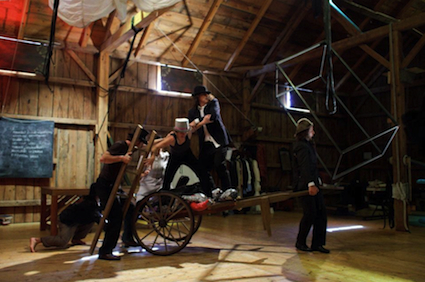
perspectives, expand dialogues, and challenge assumptions. Today we feature the photography of Maria Baranova, from Double Edge Theatre's rehearsals for The Grand Parade (of the Twentieth Century): "an original, multi-disciplinary piece of
theatre" that imagines the life and art of Marc Chagall alongside the shifting cultural tides of the last century. The piece is directed by Stacy Klein, with music composed by Alexander Bakshi.
Alongside this work, we offer the closing paragraphs of Invisible Cities, the seminal story cycle by Italo Calvino consisting of a series of conversations between Marco Polo and Kublai Khan. Polo's ever-expanding descriptions of magical and diverse cities is revealed, by the close of the book, to be facets of a single place.
••••••••••
The Great Khan's atlas contains also the maps of the promised lands visited in thought but not yet discovered or founded: New Atlantis, Utopia, the City of the Sun, Oceana, Tamoé, New Harmony, New Lanarck, Icaria.
Kublai asked Marco: "You, who go about exploring and who see signs, can tell me towards which of these futures the favouring winds are driving us."
"For these ports I could not draw a route on the map or set a date for the landing. At times all I need is a brief glimpse, an opening in the midst of an incongruous landscape, a glint of lights in the fog, the dialogue of two passersby meeting in the crowd, and I think that, setting out from there, I will put together, piece by piece, the perfect city, made of fragments mixed with the rest, of instants separated by intervals, of signals one sends out, not knowing who receives them. If I tell you that the city towards which my journey tends is discontinuous in space and time, now scattered, now more condensed, you must not believe the search for it can stop. Perhaps while we speak, it is rising, scattered, within the confines of your empire; you can search for it, but only in the way I have said."
Already the Great Khan was leafing through his atlas, over the maps of the cities that menace in nightmares and maledictions: Enoch, Babylon, Yahooland, Butua, Brave New World.
He said: "It is all useless, if the last landing-place can only be the infernal city, and it is there that, in ever-narrowing circles, the current is drawing us."
And Polo said: "The inferno of the living is not something that will be; if there is one, it is what is already here, the inferno where we live every day, that we form by being together. There are two ways to escape suffering it. The first is easy for many: accept the inferno and become such a part of it that you can no longer see it. The second is risky and demands constant vigilance and apprehension: seek and learn to recognise who and what, in the midst of the inferno, are not inferno, then make them endure, give them space."
Bill Mazeroski, after his home run to win the 1960 World Series: James Klingensmith
Today is Opening Day for Major League Baseball, that turning of a cultural season to match the Spring's turning of the fields.
Above we feature a legendary photograph of one of baseball's finest moments: Bill Mazeroski's walk-off home run in the 1960 World Series, the year that the Pittsburgh Pirates improbably defeated the mighty New York Yankees. Born in Rush Run, Ohio, this All Star second-basemen and Hall of Famer has continued to make important contributions to his home region of the Ohio Valley long after he stepped off the field.
This iconic photograph was taken by Pittsburgh Post-Gazette James Klingensmith, who passed away last summer.
Below please find one of our country's Poet Laureates, Donald Hall, discussing Opening Day at Fenway Park -- alongside an equally, though differently, eloquent Red Sox blogger. Mr. Hall has lived for decades at Eagle Pond Farm in rural New Hampshire:
Paul Muldoon was born in the countryside of Northern Ireland, between counties Armagh and
Tyrone in Northern Ireland, in 1951. In his poem "Mixed Marriage," he alludes not
only to the sectarian violence of the Troubles, but
also to a state of cultural transition that would be familiar to many
rural artists on either side of the Atlantic:
My father was a servant-boy.
When he left school at eight or nine
He took up billhook and loy
To win the ground he would never own.
My mother was the school-mistress,
The world of Castor and Pollux.
There were twins in her own class.
She could never tell which was which.
She had read one volume of Proust,
He knew the cure for farcy.
I flitted between a hole in the hedge
And a room in the Latin Quarter.
Muldoon himself has flitted between a number of categories. In the thirty years from the poems in Why Brownlee Left (1980) to Maggot (2010), this poet has made great art out of the chaos of modern life; his work confuses the lines between poetry and fiction (and our expectations of those genres) while also troubling easy cultural distinctions such as "Irish" or "American." Muldoon has lived in the United States since the late 1980's, and has served for many years as a professor at Princeton University and Chair of its Lewis Center for the Arts. For the last five years he has also served as Poetry Editor for the The New Yorker, guiding the most visible outlet for poetry published in America.
Despite this prestigious curriculum vitae, Muldoon remains a humble and open-minded figure on the literary landscape. In his more recent work, notably 2002's Moy Sand and Gravel, the poet has returned with new intensity to consider the history, culture, and language of his birthplace along the border. We see Muldoon demonstrate his gift for balancing this knowledge of the rural with his encyclopedic grasp of modern literature in this excellent interview piece for Wunderkammer Magazine:
The Moy that Muldoon returns to in his 2002 collection is one conscious of its place alongside many borders -- those between traditional and modern culture, the rural and the urban, and between a deep, almost archeological, past and a fluid present tense. In his poem "The Misfits," which places a viewing of that famous film written by Arthur Miller (with the last on-screen appearances by Clark Gable and Marilyn Monroe) alongside his childhood duties on the farm, where he mines a row of potatoes, "what would surely seem / to any nine- or ten-year-old an inexhaustible seam."
This pun on visual representation and human creation finds succinct and powerful articulation in the title poem, "Moy Sand and Gravel." Paul Muldoon's website offers a reading of the poem here; please find the text below:
To come out of the Olympic Cinema and be taken aback
by how, in the time it took a dolly to travel
along its little track
to the point where two movies stars' heads
had come together smackety-smack
and their kiss filled the whole screen,
those two great towers directly across the road
at Moy Sand and Gravel
had already washed, at least once, what had flowed
or been dredged from the Blackwater's bed
and were washing it again, load by load,
as if washing might make it clean.
The Arena Stage at the Mead Center for American Theater has just announced that Double Edge Theatre will offer the world premiere of The Grand Parade (of the Twentieth Century) February 6-10 in Washington, DC. Inspired by Marc Chagall's paintings, this piece offers a narrative of the twentieth century that The Arena Stage has described as "an emotionally stunning journey through the 20th century with the use of aerial flight, puppetry and music."
As we've written previously, Double Edge is a one-of-a-kind theatre company that lives, trains, and farms in Ashfield, Massachusetts. Not only are they one of the most powerful examples of "laboratory theater" in this country, but they also focus on the idea of "living culture," consistently asking how themselves how they can engage with local communities. This documentary excerpt begins to tell the story.
Here is more information from the Arena Stage's press release:
The Grand Parade is conceived and directed by Double Edge Theatre Founder and Artistic Director Stacy Klein and is created with Carlos Uriona, Matthew Glassman, Hayley Brown, Jeremy Louise Eaton, Adam Bright and Milena Dabova. The show is realized with a collaborative team of artists from the United States, Argentina and Russia and features original compositions by Alexander Bakshi of Russia. The Grand Parade creates a mythology of the American century and its Russian counterpart, from the story of Evelyn Nesbit in the 1900s to the fall of the Wall to the Supreme Court Gore v. Bush decision in 2000. This imaginative, kaleidoscopic mashup of the century echoes Chagall’s life, which spanned from 1887 to 1985, and summons the artist’s sensibilities and personal memories.
“Work on The Grand Parade has been a wild and revelatory experience, from learning that women are still facing the same century long struggle, and that lessons of war and economy have gone unheeded, to the amazement and sheer fun of peoples’ continued attempts to fly, to invent, and to laugh in spite of it all,” says Klein. “With Chagall as our muse, we have dared our way through the century’s chaos, trying to find our own thousand ways to fly.”
More coverage of The Grand Parade is forthcoming; until then, many gorgeous photographs from the rehearsals in Ashfield can be found on Double Edge's Facebook page, along with recent news of their upcoming training intensive and their critically-acclaimed summer spectacles on the farm.
For decades, as young people have been leaving farms behind, the
average age of the American farmer has been rising. The last time the
government counted farmers, in 2002, the average farmer was 55-years-old.
But there's a new surge
of youthful vigor into American agriculture — at least in the corner of
it devoted to organic, local food. Thousands of young people who've
never farmed before are trying it out.
Mr. Charles's piece proceeds to tell the story of The Young Farmers Conference, hosted by the Stone Barns Center for Food and Agriculture in Tarrytown, New York. Located 25 miles north of Manhattan, the Center is a fully-operational farm that works to train farmers and design public outreach programs that communicate the benefits of "healthy, seasonal and sustainable food." In particular, the Center is charged with a mission to bring this message to children, that next generation of consumers and potential farmers.
The Center fosters some extraordinary rural - urban connections, and, as exemplified by their introduction to the Young Farmers Conference, they also focus in detail on that other aspect of farming - the fact that farming is a business. The Center is also raising a new generation of rural entrepreneurs.
All of these facets of the mission revolve around what Dan Barber, of the well-known Blue Hill restaurant and farm, shares in the video above: that "you need to be inspired by a place, and have that place become a part of that experience."
This is echoed in the voices of those emerging farmers who participated in the 2010 conference:
More than most media produced about "generation organic," or whatever one wishes to call this movement, this video gives me great hope. As a child of the Farm Crisis, I lament the extent to which the sustainable agriculture movement is portrayed in a pastoral, romantic light -- a kind of soft-filtering of Wendell Berry's hard truths.
We are not having a serious discussion about the "sustainability" of this movement (culturally, economically) until we've brought the mass of new urban-born farmers into discussion with those farmers and communities rooted in their rural place, until we have "conventional" and "organic" farmers sitting down at a table together. Too often the urban/university-driven dynamic to this movement can seem to slight, or outright condemn, those farmers who have lived for decades on the land. That attitude is the least sustainable element of the movement.
Today we begin a new series on Art of the Rural that seeks to serve as a resource for the wide range of music expression -- rural and urban, past and present, national and international -- waiting to be explored in libraries, record stores, and online.
We really value our readers' input, and we'd like to feature folks' suggestions in this space as well. What music has been moving, inspiring, or challenging you lately? If this music has emerged from rural place, or points toward rural-urban or rural-international connections, we would love to hear about it -- and share it. Please feel free to post your ideas (with links, if possible) on the Facebook thread for this piece, or send us an email at artoftherural at gmail.com. Thanks!
The Dust Busters also make an appearance alongside Mr. Cohen; longtime readers of this site may remember our piece on Down Home Radio -- its editor Eli Smith is a member of TDB. Folks can see an interview with Mr. Smith and TDB at The Jalopy Theater here, via Brooklyn Independent Television. Below, The Dust Busters offer "Black Bottom Strut:"
Last weekend The Daily Yonder shared the music of 2/3 Goat. Here's lead singer and mandolin player Annalyse McCoy, who hails from Inez, Kentucky, in an interview with Jeff Bigger:
"Music is such an integral part of Appalachian culture and tradition,"
said McCoy, who grew up in Inez, Kentucky and also works as an actress
in New York City. " As a child of Appalachia, I felt that there was no
better or more natural way to "give back" to try and help my community
than through song. Amid all the destruction that mountaintop removal
causes -- all the thousands of miles of streams that have been buried,
all the remaining water that's been tainted by heavy metals -- there is
purity and light left in Appalachia; there is Hope."
The good folks at Dust-to-Digital also shared this extensive feature on another Kentuckian, musician and folk archivist Nathan Salsburg, who is currently working to archive a massive collection of 78 rpm records found in a house in Louisville. Mr. Salsburg has released two of our favorite records this year, the earlier Avos (guitar duets with James Elkington) and, just last month, Affirmed - a solo guitar record that finds a meditative center within the legacies of many of the Kentucky Derby's Triple Crown winners. Please see our archive for our previous pieces on Mr. Salsburg's work with Root Hog or Die and the Alan Lomax Archive/Cultural Equity; here, from Affirmed, is "Back Home in Bogenbrook:"
I was excited to recently discover the music of Blaze Foley, a musician who spent a good deal of time living in a tree house in rural Georgia before moving to Austin and living an itinerant lifestyle as perhaps the most bonafide Outlaw of that country music movement. He was the inspiration for Lucinda Williams's "Drunken Angel," the subject of some recent CD reissues, and his music has also happily reappeared on vinyl. Here's the trailer for the Duct Tape Messiah documentary, followed by a song that never really gets old, Blaze's "Oval Room:"
Part of what we hope to achieve with Rural Tracks is a kind of unexpected and meandering path that leads to some unlikely but revealing comparisons -- for instance, considering Harry Smith alongside Blaze Foley.
Please follow the links at the start of this piece to share your suggestions; we will publish them in subsequent updates to this feature. Thanks again for reading The Art of the Rural.
As a companion piece to today's article considering Crystal Bridges, Alice Walton, and the Occupy Movement, Contributing Editor Rachel Reynolds Luster has just sent word of Feed the Movement, a grassroots effort by farmers in the Northeast to help feed the Occupy gathering in New York:
WNYC has also profiled the work of the folks on the ground in city who gladly receive this food and then work to prepare it to be put to use on Wall Street. Jennifer Hsu writes of how one OWS member and an unemployed chef are cooking for thousands of people each afternoon:
Every night at Zuccotti Park, dinner is served around 7 P.M. What
protesters may not realize is that their meals are made from fresh,
organic produce donated by a dozen or so small farms located throughout
the Northeast.
Since the early weeks of the protest, regional farmers have been
coming down independently to Occupy Wall Street to donate fruits and
vegetables. In those days, meals were prepared in volunteers' homes.
Yet, as the protest quickly gained momentum, food preparation needed to
get more organized, and Occupy Wall Street set up a daily dinner
operation out of a soup kitchen in East New York, Brooklyn.
Revolutions Per Minute: Indigenous Music Culture is an site that covers an extraordinary range of contemporary Native American music--everything from traditional forms to the electronic "art trash" rap of Glad as Knives. I highly recommend a visit to RPM--I'm excited to have discovered this site, and I look forward to writing in greater depth about it soon.
Here's RPM writing about Native Roots, a band that bridges cultures and brings people together:
Native Roots has been making their unique “NDN-Jamaican” music since 1997. Their sound has a solid foundation in reggae but is blended with the band’s Indigenous culture.
The songs incorporate traditional drums, flute and chants, but you can hear the cultural influence in Emmett “Shkeme” Garcia’s vocals as well – his voice reflecting his experience singing traditional pueblo and powwow music
The Texas Mountain Trail Region recently shared this video on their Facebook page, the story behind Marfa Maid Goat Cheese. Surviving in West Texas isn't easy, Malinda Beeman tells us, but she finds that the process of running a successful agricultural business is a lot like the process of making art.
This gorgeous 12 minute documentary was created by Barefoot Workshops, a non-profit "that teaches individuals and organizations how to use digital video, new
media, and the arts to transform their communities and themselves." This organization has created a great deal of work that would interest our readers, so I encourage folks to head to their site and learn more; I'll also be writing at greater length about their films soon. Until then, here's Simple As That, which was filmed, written, and edited by Kari Branch, Russell Walker and Ashley McCue:
It's encouraging to hear the story of Marfa Maid Goat Cheese. Their project, and the point in their lives when they commenced this work, suggests there could be a model here for how an older generation of rural citizens can affect local economic change. As a generation of baby-boomers considers "moving home," we may have an example of how (especially in the challenging economy) these returning neighbors do more than just settle down to retire in rural America.
This suggests "The Road to Exurbia," a recent piece published in Places (see our article on their fiction series from last week): James Barilla offers an extraordinarily insightful essay on rural exurbias--those communities close enough to major cities that they can accommodate folks who really want to live (and raise children) in a rural environment. Mr. Barilla tells his own story, and the story of his father, but also discusses the larger trend of exurbias across the country. Here's the opening paragraphs to this essay:
Each year, by his own calculation, my dad drives as many miles as the
circumference of the earth. He gets up while the dawn mist is still
clinging to the hemlocks and the horses are still crunching grain in
their pails, settles into the car with a travel mug of coffee and a book
on tape, and makes his way from a tiny hill town in Western
Massachusetts to his job in a city near Boston. He’s been doing it for
over 24 years, which means he’s been rotating the earth longer than many
satellites.
He lives on a dirt road, not far from the boundary
of the state forest. It’s the kind of place where mountain laurel grows
in gnarled thickets under the canopy of oak and maple and you can’t see
your neighbors. Moose wander up to the barn to make eyes at the horses,
coyotes yip to each other at dawn and snakes seize wood frogs under the
porch. It’s a place where you can swim in a clear pond in summer and
amble across its frozen surface in winter.
“Days like these,” my
dad will say on a summer Saturday evening, sitting contemplatively on
the deck after an afternoon swim in a nearby lake, “this place feels
like a little bit of paradise.”