Showing posts with label rural poetry series. Show all posts

Tuesday, December 11, 2012

Readings: Mary Oliver: "Cold Now"

selection from a photograph of the poet by Rachel Giese Brown

Cold now.
Close to the edge. Almost
unbearable. Clouds
bunch up and boil down
from the north of the white bear.
This tree-splitting morning
I dream of his fat tracks,
the lifesaving suet.

I think of summer with its luminous fruit,
blossoms rounding to berries, leaves,
handfuls of grain.

Maybe what cold is, is the time
we measure the love we have always had, secretly,
for our own bones, the hard knife-edged love
for the warm river of the I, beyond all else; maybe

that is what it means the beauty
of the blue shark cruising toward the tumbling seals.

In the season of snow,
in the immeasurable cold,
we grow cruel but honest; we keep
ourselves alive,
if we can, taking one after another
the necessary bodies of others, the many
crushed red flowers.

"Cold Now" appears in the Pulitzer Prize-winning collection American Primitive, first published by Back Bay Books in 1983. The poet was born in Maple Heights, Ohio and currently resides in Provincetown, Massachusetts. Further biography, context, and poems by Mary Oliver can be found at The Poetry Foundation.

Monday, May 7, 2012

Readings: Rural Traditions Sunk Into Eternal Oblivion

from The Farmer's Year: A Calendar of Animal Husbandry; Clare Leighton, 1935

In our Readings series, we offer selections from visual and printed texts that offer perspectives, expand dialogues, and challenge assumptions. Today we feature the response of Thomas Hardy to a query by Sir Rider Haggard, who, at the turn of the last century, was working on Rural England, the first study of its kind.

A poet, novelist, and architect, Thomas Hardy chose to spend his life in his home region of Dorset, an area mythologized in his work as "Wessex." Hardy witnessed in this lifetime the erosion of a rural culture that had been relatively stable for five hundred years. By the 1840s, the Corn Laws removed protections on English agriculture, which changed farming, its labor force, and the population of rural England. As fields turned to pastures, and as laborers fled for better paying jobs in the industrial centers (and those lures of entertainment and cosmopolitan culture), Hardy's Dorset became a ghosted, alien place in his late poetry. 

As a counterpoint, "A Sheep Fair" is also included below.

••••••••••

For one thing, village tradition--a vast mass of unwritten folk-lore, local chronicle, local topography, and nomenclature--is absolutely sinking, has nearly sunk, into eternal oblivion. I cannot recall a single instance of a labourer who still lives on the farm where he was born, and I can only recall a few who have been five years on their present farms. Thus, you see, there being no continuity of environment in their lives, there is no continuity of information, the names, stories, and relics of one place being speedily forgotten under the incoming facts of the next. For example, if you ask one of the workfolk (they always used to be called 'workfolk' hereabout--'labourers' is an imported word) the names of surrounding hills, streams; the character and circumstances of people buried in particular graves; at what spots parish personages lie interred; questions on local fairies, ghosts, herbs, etc., they can give no answer: yet I can recollect the time when the places of burial even of the poor and tombless were all remembered, and the history of the parish and squire's family for 150 years back known. Such and such ballads appertained to such and such locality, ghost tales were attached to particular sites, and nooks wherein wild herbs grew for the cure of divers maladies were pointed out readily.

••••••••••

A Sheep Fair

The day arrives for the autumn fair,
            And torrents fall,
Though sheep in throngs are gathered there,
            Ten thousand all,
Sodden, with hurdles round them reared:
And, lot by lot, the pens are cleared,
And the auctioneer wrings out his beard,
And wipes his book, bedrenched and smeared,
And rakes the rain from his face with the edge of his hand,
                                    As torrents fall.

The wool of the ewes is like a sponge
            With the daylong rain:
Jammed tight, to turn, or lie, or lunge,
            They strive in vain.
Their horns are soft as finger-nails,
Their shepherds reek against the rails,
The tied dogs soak with tucked-in tails,
The buyers hat-brims fill like pails,
Which spill small cascades when they shift their stand
                                    In the daylong rain.

Postscript:

 
Those panting thousands in their wet
            And wooly wear:
And every flock long since has bled,
And all the dripping buyers have sped,
And the hoarse auctioneer is dead,
Who "Going--going!" so often said,
As he consigned to doom each meek, mewed band
                        At Pummery Fair.

Monday, April 30, 2012

The Tree That Bursts Through The Silo

Tree In Silo; Ken Wolf

Many thanks to MarĂ­a Arambula for sharing on our Arts and Culture Feed A.G. Sulzberger's latest rural dispatch for The New York Times, "Amid Rural Decay, Trees Take Root in Silos." The image of these trees bursting from disused farm structures unifies an arc of how the last century has dealt with rural place as an aesthetic ideal.

To begin, here's Mr. Sulzberger discussing this phenomenon across Kansas and Missouri:
The empty structures catch seeds, then protect fragile saplings from the prairie winds and reserve a window of sunlight overhead like a target. In time, without tending by human hands, the trees have grown so high that lush canopies of branches now rise from the structures and top them like leafy umbrellas. 

Across a region laden with leaning, crumbling reminders of more vibrant days, some residents have found comfort in their unlikely profiles. 

“It just struck me as, I don’t know, a symbol of something,” said Ken Wolf, who has spent many days of his retirement searching the area for what he calls, simply, silo trees, photographing dozens along the way. “I see it as a kind of passing.” 
Mr. Wolf's photographs present these tree-silos are a kind of vernacular architecture, not consciously assembled structures -- though they suggest this aesthetic through neglect and abandonment. As the photographer surmises, we're in the presence of a symbol heavy with historical and cultural weight.

It's jarring, then, to consider the image of this tree just one hundred year's ago, in the poetry of William Butler Yeats. In "Upon A House Shaken By The Land Agitation," Yeats laments the passing of the Anglo-Irish Ascendency who even, before the Easter Rising, were seeing their large estates broken up into smaller holdings and dispersed to local farmers. Yeats's position on the matter would be akin to many modernists, who envisioned their art free from the demands of (or condescensions to) popular audiences; the Nobel laureate saw in the destruction of an estate's "big house" a metaphor for the loss of what he would call (in another poem featuring a tree-symbol): "custom and ceremony." After decades connecting rural folklore to national literature, Yeats displays the anxieties of his class and his cultural standing -- worrying if these same people, so often portrayed by him as the spirit of the nation, would really be careful stewards of the land and its culture. He laments what is lost by allowing a tree to flourish in the place of a symbol of high cultural wealth. 

In Mr. Wolf's phtography we find a drastically different situation but, nonetheless, a structure in ruin and a landscape in transition. What is contested is what narrative we ascribe to the branches breaking free from the silo's concrete hold; is this a reclamation or a commentary on industrial agriculture, a scene of "rural decay" or something that transcends economics and cultural cliches? Is this a preface or a postscript?

Upon A House Shaken By The Land Agitation

How should the world be luckier if this house, 
Where passion and precision have been one 
Time out of mind, became too ruinous 
To breed the lidless eye that loves the sun? 
And the sweet laughing eagle thoughts that grow        
Where wings have memory of wings, and all 
That comes of the best knit to the best?
Although  Mean roof-trees were the sturdier for its fall,
How should their luck run high enough to reach
The gifts that govern men, and after these 
To gradual Time’s last gift, a written speech 
Wrought of high laughter, loveliness and ease?


Silo With Tree; Ken Wolf

Wednesday, March 28, 2012

Rural Poetry Series: Paul Muldoon


Paul Muldoon was born in the countryside of Northern Ireland, between counties Armagh and Tyrone in Northern Ireland, in 1951. In his poem "Mixed Marriage," he alludes not only to the sectarian violence of the Troubles, but also to a state of cultural transition that would be familiar to many rural artists on either side of the Atlantic:
My father was a servant-boy.
When he left school at eight or nine
He took up billhook and loy
To win the ground he would never own.

My mother was the school-mistress,
The world of Castor and Pollux.
There were twins in her own class.
She could never tell which was which.

She had read one volume of Proust,
He knew the cure for farcy.
I flitted between a hole in the hedge
And a room in the Latin Quarter.
Muldoon himself has flitted between a number of categories. In the thirty years from the poems in Why Brownlee Left (1980) to Maggot (2010), this poet has made great art out of the chaos of modern life; his work confuses the lines between poetry and fiction (and our expectations of those genres) while also troubling easy cultural distinctions such as "Irish" or "American." Muldoon has lived in the United States since the late 1980's, and has served for many years as a professor at Princeton University and Chair of its Lewis Center for the Arts. For the last five years he has also served as Poetry Editor for the The New Yorker, guiding the most visible outlet for poetry published in America.

Despite this prestigious curriculum vitae, Muldoon remains a humble and open-minded figure on the literary landscape. In his more recent work, notably 2002's Moy Sand and Gravel, the poet has returned with new intensity to consider the history, culture, and language of his birthplace along the border. We see Muldoon demonstrate his gift for balancing this knowledge of the rural with his encyclopedic grasp of modern literature in this excellent interview piece for Wunderkammer Magazine:


Five Dialogues, Paul Muldoon from Wunderkammer Magazine on Vimeo.

The Moy that Muldoon returns to in his 2002 collection is one conscious of its place alongside many borders -- those between traditional and modern culture, the rural and the urban, and between a deep, almost archeological, past and a fluid present tense. In his poem "The Misfits," which places a viewing of that famous film written by Arthur Miller (with the last on-screen appearances by Clark Gable and Marilyn Monroe) alongside his childhood duties on the farm, where he mines a row of potatoes, "what would surely seem / to any nine- or ten-year-old an inexhaustible seam."

This pun on visual representation and human creation finds succinct and powerful articulation in the title poem, "Moy Sand and Gravel." Paul Muldoon's website offers a reading of the poem here; please find the text below:
To come out of the Olympic Cinema and be taken aback
by how, in the time it took a dolly to travel
along its little track
to the point where two movies stars' heads
had come together smackety-smack
and their kiss filled the whole screen,

those two great towers directly across the road
at Moy Sand and Gravel
had already washed, at least once, what had flowed
or been dredged from the Blackwater's bed
and were washing it again, load by load,
as if washing might make it clean.

Related Articles:
Rural Poetry Series: Patrick Kavanagh
Rural Poetry Series archives

Wednesday, February 8, 2012

Rural Poetry Series: C.D. Wright

I’m country but sophisticated. I’m particular and concrete, but I’m probing another plane. . . . There are many times when I want to hammer the head. Other times I want to sleep on the hammer.
     - C. D. Wright

C.D. Wright was born in Mountain Home, Arkansas, and her experience within the Ozarks and her native region have left an unshakable mark on a career that's seen the poet and her work meet with audiences across the country.

Wright is the daughter of a judge and a court reporter; this biographical note helps to provide a familial and regional context for poems which can stun and dizzy readers in their abilities to transcend normal temporal and spatial expectations. In books such as Like Something Flying Backwards: New and Selected Poems (2007) or the much-loved Deepstep Come Shining (1998), Wright utilizes a one-of-a-kind amalgam of narrative, collage, and lyrical techniques - yet, unlike a great many of her contemporaries, this stylistic DNA is not an end in itself, but a way of telling stories deeply rooted in local experience. 

Her most recent book, One With Others, was a finalist for the 2010 National Book Award in Poetry. Dan Chiasson, writing in The New Yorker, offers this excellent introduction to both the book and Wright's poetics:
In August, 1969, a Memphis man known as Sweet Willie Wine led a group of black men on a four-day March Against Fear, from West Memphis to Little Rock, passing through the small towns of the Arkansas delta. One with Others the Arkansas-born poet C. D. Wright’s new, book-length poem, tells the story of the march, and of the only outsider to join it, a small-town white woman, Margaret Kaelin McHugh, whom Wright calls V. The gnomic title suggests the bargain that V made: the act that momentarily unified her with others permanently singled her out. Becoming “one with others,” she ended up a pariah—one with others. The book is foremost an elegy for McHugh, whom Wright, in interviews, has described as “a giant of my imagination, an autodidact, deeply literary, an outraged citizen, a killingly funny, irresistible human.” 

The era has been so memorably captured in documentaries that, even when you imagine it, you end up drifting into documentary conventions. It turns out that the literary genre least likely to get in the way of this story is poetry, which, despite its reputation for gilt and taffeta, comfortably veers close to “documentary” conventions. It comes especially close in Wright’s angular strain of postmodern poetry, which draws on refractive techniques now a hundred years old: collage, extensive quotation, multiplicity of voice and tone, found material, and, often, a non-authorial, disinterested stance. “One with Others” represents Wright’s most audacious experiment yet in loading up lyric with evidentiary fact.
Here is video of Wright on PBS NewsHour reading a selection from One With Others from her home outside of Providence, Rhode Island; an excerpt from the long poem is also included below:


If white people can ride down the highways
with guns in their trucks
I can walk down the highway unarmed
Scott Bond, born a slave, became
a millionaire. Wouldn’t you like to run wild
run free. The Very Reverend Al Green
hailed from here. Sonny Liston a few miles west,
San Slough. Head hardened
on hickory sticks. A reporter asks a family
of sharecroppers quietly watching the procession,
Does this walk mean anything to you.
The father says, the others nod,
It means that Sweet Willie Wine is walking.

Monday, January 2, 2012

To The New Year 2012

From the Foster-Fluharty Farm; Matthew Fluharty
from Sabbaths, 2005
VI.

I tremble with gratitude
for my children and grandchildren
who take pleasure in one another.

At our dinners together, the dead
enter and pass among us
in living love and in memory.

And so the young are taught.

          - Wendell Berry

Friday, September 16, 2011

Rural Poetry Series: Josh Wallaert

Film still from Arid Lands; Grant Aaker and Josh Wallaert

Today we would like to add the poetry of Josh Wallaert to the company of our Rural Poetry Series. Our readers will be familiar with Mr. Wallaert's work with Places, where he serves as the assistant editor, and will also be interested to learn of some of his other projects which help to add context to the many pieces of fiction, poetry and found poetry that are available on his site.  Included below is  "How To Lead A Horse," previously published in Shenandoah

How To Lead A Horse

Elizabeth, I loved the way you broke
that horse, how you put your careful
hand against his shoulder, you
showed him where to turn. I've worked
all my life not knowing where to put
my hands, how a poem responds
to pressure, knows where it wants to go.
I ride past the new houses to the church
where the coyotes ran your horse
into the fence so many years ago.
He was nine months old. I watched
the pastor help you lift him from
the ground. You were so calm,
holding his bent leg in your hand
while the pastor removed the barbs.
The horse was quiet, his young hip
jerked out of place. I followed you
walking that horse two miles back
to the house. I tried to remember
where you put your hands, in case
I would ever have to do this myself.
How much more I had to learn.

Mr. Wallaert grew up in Chesire, Oregon, along the the Long Tom watershed in the the southern Willamette Valley. Much of Mr. Wallaert's poetry sets that question of "where to put / my hands" within larger contexts of the arts and commerce, considering how local (and personal) spaces are interlinked to distant and even divergent points on the map.

This experience in rural Oregon, coupled with this artistic sensibility,  no doubt informs Arid Lands, a documentary co-directed with Grant Aaker. Much like the interdisciplinary work he helps to bring to readers in Places, we see here a poet and writer turn from the page to the lens to craft a "creatively ecological" film (in the words of The Chronicle for Higher Education). This project's description and trailer are included below; folks can visit Josh Wallaert's site for more information on these projects.


Related Articles:

Tuesday, August 30, 2011

Rural Poetry Series: Bob Arnold and Longhouse Press

Bob Arnold in the Woodlot; photograph by Susan Arnold, published in Jacket

In the wake of Hurricane Irene, national attention has turned from the deserted streets of New York City to Vermont, where flooding has destroyed roads, isolated communities, and posed a massive logistical challenge to the state's citizens. While our thoughts go out to folks in the area, today I offer a poet who exemplifies the resourcefulness and good will that's so common amongst Vermonters, and which we'll see on display as they set about the tough work of cleaning up and rebuilding their communities.

Poet, publisher, editor, lumberman, and stonemason Bob Arnold is an internationally regarded literary figure, yet his presence in the field and in his place is entirely of his own creation. Mr. Arnold's story of personal and poetic growth in part fits into what we might expect out of a New England upbringing, yet his many forms of work are also indebted to forms of art and consciousness that emerged in the 1960s in America -- and internationally. Jacket magazine (an outstanding online poetry journal) has published a series of valuable conversations with Mr. Arnold about his poetry, his editorship of the widely-acclaimed Longhouse Press and the intersections of life, work, and art. These interviews are not only the best introduction to the poetry of Bob Arnold, but they are also, in themselves, exciting conversations about living and creating thoughtful and intentional work in our daily lives.

Here's Mr. Arnold talking with Kent Johnson about some of the experiences which go into the creation of his poems:
I have very little to write about until I’m out in life living it. This means with the chainsaws, the hammers, the stonework, the woods, the fields, the river, and with the girl, Susan. It’s been that way for almost 40 years and I’m doing everything within my powers to make sure it doesn’t stop. Even if a lot of the time it seems fueled on a dream, gritty determination and the greatest thing that ever hit town, team-work. I can’t say enough for love and marriage. And I know that thought is going to make some smile, and make others grimace...I think the key is staying loose, eyes open, available and even vulnerable, open for a pass. It’s downright athletic. After a life of cutting trees, roofing homes, huts and barns, cribbing up old shacks and cabins and houses, painting and painting, raking and raking, wood-splitting & wood-splitting, the body and the mind get to know one another. If you develop the mind along with the body, it could become a lantern burning bright. 

Of course I must tip my cap to my background — a flinty Irish mother from Belfast with a large family of storytellers and hard workers, lots of kids. And on my father’s side, all lumbermen, mainly businessmen when I was born, but all the forefathers were choppers, sawyers, drivers, mountain butchers. The businessmen wanted the oldest son, me, to learn the ropes, so I was dropped into the lumberyards at age ten and worked every day after school with more Irishman and Poles and all through each summer — first unloading boxcars of western and eastern lumber and loading truck deliveries, and then when I was a little older, receiving those truck deliveries on some muddy hillside with a carpentry crew and two or three spec houses going up. The plan was to teach me the business and then after college go into the business. Put on a tie. Instead, the sixties got in the way, with its music and rebellion and tribal strength, and I barely got out of high school. 
Here's "No Tool or Rope or Pail" from the collection Where Rivers Meet:
It hardly mattered what time of year
We passed their farmhouse,
They never waved,
This old farm couple
Usually bent over in the vegetable garden
Or walking by the muddy dooryard
Between house and red-weathered barn.
They would look up, see who was passing,
Then look back down, ignorant to the event.
We would always wave nonetheless,
Before you dropped me off at work
Further up on the hill,
Toolbox rattling in the backseat,
And then again on the way home
Later in the day, the pale sunlight
High up in their pasture,
Our arms out the window,
Cooling ourselves.
And it was that one midsummer evening
We drove past and caught them sitting
together on the front porch
At ease, chores done,
The tangle of cats and kittens
Cleaning themselves of fresh spilled milk
On the barn door ramp;
We drove by and they looked up—
The first time I've ever seen their
Hands free of any work,
No too or rope or pail—
And they waved.
Bob Arnold and his wife Susan oversee Longhouse Press with a mission to produce books of poetry to the highest standards of craftsmanship. For over thirty years they have stewarded the work of an extraordinary range of poets from America and beyond, as well as serving an integral role in continuing the mission of their close friend Cid Corman's journal Origin. In addition to this work, Mr. Arnold is literary executor both for Mr. Corman and (after Corman's passing) Lorine Niedecker. Thus, a tremendous amount of artistic energy is cultivated on the grounds of the Arnold's Vermont farm. 

This leads us to another element of Mr. Arnold's work that I would encourage readers to explore: the poet's most recent book, Yokel. While he has a reputation for creating some of the finest short verse, Mr. Arnold's new effort is what he calls "a long Green Mountain poem." (Folks can read enthusiastic early reviews here and here) Within these pages, the poet thinks through a number of issues that many rural citizens, policymakers, and fellow artists are also grappling with: how to preserve, and how to faithfully carry forward into modern life, the traditions and local memories of a rural place. Again, here's Mr. Arnold in conversation with Kent Johnson last year:
I’ve just completed a 105 piece long poem called Yokel that took ten years to write. It’s farm narrative and portraits and outdoor work poems covering four decades of watching this old life and tradition around me disappear from the map. It just couldn’t be done with small poems only — just as Basho’s travel notebook had to be pinpoint poems compassed around a netting of anecdotes and ruminations. My long poem Yokel has big brawny pieces wide as the barn door and a river sounding endless to the ears. It takes the architecture of a long poem to carry that span.
We will be presenting more of Bob Arnold's poetry and art later this week. Until then, folks can visit Longhouse Press, which features many of his poetry collections as well, to learn more. Necessary reading also includes Mr. Arnold's blog Longhouse Birdhouse, where he reports today that the roads around their farm have been washed away by Hurricane Irene, but he and his neighbors are safe. By his estimation, it may be weeks or months before crews can restore these local roads; "many are taking matters into their own hands," he writes, "which is always a good sign."

Related Articles:
Rural Poetry Series: Lorine Niedecker

Monday, July 11, 2011

Lorine Niedecker's Calendar Poems: July


What a
white muffler
in a dark coat
will do for a
dull man 


More information on Lorine Niedecker and The Rural Poetry Series can be found here. Also see her February entry here.

Friday, June 17, 2011

Rural Poetry Series: Patrick Kavanagh


Patrick Kavanagh (1904-1967) was born into a farming family in County Monaghan, Ireland. He spent the first part of his adult life farming those same fields in the small townland of Inniskeen, an experience which gave rise to the long poem many consider to be his masterpiece, The Great Hunger.  Despite the pastoral fantasies many urban poets projected onto the Irish rural, Kavanagh's poem told the story of the economic, cultural and even sexual poverty of life "beyond the pale." For its frankness, and for the ways in which it threatened the politically-useful images of "the Irish peasant," The Great Hunger--as with James Joyce's Ulysses--was banned in Ireland upon its publication.

In the years following The Great Hunger, Kavanagh continued to present the realities of Irish rural life--but also its communal mysteries. After surviving lung surgery, Kavanagh created a series of lush and circumspect poems that unified rural and urban experience within a timeless and benedictory continuum. (See "Canal Bank Walk")

Midway through this poetic career, Patrick Kavanagh composed "Epic," a poem that looks back on his rural place, and its local peculiarities, at the moment when the outside world was bracing itself for World War Two. While poets from Ireland, America and beyond cite "Epic" as an influential affirmation of local culture, Paul Muldoon--one of the rural-born Irish poets to inherit Kavanagh's concerns--points us towards considering the complications of assigning one "importance" over another. We find this profound and simultaneously ambiguous poem related to many of the recent articles and conversations we have featured:

Epic

I have lived in important places, times
When great events were decided: who owned
That half a rood of rock, a no-man's land
Surrounded by our pitchfork-armed claims.
I heard the Duffys shouting 'Damn your soul'
And old McCabe, stripped to the waist, seen
Step the plot defying blue cast-steel –
'Here is the march along these iron stones'.
That was the year of the Munich bother. Which
Was most important? I inclined
To lose my faith in Ballyrush and Gortin
Till Homer's ghost came whispering to my mind.
He said: I made the Iliad from such
A local row. Gods make their own importance.

Tuesday, June 7, 2011

Rural Poetry Series: James Still

"James Still at his cabin on Dead Mare Branch, on his 80th birthday, July 16, 1986;" Tom Eblen

Today in the Rural Poetry Series we turn to the work of James Still (1906-2001), a poet born in Alabama but at home in Knott County, Kentucky. From there,  Mr. Still composed a series of novels, short stories and poems that dramatically altered (and advocated for) Applachian literature. His fiction masterpiece, River of Earth (1940), dramatizes the pull between rootedness and mobility--lessons learned first-hand. Mr. Still joined the struggle for miners' rights in the 1930's while also completing graduate degrees at Vanderbilt and the University of Illinois; he worked in the Civil Service, in the cotton fields, and even as a bible salesman. His range of experiences were capped as a Sergeant in World War II, stationed in Egypt. 

From these wanderings, Mr. Still's most fortuitous connection came with his friendship to Don West, an activist, educator, founder of the Appalachian South Folklife Center--and an excellent poet himself. Mr. West suggested Knott County, which led to James Still's work in the library and local schools, and his eventual connections with The Hindman Settlement School and its Appalachian Writers Workshop.

Many years ago as a young poet, I had the chance to attend the Workshop at Hindman. Though perhaps not explicitly referred to as such, it was clear we all were in "James Still Country." His whereabouts were the subject of anxious and excited updates, and the reverence in the packed auditorium for his reading was palpable and deeply moving, a foundational example for me of how the arts can transform local culture. 

While a follow-up article will elaborate upon the Hindman Settlement School and the Appalachian Writers Workshop, I'd like to share a poem of Mr. Still's that is inseparably linked to his home place. 
Heritage

I shall not leave these prisoning hills
Though they topple their barren heads to level earth
And the forests slide uprooted out of the sky.
Though the waters of Troublesome, of Trace Fork,
Of Sand Lick rise in a single body to glean the valleys,
To drown lush pennyroyal, to unravel rail fences;
Though the sun-ball breaks the ridges into dust
And burns its strength into the blistered rock
I cannot leave. I cannot go away.

Being of these hills, being one with the fox
Stealing into the shadows, one with the new-born foal,
The lumbering ox drawing green beech logs to mill,
One with the destined feet of man climbing and descending,
And one with death rising to bloom again, I cannot go.
Being of these hills I cannot pass beyond.
While this poem can be found in From the Mountain to the Valley: New and Selected Poems, the United States of Poetry series also offers this video of "Heritage" shot among the grounds surrounding his cabin:


This season has been an exciting one for Mr. Still's many readers. To commemorate the ten-year anniversary of his passing, The Hindman Settlement School recently hosted A Celebration of James Still featuring talks, readings, musical performances and the exciting release of Mr. Still's final novel: Chinaberry. The novel is edited by one of Appalachia's finest contemporary writers, Silas House, and is now available from The University of Kentucky Press. 

Here's an excerpt from Tom Eblen's excellent article in The Lexington Herald-Leader on the book's release:
Unlike his other writing, Chinaberry is not set in the Eastern Kentucky mountains. It takes place in the wide-open cotton and cattle land of rural Texas nearly a century ago, and in Still's native Alabama.

Chinaberry is about the epic journey of an unnamed boy of 13, who often seems much younger. He leaves Alabama with family friends for a summer of picking cotton in Texas. During the next three months, his life is transformed.

"I think it's a love story on so many levels," House said. "It's a love story between the author and childhood, between a person and a place. I think there's a palpable love for Texas in the book, and for a way of life that's gone forever."

At the heart of the story is the relationship that develops between the boy and the Chinaberry ranch's owner, Anson Winters, and his second wife, Lurie. Anson virtually adopts the boy, treating him as a replacement for the young, handicapped son whose death he still grieves.

"What's so brilliant about the book is that (Still) doesn't make any judgments; it's a psychological thriller in a way," said House.

The celebration at Hindman was also punctuated by the re-release of Heritage, a collaboration between James Still and dulcimer/banjo player Randy Wilson. Appalshop and June Appal Recordings have made this material available for the first time on CD, with more information available here.

Folks should also peruse the Fall 2010 James Still special issue of Appalachian Heritage, a journal closely associated with Mr. Still and also with current and emerging voices in Appalachian literature. 

Wednesday, March 9, 2011

Lorine Niedecker's Calendar Poems: February


If you circle
the habit of
your meaning
it's fact and
no harm
done.


More information on Lorine Niedecker and The Rural Poetry Series can be found here.

Tuesday, February 22, 2011

Rural Poetry Series: Lorine Niedecker

photograph by Bonnie Roub; from the Electronic Poetry Center

The Brontës had their moors, I have my marshes.

Two weeks ago we featured the first of a series of "calendar poems" composed by Lorine Niedecker (1903-1970), a poet from Blackhawk Island, Wisconsin. With the exception of a brief sojourn in New York City in her youth and a move to Milwaukee toward the end of her life, Ms. Niedecker spent the span of her days living, working, and writing along the banks of her native fishing community.

At a moment when American poets increasingly found themselves supported by universities, Ms. Niedecker chose to remain near Blackhawk Island and the neighboring town of Fort Atkinson; she took whatever work the local economy offered: proofreader, cleaning woman, librarian.  Her poetry appeared sporadically throughout her life, despite the support of contemporary figures the likes of William Carlos Williams, Basil Bunting, and Louis Zukofsky--her former lover.

Like the school of Objectivism advocated by Zukofsky, Niedecker treated the poem as an object all to itself, a structure which, in whole, could communicate with precision. As evidenced by the poems below, Niedecker added a local element as well as a gender perspective that enriched the work of these like-minded poets navigating the legacy of modernism. While we find in these poems an adherence to Williams's dictum "no ideas but in things," we also see here another use of "the vernacular," as a rural expertise and a local language is brought to bear on this avant-garde poetics. The results are profoundly, movingly, different than her contemporaries' work:

[Untitled]
Remember my little granite pail? 
The handle of it was blue. 
Think what's got away in my life- 
Was enough to carry me thru.
 
 Poet's Work 
 Grandfather
  advised me:
        Learn a trade
I learned
  to sit at desk
        and condense
No layoff
  from this
        condensery 
 
[Untitled] 
In the great snowfall before the bomb
colored yule tree lights
windows, the only glow for contemplation
along this road. I worked the print shop
right down among em
the folk from whom all poetry flows
and dreadfully much else.

I was Blondie
I carried my bundles of hog feeder price lists
down by Larry the Lug,
I'd never get anywhere
because I'd never had suction,
pull, you know, favor, drag,
well-oiled protection.

I heard their rehashed radio barbs--
more barbarous among hirelings
as higher-ups grow more corrupt.
But what vitality! The women hold jobs--
clean house, cook, raise children, bowl
and go to church.

What would they say if they knew
I sit for two months on six lines
of poetry?
There has been a groundswell of interest in Ms. Niedecker's poetry in the last decade, highlighted most beautifully in Jenny Penberthy's edition of Lorine Niedecker: Collected Works. For further information, turn to the Friends of Lorine Niedecker, an organization based in Fort Atkinson; each year they host a poetry festival in honor of Ms. Niedecker that attracts poets and critics from across the country. The town also houses her archives in The Hoard Historical Museum and The Dwight Foster Public Library.

The internet also offers a number of ways to engage with Ms. Niedecker's work. The Electronic Poetry center at SUNY-Buffalo features a useful page of Niedecker links, complete with a rare 16 minute audio recording. Karl Young's website offers this online facsimile of Paean to Place, one of Ms. Niedecker's finest long poems. Milwaukee Public Radio's Lake Effect program is also streaming a segment produced to coincide with the first Lorine Niedecker Wisconsin Poetry Festival in 2009.

Lastly, folks may be very interested in viewing Cathy C. Cook's lyrical documentary Immortal Cupboard: In Search of Lorine Niedecker.  Contained below is a brief clip from the film;  a half-hour  interview with Ms. Cook from Wisconsin Public Television's Director's Cut can be found here.

Friday, February 4, 2011

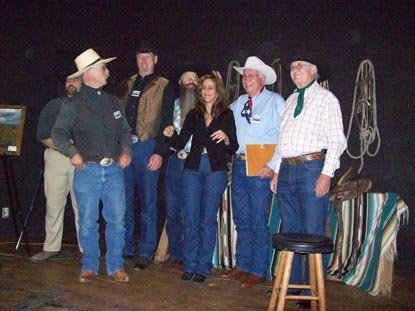
The Texas Crossroads Cowboy Gathering

photograph from a recent Texas Crossroads Cowboy Gathering

By Beth Nobles, Art of the Rural Correspondent

There’s no question about Bob Kinford’s occupation when you meet the founder and organizer of the Texas Crossroads Cowboy Gathering--this is a man who works horses and cattle.  Even in the heart of Far West Texas’ Chihuahuan desert, he gets noticed when he enters a room.  Sporting a wide-brimmed hat, well-worn cowboy boots, and his neck tied with a wild rag, this cowboy is a horse trainer and a specialist in herd behavior and natural reduced-stress cattle handling; as well as a poet, storyteller, cook, and publisher.
Just as the Edinburgh Fringe Festival developed as an alternative venue in Scotland, Bob Kinford organized the Texas Crossroads Cowboy Gathering three years ago as an option for performers trying to break into the cowboy poetry circuit.
“Cowboy anthologies, stories and poetry are not considered an actual genre by the publishing industry, and gatherings are the only practical way to market the work,” said Bob recently.  “It seemed that gatherings I attended kept hiring the same people and were not hiring out of the open mic performers.”
“We are filling a niche for up-and-coming entertainers, as well as those who are trying to expand out to different areas of the country. As far as I know, we are the only gathering that live-streams video of all shows to the internet. This is allowing us to fulfill our goal of getting the genre out to a whole new audience, not just in the United States, but also internationally. The average person has never heard of cowboy poetry or music. Those who have not actually heard it before assume that it is just a bunch of hicks with no talent.”
Now, in anticipation of the Crossroads Cowboy Gathering’s third year (in Van Horn, Texas, February 3-6), Bob has planned outreach events in area schools.  For example, “We’ve got 27 performers this year, and all are either currently involved in agriculture or have their roots in it. Many are ranchers or retired ranchers. I would like to make Crossroads not just an entertainment venue, but educational as well,” said Bob.   Tiny Valentine, Texas (approximate population 250) “will host Crossroad’s performers Evelyn Roper, Bob Atkins and Tony Argento at their elementary school.  They will sing and recite poetry, as well as giving the kids a chance to ask them questions about their art or agriculture.”
As a rural festival organizer, Bob shares some of the same challenges with organizers anywhere, “getting through the politics of having other events hire from our pool of entertainers, and drawing an audience with a very limited budget.”  However, this audition venue for aspiring cowboy poets and performers seems to be a survivor.  Already, plans are underway for a February 2-5, 2012 Texas Crossroads Cowboy Gathering in Van Horn, Texas.
Information about attending this year’s festival in person or through live-streaming video is available at the Gathering’s website.

Thursday, February 3, 2011

The Calendar Poems of Lorine Niedecker


Wade all life
backward to its
source which
runs too far
ahead

Between digging out from our massive Midwestern storm, I'd like to offer this entry from Lorine Niedecker (1903-1970), a poet from Blackhawk Island, Wisconsin whose influence on contemporary poetry has come to far exceed the boundaries of her river road. There will be much more on Ms. Niedecker soon; her work falls into conversation with a number of other upcoming posts that consider what's at stake in the concept of the "vernacular" in photography, architecture and visual art. The above poem is the first entry in a series entitled Next Year or I Fly My Rounds Tempestuous; it was a portion of a calendar book she gifted to the Objectivist poet Louis Zukofsky in December of 1934.

Until then, there is much more of Ms. Niedecker's work to be enjoyed in Jenny Penberthy's excellent Lorine Niedecker: Collected Works, and more information by Ms. Penberthy on the calendar series can be found here.  The Poetry Foundation also offers this concise biography, with poems; information on the the lyrical documentary Immortal Cupboard, complete with excerpts, can be viewed by following this link.

Tuesday, October 19, 2010

The Rural Poetry Series: Henry Real Bird

Henry Real Bird (left) with riding partner Levi Bruce; Joseph Terry, National Public Radio

"I'm going to ride where my grandfather rode. I'm going to show the kids how to write poetry...I'm just a simple guy on horseback, with a frying pan and a coffeepot and a match and pencil and paper, riding on horseback and flat enjoying myself."

Our Rural Poetry Series continues today with the life and work of Henry Real Bird, an artist who sees little separation between the art of poetry and the art of living. The way in which Mr. Real Bird conducts his daily life suggests such connections; he's a rancher, an educator, a native Crow speaker and he's also the Poet Laureate of Montana. In that official capacity, Mr. Real Bird chose to accept the Laureate's work by bringing poetry to people across the state--in person, on horseback. 

This summer the poet undertook a 415 mile trek across Montana, handing out books of poems to folks that he met in the ranches, towns and reservations along the way. As the Western Folklife Center notes, in its extensive coverage of the journey on its blog, "This is not a press stunt, but rather a demonstration of Henry’s life, culture and poetry: a journey of horse and horseman slowly making their way across a vast ancestral landscape." 

The WFC's blog also features a few audio interviews with Mr. Real Bird along his way, as well as a recording of an early draft of a poem commemorating the journey. (National Public Radio also produced a story on the Laureate's travels.) The Writing Without Paper blog offers an comprehensive list of links to resources for learning more about Henry Real Bird, his poetry and his journey; included therein is Pat Hill's interview with the poet from the The Montana Pioneer, revealing how the language of his poems and his native Crow language come into concert:
Real Bird said he also strives to make sure Crow culture is safe, and that retaining native language is an integral part of preserving native culture. “I work on that as an educator…to preserve the language,” he said. “In 1954, there were 30 of us in the third grade, and we all spoke Crow. Now, of all the grades K through 6th, only one percent are Crow Indian speakers.” Real Bird said the loss of the Crow language on the Reservation has led to a “sell-out” of  Crow culture. “These sell-outs, they're strange,” said Real Bird. “If you speak Crow, you're of low mentality or something. They shun the language and move on.” Real Bird said he wants to see more emphasis put on Crow language in reservation classrooms, and he teaches his family to speak Crow on the home front.

“I want to speak Crow Indian with my granddaughter,” he said, “and then with her younger brother. There's a big loss with the oral tradition gone…some kids not even knowing where they come from. It's unbelievable what we have become.
Native American culture and cowboy poetry merge in Henry Real Bird's work with a sensibility that finds common ground with the Beat Generation and rich oral traditions of the American West:

Red Scarf

Boots and chinks
Silver bit and silver spurs
Eased into the dawn
To walk out kinks
Horse like shiny, free of burrs
Trotted into day
I’m ridin’ bay
If you can see the beauty
In the sunset with many colors
I only see the beauty in the sunrise with many colors
You can find me
In the beauty in the sky
In sunrise and sunset
In the shadow of the sky
Among the stars
If you can see the beauty, in the sky
You can find me, in your eye
With a red scarf on
Boots and chinks
Here I am, I’m ridin’ gone
Ground about day
Lookin’ for a stray
Red-tail hawk blessed me with his shadow
Clouds peak to my south
Granite to the west
Sheep Mountains and the Pryors
Look their best
Grass full grown
As I stood
In my heart that is good
If you can see the beauty
In the sunset with many colors
I only see the beauty
In the sunrise with many colors
You can find me
In the beauty in the sky
In sunrise and sunset
In the shadow of the sky
Among the stars