Kurt Wagner of Lambchop standing with his Beautillion Militaire 2000 series of paintings
The tragedy in Newtown, Connecticut is so deep, so overwhelming, that for many of us it's been a moment of re-orientation and reflection, of counting blessings and extending a hand to help in what ever distant way we can.
One of those forms of grief and support has been folks' sharing of music and art in various mediums. On Facebook, The Alan Lomax Archive and Association for Cultural Equity offered a stirring "Peace in the Valley" by Joe Savage and, last night, Saturday Night Live's cold opening began with the New York City Children's Chorus singing "Silent Night." Such moments remind us that, while in the midst of national mourning, something as seemingly-insignificant as a piece of art becomes the thing we need the most.
Below, I offer "Nice Without Mercy," a song from Lambchop's acclaimed Mr. M. While Kurt Wagner's lyrics within Mr. M often meditate on the loss of his friend Vic Chestnut, these songs, to my listening, are less about a particular context and more about a process of grief, redemption, and the unexpected beauty and compassion we find along the way:
[Today we're thankful to have the opportunity to offer this repost from Nathan Salsburg's Root Hog or Die, an extraordinary radio show and music blog that we've written about previously. This piece concerns The Allen Brothers' "Chain Store Blues," which also appears on Nathan's recently-released 3 CD/LP compilation Work Hard, Play Hard, Pray Hard. The song is indicative of how these selections -- whether joyous or solemn -- feel utterly contemporary, and of how they reveal elements of our cultural history too often forgotten. AOTR's Notes From The Field editor Jennifer Joy Jameson will be sharing a full feature on Work Hard soon.]
By Nathan Salsburg
An energetic, if short-lived, protest movement of the late 1920s and early ‘30s flexed against the encroachment of chain-stores — evidence that the “buy local” concept is of some vintage. Although several chain-store blues were recorded in the pre-war recording era, however, only the Allen Brothers’ 1930 plea for support of independent “home stores,” entitled “I Got the Chain Store Blues,” was released.
Perhaps the labels assumed that the chains, many of which sold their records, wouldn’t take kindly to such sentiments. By 1930, Chattanooga, Tennessee — then the base of operations for the Sewanee-born Lee and Austin Allen — was home to a Sears Roebuck, a Montgomery Ward, and a McLellan’s five-and-dime. Other stores like Woolworth’s, J.C. Penney, and the A&P (“Where Economy Rules”) had infiltrated many smaller towns, prompting “trade-at-home” campaigns and legislation to limit what the chains sold and where they sold it.
W.K. Henderson, the sensational personality behind Shreveport’s radio-powerhouse WKHK, threw his considerable weight behind the movement: “We have attempted to bring to light the ruinous and devastating effect of sending the profits of business out of our local communities to a common center, Wall Street…. appealed to the fathers and mothers — who entertain the fond hope of their children becoming prosperous business leaders—to awaken to a realization of the dangers of the chain stores‘ closing this door of opportunity…. insisted that the payment of starvation wages such as the chain-store system fosters, must be eradicated.”
[Two perfect post-Thanksgiving companions: Fiddlin' John Carson's "The Farmer Is the Man" (who feeds them all, he sings) and "Chain Store Blues" which begins at 3:07]
Each week we present a compendium oflinks and perspectives offered daily on our Rural Arts and Culture Feed. We encourage folks who have upcoming events (local or national) to contribute to The Daily Yonder Calendar.
By Rachel Rudi, Digital Contributor
•El Teatro Campesino
has created powerful, boundary-crossing work in San Juan Bautista,
California for over forty years. Below, composer Daniel Valdez
discussing Cancion De San Juan: Oratorio of a Mission Town.
Through CANCIÓN DE SAN JUAN: ORATORIO OF A MISSION TOWN, El
Teatro Campesino and composer Daniel Valdez hoped to honor history’s
forgotten voices by telling human stories through music and images –
evoking the moments and memories of real people who lived and died
staking a claim to this little corner of the world. Together these
stories, researched and collected by current residents of San Juan
Bautista, were woven into an epic tapestry that unfolded as a paean to
the rise, fall and constant rebirth of a small town in all its
multicultural glory. CANCIÓN DE SAN JUAN: ORATORIO OF A MISSION TOWN
explored the many transformations experienced by the people of this
region – and their perseverance, resilience and stubborn refusal to
cease existing in the face of overwhelming odds.
• "I wish a lot of people could see this. This is something that's going on in the reservation: This don't look too cool." Appalling news from Wyoming:
• "A hundred years ago, when extension was founded, one-third of our nation's population was involved in agriculture.... We need extension today, more than ever, because our society is growing not only in size, but also in the nature and complexity of its problems:"
• Shelby Grebenc, a Colorado poultry farmer in her teens, writes beautifully in The Denver Post: "If
you want sustainable, wholesome, pasture-raised organic, hormone- and
antibiotic-free food, you have to support it. You cannot get these
things by talking about it and not paying for it."
• A must-read: During World War II, the Rowher and Jerome camps in Arkansas housed over 16,000 Japanese Americans. An intern at the University of Arkansas's Institute on Race and Ethnicity considers the legacy of these camps and their relation to contemporary American life:
• "Even as cities from Philadelphia to Chicago to Detroit mobilize to hydrate the food deserts, it's becoming clear that even if you make fresh produce affordable, people may not buy it."
•"Kultivator is an experimental cooperation of organic farming and visual art practice, situated in rural village Dyestad, on the Island of Oland on the southeast coast of Sweden. By installing certain functions in abandoned farm facilities, near to the active agriculture community, Kultivator provides a meeting and workign space that points out the parallels between provision production and art practice, between concrete and abstract processes for survival Kultivator initiates and executes meetings between idealism and realism, hoping that fruitful cooperations should should take form."
• Welcome to Shelbyville"takes an intimate look at a southern town as its residents – whites and African =Americans, Latinos and Somalis – grapple with their beliefs, their histories and their evolving ways of life:"
•Mark Your Calendars: The 2012 Rural Arts & Culture Summit will happen this June 5–6, in Morris, Minnesota, hosted by the Center for Small Towns at University of Minnesota-Morris. We will be sharing much more on this event in the coming months -- please plan to join us there!
• This week in 1975, Waylon's "Are You Sure Hank Done It This Way" was the number one country single in the land. Via the essential Southern Folklife Collection:
Storytelling is a partnership between the person telling the story and the person receiving the story; each depends on the other. This exchange is not designed to be passive, unless the purpose is propaganda. “The purpose of art is to lay bare the questions hidden by the answers,” wrote James Baldwin. Likewise, isn’t such questioning an important part of the artist–audience exchange? And isn’t the measure of the energy of such exchange an indicator of a culture’s vibrancy?
A new film, Beasts of the Southern Wild, furnishes an occasion to test this assertion. Beasts is the latest film fantasy about the rural South. I think it’s a depressing film, so I’m wondering why millions of viewers and the critics find it so exhilarating. A.O. Scott’s review for The New York Times is typical, “a blast of sheer, improbable joy.” Philip Martin writing for The Arkansas Democrat-Gazette seems to suggest that anything less than total buy-in is unpatriotic: “Wild is ... a visual tone poem. To try to impose any orthodox sensibility, much less political correctness, on the film is close to blasphemy.” Obviously, the movie has struck a mass emotional chord; as one of a handful of naysayers, what’s my problem?
Beasts of the Southern Wild is the story of six year old Hushpuppy. Deserted by her mother when she was a baby, Hushpuppy is being raised (jerked up is more like it) by her abusive, alcoholic father, Wink, who appears to think she is a boy, the fabled Man Child come as the Redeemer of the least among us. For her part, Hushpuppy tells us, “I can count on two hands the times when I’ve been lifted up,” and she means held in someone’s arms. (For a detailed analysis of the Hushpuppy character’s lineage in popular culture, see bell hooks’ commentary "No Love in the Wild".)
Beasts is in a line of popular movies about the rural South that includes Deliverance (1972) all the way back to D.W. Griffith’s silent The Harum-Scarum and the Mountain Idealist (1909). The music in Paramount’s candy-colored Li’l Abner (1959) was nominated for an Academy Award. The opening number:
Soloists: It's a typical day In Dogpatch, USA. Where typical folks Do things in a typical way. First we rubs the sleep from our eyes, Gets our grub, and shoos 'way the flies. We spend what's negotiable, Then we gets sociable, Sittin' around swappin' lies! And then we drops by to collect unemployment pay!
All: Which leads us to say it's a typical day In Dogpatch, USA!
Lonesome Polecat: Lonesome Polecat, Indian Brave!
Hairless Joe: Hairless Joe, me need’um a shave!
Both: We livin' an' sleepin' n' doin' housekeepin' in big subterranian cave! While Kickapoo Joy Juice we make’um is heap "grade A!"
Skraggs: Take us boys what's known as the Skraggs, Mammy said she had us as gags! Can't git that depressin' an' homely unlessin' ya comes from a long line o' hags! There ain't any widders or orphans we won't betray!
Moonbeam: Howdy boys, I'm Moonbeam McSwine, Sleepin' out with the pigs is my line. The fellas admire me, But they don't squire me Unless the weather is fine! But I does alright when the wind blows the other way!
All: Which leads us to say it's a typical day, in Dogpatch, USA...It's a typical day (echo: it's a typical day) in Dogpatch, USA! Where typical folks ( echo: typical folks) Does things in a typical way!
Fast forward more than half a century and the cartoonish Dogpatch has morphed into the Bathtub, something more akin to a graphic novel and now located near the southern Louisiana levees. Like the characters in Dogpatch, po’ folk in the ‘tub have the “typical way,” drinking from dawn until they collapse – plus now they have the added headache of the approaching Apocalypse set off by global warming. Thirty years before the Beasts, Hank Jr laid down the survivalist anthem:
The preacher man says it’s the end of time And the Mississippi River she’s a goin’ dry The interest is up and the Stock Markets down And you only get mugged If you go down town I live back in the woods, you see A woman and the kids, and the dogs and me I got a shotgun, a rifle, and a 4-wheel drive And a country boy can survive Country folks can survive
So who feels exhilarated by a film that appears to be a grab-bag fantasy about the end of time, poverty, and alcoholism? I hope rural Southerners, despite some affinity for the Book of Revelation, know too much about themselves to swallow the concoction. With more than 2.1 million Americans in prison, there’s no easy way for people who are part of communities with modest incomes to gloss the damage done by drug and alcohol addiction. Ask the school teachers here in Appalachia, and any one of them will tell you about the real-life fates of neglected and abused Hushpuppies.
Is the film, then, thrilling, “a blast of joy,” for penned-up, pent-up middle-class suburban and urban people ready to break free into a hedonistic wild? If this is the case, are rural people and their tourism bureaus prepared to fulfill this urban fantasy? In an era when pop culture and cosmopolitanism appear to be synonymous, what do rural people actually think about the way they are being portrayed in today’s mass media? Have the relentless stereotypes of popular culture finally hypnotized us all, rural and urban alike, erasing any sense of history and present reality so at any given moment we’re liable to turn into a caricature of ourselves? I realize these are heady questions when one could just relax -- hey dude, it’s just a movie. Meanwhile, tens of thousands are lining up to feel the beast, the hype is on, and I wonder what the fervor signifies.
Dudley Cocke is the artistic director of Roadside Theater, the professional theater wing of the multi-media arts and humanities center, Appalshop, in Whitesburg, KY.
Think twice and see it once. Think you're right and know you're right before you do something. I like to have people see what I see, the way I see it. I try to see through a thing.
We begin this week with news of the extraordinary "memory paintings" of Helen LaFrance, a self-taught Kentucky artist who has spent a life painting, and, at the age of 93, is still producing vibrant work from a dayroom-studio in her nursing home.
In 1995, I had the pleasure of being introduced to self-taught Southern artist Helen LaFrance.
An accomplished painter, quilter, wood carver, and Biblical
interpreter, Helen LaFrance also has an exceptional ability to connect
with the viewer emotionally through the memories they share. She paints
scenes of a time and place that many recall but others respond to as
well. On canvas, she transcribes the values and traditions she grew up
with, the concept of family and church, the strong work ethic that was
her model. These paintings fall into a category of American folk art
known as memory painting. And memories, as we all know, give meaning to
our own lives and to the lives of others when we share them.
We are also including below this fine video by the Oxford American that first introduced us to the work of Helen LaFrance; below, please also find a video produced in conjunction with her Kentucky Governor's Award in the Arts.
I have a few friends who were recently married—the kind of
friends who first told me about the art environments of Grandma Tressa Prisbrey, of Kenny Hill,
and the kind I found myself convening with after visiting Howard Finster’s
Paradise Gardens for the first
time. In celebration of their union, I hoped to find a gift for them that was
not just handmade, or unique, but something that has a particular redemptive
quality to it. These are friends who recognize the beauty and immense potential
in everyday objects, places, sounds, and stories that have otherwise been
thrown away or seen as worthless. So, in keeping with this orientation to the
world, I was glad to use their wedding gift as an excuse to get in touch with
Middle Tennessee sculpture artist and gospel singer John Baird.
I came to know about the multi-form creative works of John
Baird last summer in Nashville. I was assisting folklorist Evan Hatch, who was coordinating
the Tennessee Folklife program at the
73rd National Folk Festival – an annual, traveling festival produced
by the National Council for the Traditional Arts. Evan, who has documented John’s
art and music for years, invited him to exhibit and sell his metal sculptures
at the festival. Over the course of the 3-day festival, I found myself regularly
breaking from duty by chatting with John and his wife Ruby, a talented fiber
artist. I even convinced John to sing a few of his original gospel tunes for
me—songs that he performs from time to time at churches near their home.
The Bairds reside in Kittrell, Tennessee, in the countryside
of Rutherford County—just down the old 70 Highway from Murfreesboro, the
college town of Middle Tennessee State University. John grew up in rural
Rutherford County, first learning to weld as a young man in the Future Farmers
of America. He did not regularly create works of visual art until the 1980s, around
his retirement from a long career working as a farmer, a salesman, and a truck
driver. For years now, he’s collected scrap metals of all kinds and crafted
them into animals (or animal-type-creatures), people, or whatever potential
John sees in the mismatched shapes of his mounting collection of thrown-away
metal parts. His sculptures range in size and subject from miniature motorcycles
or water pumps, to oversized spiders measuring about 4 feet, to a free-standing
take on the Eiffel Tower (titled the “Awful Tower”), to a cowboy made of old
horseshoes. After last year’s festival was over, I got up the nerve to ask John
how much it would be to purchase the bird made out of antique sewing machine
parts. I bought it, and proudly perched the bird on my mantle, where it reminds
of the ability to form new and lovely out of old and odd.
On the afternoon that Evan and I rode out to the Baird home
in Kittrell, John and Ruby kindly poured us tea and toured us around some of
the finished works. In examining John’s sculptures, I moved back and forth from
a sort of drop-jaw awe in response to the skilled craftsmanship of the pieces,
to keeling over at the clever and lighthearted spirit of the artwork. John was
pleased to find me laughing.
When I asked John if he draws influence from the landscape
or his community, he wasn’t too sure what to say. However, it strikes me as a
rather intuitive application of both landscape and community in making such use
of his surroundings—these being the scraps that he finds at yard sales or junkyards,
and the metal bits friends and neighbors regularly give him with the intention
of use in his art.
The front and back yards of the Baird home are covered in
painted roses as tall as Ruby, and lined by a wall made from rocks John has
hunted with a neighbor of his. In the backyard, John and Ruby have, together, built
a rock garden out of flowers and wagon wheels, featuring rocks shaped like animals
that I could have sworn John carved himself. Instead, he looks for rocks in
their natural form, which happen to be in the shape of rabbits or deer—a skill John
uses in coming up with ideas for his metal sculptures. He told me, “If I come
across a scrap of metal, I see if it’s like something…maybe a head for [an
animal], or a grill for a car [sculpture]. I just start from one piece and go
from there.” To me, this speaks to his ability to see great possibility for
human communication through the careful bricolage of the discarded and the
ordinary. This is the redemptive understanding, the aesthetic worldview that I knew
the Bairds shared with my soon-to-be-wed friends.
John Coltrane, Cannonball Adderley, Miles Davis, and Bill Evans, recording in 1958
If there is any particular affinity I have for poetry associated with the South, it is with idiom. I credit hill people and African Americans for keeping the language distinct. Poetry should repulse assimilation. Each poet's task is to fight their own language's assimilation. Miles Davis said, "The symphony, man, they got seventy guys all playing one note." He also said, "Those dark Arkansas roads, that is the sound I am after." He had his own sound. He recommended we get ours.
Crews at home in his Florida; Oscar Sosa, New York Times
She felt the snake between her breasts, felt him there, and loved him there, coiled, the deep tumescent S held rigid, ready to strike. She loved the way the snake looked sewn onto her V-neck letter sweater, his hard diamondback pattern shining in the sun. It was unseasonably hot, almost sixty degrees, for early November in Mystic, Georgia, and she could smell the light musk of her own sweat. She liked the sweat, liked the way it felt, slick as oil, in all the joints of her body, her bones, in the firm sliding muscles, tensed and locked now, ready to spring — to strike — when the band behind her fired up the school song: “Fight On Deadly Rattlers of Old Mystic High."
The South lost two preeminent artists last week: Earl Scruggs and Harry Crews. While our Arts and Culture Feed covered many of the remembrances and documentary footage of Mr. Scruggs, we'd like to offer further gateways into discovering the solitary and one-of-a-kind fiction of Harry Crews. To begin, there's the excerpt above -- the opening paragraph to his critically-acclaimed 1976 novel A Feast Of Snakes.
Dwight Garner, writing in the The New York Times, shares this quote about how Crews dealt with the poverty of his rural place, qualities that place him among that other clear-eyed commentator of the rural poor, Joe Bageant:
“I was so humiliated by the fact that I was from the edge of the
Okefenokee Swamp in the worst hookworm and rickets part of Georgia I
could not bear to think of it … Everything I had written had been out of
a fear and loathing for what I was and who I was. It was all out of an
effort to pretend otherwise.”
Pretend is a loaded word in Crews' fiction, which finds a
powerful and often uncomfortable margin between brute realism and
otherworldly imagination. Searching for the Wrong-Eyed Jesus, a sort of lyrical documentary on Southern culture also considers this quality. This clip features music from David Eugene Edwards of 16 Horsepower and Wovenhand:
By far, however, the most comprehensive and moving remembrance of Harry Crews has come from Maud Newton, a writer, critic, and former student of Harry Crews at the University of Florida. Her piece in The Awl reveals many sides to Crews beyond the work or the official obituaries, including this excerpt from his A Childhood: The Biography of a Place:
One of my favorite places to be was in the corner of the room where the
ladies were quilting. God, I loved the click of needles on thimbles, a
sound that will always make me think of stories. When I was a boy,
stories were conversation and conversation was stories. For me it was a
time of magic.
It was always the women who scared me. The stories that women told
and that men told were full of violence, sickness, and death. But it was
the women whose stories were unrelieved by humor and filled with
apocalyptic vision. No matter how awful the stories were that the men
told they were always funny. The men's stories were stories of
character, rather than of circumstance, and they always knew the people
the stories were about. But women would repeat stories about folks they
did not know and had never seen, and consequently, without character
counting for anything, the stories were as stark and cold as legend or
myth.
[Editor's Note: As I am facing numerous writing deadlines, this seems like a good time to give a
retrospective glance to the first two years of Art of the Rural.
Over these weeks I will feature a few new articles, but also many
favorites from the archives. Thanks again to everyone who has read and
contributed; what began as a labor of love has become a project far
larger, and far more rewarding, than I ever could have anticipated - and
I deeply appreciate the readership and participation of such a diverse
audience. Starting March 19th, we will offer new articles and share some
new projects related to our mission.
David Lee's Carolina Soul was originally published on August 2, 2011.]
**********
Long-time readers might remember our piece from last year on the Carolina Soul site and the Paradise of Bachelors record label. POB's first release, Said I Had A Vision: Songs & Labels of David Lee 1960 - 1988 was one of our absolute favorite records from 2010--and the release has continued to get some wonderful press, so I'd like to start off the week by sharing some of this information. If we've hit the summer doldrums (August), this record is the best antidote I can imagine. Paradise of Bachelors is now offering a limited edition LP repressing; folks can find the digital download at iTunes or Amazon Music.
Here's "You've Been Gone Too Long" by Ann Sexton. As the liner notes explain, "the tune must make any list of curious, 'Jody' genre songs, for its reference to the archetypal male opportunist who, according to Vietnam-era folklore, would latch onto women whose husbands or boyfriends were serving overseas."
While we are currently in a golden age of reissues and unearthed music, with more and more coming out each week, what sets Said I Had a Vision apart is its combination of context (rural North Carolina, from the civil rights era to the Reagan era), the quality of its songwriting, and the absolute exuberance of the performances. Many such records have these qualities in unequal parts, but Said I Had A Vision contains songs that exceed the normal obscurity-fetish that similar records often cultivate. After I play this record through, I generally feel like everyone I know needs to hear these songs.
It should be no surprise, then, that the music press has embraced this record and the regional vision behind the Paradise of Bachelors label, which is co-curated by folklorists Jason Perlmutter and Brendan Greaves. I was excited to learn that Wax Poetics had featured Said I Had a Vision in a recent issue; here's Jon Kirby:
A man of faith, [David] Lee's output tended towards the spiritual. And although most benefit from Cleveland County's proximity to Charlotte's Arthur Smith and Reflection Studios, perhaps his most generous offering was recorded on location at Mice Creek Baptist Church, in nearby Gaffney, South Carolina. "On My Way Up" by the Relations Gospel Singers showcases the careening lead of Steve Allen, whose exorcism range leaves church-van tracks through a field of delicate piano and choral support, recalling the fly-on-the-wall intimacy of an Allan Lomax artifact. Much of Lee's color-blind songwriting was realized by the Constellations, a salt-and-pepper ensemble who, during Shelby's annual Art of Sound Festival last October, proved they could still do "The Frog," walking sticks in hand. "They were just like kids to us when they started," revealed wife Nelena of Lee's most allegiant act. "We was just like a big family, rolled up together." With the exception of "northern soul" curiosity Ann Sexton, most on Lee's short-but-sweet roster still reside in Cleveland County, like blue-eyed crooner Bill Allen from nearby Cherryville. "You probably drove past there!" exclaims Lee. "You should have hollered for Bill when you was coming through."
Further write-ups on the resurgence of interest in Mr. Lee's work has appeared inOur State magazine and The Charlotte Observer. Earlier this year, Mr. Lee was awarded the Brown-Hudson award by the North Carolina Folklore Society, introduced by Mr. Perlmutter and Mr. Greaves. Afterwards, he gave a performance of "I Can't Believe You're Gone" and "I'll Never Get Over Losing You," the latter of which appears on Said I Had a Vision:
Paradise of Bachelors will release an LP/download of new material emerging from the South this fall: Poor Moon by the much-loved and critically-acclaimed Hiss Golden Messenger. Also in the works is a release of new and remastered material by Willie French Lowery, a member of the Lumbee Tribe in North Carolina and who has worked previously with the psychedelic bands Plant & See and Lumbee. I'll include a sample of each artist below; you can also follow the latest Paradise of Bachelors news on their Facebook page.
[Discovering Carolina Soul was originally published on September 23, 2010]
The former Washington Sound on Buffalo Street in Shelby, NC; from Carolina Soul
Throughout the sixties and seventies, at least one hundred African-American-owned R&B/Soul record stores thrived in the Carolinas. These retail shops, with their close links to recording studios and local record labels, were on the front lines not only of new musical ideas, but of the civil rights struggle itself. Today, this music's story is being told in a compelling fashion on the Carolina Soul blog/archive, which has spent the last five years locating and documenting the wide array of R&B/Soul music created in North and South Carolina--much of which has never been re-issued since its original release as 45 rpm records.
If you peruse Carolina Soul's extensive discography the material object of the vinyl record begins to stand as a symbol for a kind of rural-urban linkages that revolutionized the last half-century's artforms and its push toward social justice. This effort to rediscover these recordings, and to tell the stories of these musicians and their communities, is led by Jason Perlmutter (a chemist and local music collector) and Jon Kirby (an associate editor at Wax Poetics). Mr. Perlmutter, in partnership with folklorist Brendan Greaves, has begun the Paradise of Bachelors record label and is currently pressing their first release -- a retrospective of the music released on David Lee's various record labels entitled Said I Had A Vision.
Mr. Lee, who currently resides in Mooresboro, ran the Impel, Washington Sound and SCOP (Soul, Country, Opera, Pop) labels and often contributed his own songs to his musicians. Carolina Soul recently visited Mr. Lee, and, earlier in the year, the folks behind this project spent time talking with some of the artists who worked with him. Here we see the The Constellations, both then and now:
Here, from the Paradise of Bachelors' blog, is a description of the ground-breaking work done by The Constellations:
We spent an illuminating and pleasant afternoon in Mooresboro, North Carolina with the Lees; Harold Allen, Don Camp, William “Butch” Mitchell, and Benjamin and Bryan “Brownie” Guest of the Constellations. Hearing these gentlemen’s stories about unflagging brotherhood, camaraderie, and the timelessness of “love ballads”–in the face of physical threats, racist invective, and a Southern and national climate opposed to their very existence–was truly inspiring. The Constellations were the first mixed-race combo in the area, and they did it as mere kids, getting started in 1958 or 1959 as teenagers and only dissolving upon the departure of members to Vietnam in 1964 and 1965.
In that time, they recorded six energetic sides for David Lee, all of which belie their tender ages, plus two unreleased tracks–”Have You Seen My Baby?” and “I Want to Jerk”–which Mr. Lee sent to Benjamin Guest while he was serving in Vietnam. Those tapes may yet emerge for your delectation…
We can only hope to that some of this music makes its way on to Carolina Soul or onto a newly-pressed piece of vinyl via Paradise of Bachelors.
As a closing note, for those who would like to hear these gentlemen put these songs into a more eloquent context than I can provide, please refer to their interview with Frank Stasio on NPR's The State of Things.
Abner Jay, April 8, 1982, San Jose Flea Market; selection of a photo by Jon Sievert
[Editor's Note: As I am facing numerous writing deadlines, this seems like a good time to give a
retrospective glance to the first two years of Art of the Rural.
Over these weeks I will feature a few new articles, but also many
favorites from the archives. Thanks again to everyone who has read and
contributed; what began as a labor of love has become a project far
larger, and far more rewarding, than I ever could have anticipated - and
I deeply appreciate the readership and participation of such a diverse
audience. Starting March 19th, we will offer new articles and share some
new projects related to our mission.
Abner Jay: The Last Southern Black Minstrel Show was originally published on March 3, 2011.]
**********
In this post, and the previous post below, we're considering the life and music of Abner Jay--a figure whose art cuts across so many themes central to the American experience: race, class, regionalism, history, and place. Mississippi Records has just released Mr. Jay's final recordings, entitled Last Ole Minstrel Man.
I've heard from a number of folks in the two days since the previous post, readers who have been bowled over the emotion, creativity and cultural import of Mr. Jay's work. Today I'd like to share more information and links. Beyond that, the best thing to do is to sit down with his records, turn off the phone, and just listen.
Abner Jay was born in Fitzgerald, Georgia in 1921, into a family of sharecroppers. Though various internet sites tell the story slightly differently, Mr. Jay's grandfather--and perhaps his father--had been slaves. The legal terminology, however, is of less import than the realities of those early years of his life. Amoeba Records' blog offers a generous transcription (from the current release's liner notes) of Mr. Jay's own recollection of this time period:
"Abner was a slave sixty five years after the slaves were freed, because Abner grandpa and Pa love the slave life. Abner was hired out to white plantation owners when he was at the age of six. Abner worked as a slave side by side with his grandpa, a former slave. Abner could not and did not receive his pay until after he was twenty one years of age. Abner ate and slept in the barn with the mules. The White folk would hand his food out of the back door to him in a pan, mostly left overs and the food the white folk dogs wouldn't eat...
"Abner start singing on the public for the white plantation owner when he was eight. Abner start playing banjo at the age of ten, and became a one man band and bone player at the age of fourteen. Abner would play in the rich homes for the plantation owners when they wanted to entertain."
Mr. Jay later toured with minstrel and vaudeville shows, eventually striking out as a young man on his own--a one man band. Along the way he became friends with Muddy Waters, Chuck Berry, James Brown and, according to some sources, Elvis. He was also the agent and manager to the phenomenal gospel singer Sister Rosetta Tharpe. In the final decades of his life, Mr. Jay traveled from town to town in a mobile home that could convert into a performance stage
Again, Chris Campion so clearly articulates the many attributes of the sound that might surprise attendees of a local fair or flea market:
Jay finger-picked a bittersweet but heartfelt comic blues on a long-necked, six-string banjo that he said had been made in 1748. It had been passed down to him by his grandfather, Louis W Jay, born a slave and later to teach Abner many of the traditions he made it his mission to keep alive.
He was almost certainly the last living exponent of the 'bones' - a musical tradition that involved playing percussive rhythms using various cow and chicken bones that had been dried out and blanched in the sun. Jay claimed to have a repertoire of over 600 songs, which he sung in a bone-shaking basso profundo voice, the legacy of a battle with throat cancer that almost felled him in his twenties.
He would perform field songs, minstrel tunes and Pentecostal hymns interspersed with his own nuggets of homespun philosophy, off-colour yarns and side-splitting one-liners. 'What did Adam and Eve do in the Garden?' runs one. 'Eve wore a fig leaf... and Adam wore a damn hole in it.'
Jay's own compositions were decidedly secular in nature and found him musing on atypical themes such as depression, the Vietnam war and substance abuse. Titles include 'The Reason Why Young People Use Drugs' and 'The Backbone of America is a Mule and Cotton'. 'I crave cocaine,' he moaned during crowd favourite 'Cocaine Blues', exaggerating his diction for comic effect. 'But I can't find nothing here in Atlanta. Cos those hippies dun used it all up... I want sum'tin to pep me up!'
For more information, The Down Home Radio Show features Eli Smith's interview with Eric Isaacson of Mississippi Records; the two discuss the label's release of The True Story of Abner Jay as well as the true story of the record label itself, which has become a faithful steward of many later Abner Jay re-issues.
Here's a rare gem: an excerpt from Mr. Jay's final performance at the 1993 Grassroots Festival in Trumansburg, New York. We see in this personal rendition of "St. James Infirmary Blues" what Mr. Isaacson means when he says that people called Abner Jay "the black Bob Dylan." Even more forcefully than Dylan, Abner Jay stood with one foot in a lost, folkloric America and the other in the ground of rock 'n' roll, radio, and television. The great achievement of his music is that these contradictions are fused together in ways that can be both deeply-moving and profoundly unique.
We learn that he passed away days later, on his way back home.
Folk music is high class music--of course a lot of low class people singin' it. Matter of fact, most so-called folk singers don't even look like folk. Folk songs tell true stories, but terrible stories--'cause folk are terrible. Terrible songs make big songs. Why do you think kids like rock 'n' roll ? Because it's terrible. You think they're gonna listen to the Philadelphia Symphony, 101 Strings? Why do you think I like cocaine?
Tomorrow we will write more extensively about Abner Jay (1921-1996), a multifaceted musician and artist--and the self-proclaimed "last great Southern black minstrel show." His music (and his life story) was complicated and unconventional, but also singularly brilliant.
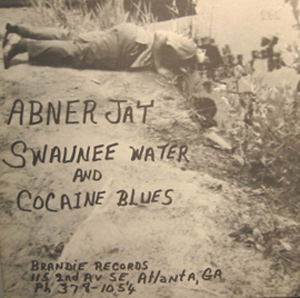
Rather than cocaine, he used to claim that the secret of his eternal youth and vitality was lying on his belly drinking water scooped out of the Suwannee River in his home state of Georgia. And at least two of his albums (privately-pressed and released on his label Brandie, named after his wife) feature a photograph of him doing just that, along with the tracklisting, which he customarily scrawled over it in marker pen.
Jay was himself born near the source of one of the tributaries of the river in Irwin County, Georgia (in 1921). He started performing in medicine shows at the age of 5. In 1932 he moved on, to the Silas Green show, a travelling minstrel show and vaudeville revue that had also once employed Bessie Smith. Aged 14, he became a one-man band.
Enjoy these two selections from The True Story of Abner Jay, an earlier record re-released by Mississippi Records:
The Cas Walker Knoxville city council fist-fight; LIFE Magazine
[Editor's Note: As I am facing numerous writing deadlines, this seems like a good time to give a
retrospective glance to the first two years of Art of the Rural.
Over these weeks I will feature a few new articles, but also many
favorites from the archives. Thanks again to everyone who has read and
contributed; what began as a labor of love has become a project far
larger, and far more rewarding, than I ever could have anticipated - and
I deeply appreciate the readership and participation of such a diverse
audience. Starting March 12th, we will offer new articles and share some
new projects related to our mission.
The Legend of Cas Walker was originally published on April 11, 2011.]
**********
I recently received an email and suggestion from Chuck Shuford, a writer and arts commentator for The Daily Yonder and a number of other publications. I think that many of our readers will be interested in this: the life and times and televised work of Cas Walker (1902-1998). Here's an excerpt from Mr. Shuford's correspondence:
My friend sent me a link to Cas Walker pontificating on his early morning TV program -- this was probably sometime in the 70's. You need to know about Cas. He owned a chain of grocery stores in E.TN, E. Ky, and SW Va. He was also a politician, serving on the Knoxville City Council where he got in a fist fight at least once with a councilman holding a contrarian view. He was elected Mayor of Knoxville and then very soon after, recalled. He then ran for council again successfully until he retired in the early 70's. If god ever made an ornerier man, I've been hard to come by him. As someone once said "If I ordered a car load of SOB's and they only sent Cas, I'd sign for it." Dolly Parton and the Everly Brothers sang on his show as youngun's. His home, which he lived in until his death, is about 3 blocks from our home. Ironically, it is now owned by a lefty UT professor who recently wrote a book on Eugene V. Debs.
Writing in the Knoxville Metro Pulse, Betty Bean reveals how this "Hillbilly Collosus" also possessed an ability to manipulate media and technology:
Cas had served on City Council longer than I’d been alive, and had been among the first to grasp the power of television not only for selling stuff but for fighting off fluoridation, metro government, bad check writers, shoplifters, dog thieves, civic improvements of any sort, and police officers who hung around and drank coffee in establishments other than his own.
YouTube offers a small selection of Cas Walker Farm and Home Hour clips, including one of the Dolly Parton performances Mr. Shuford alludes to above. Is that Waylon Jennings playing on the right of the screen?
Cas Walker's life is impossible to summarize in just a few paragraphs, so please refer to this lively and surprising feature by Ms. Bean in the Metro Pulse. Mr. Walker's ascension to millionaire grocery magnate is marked by a rough, self-conscious transition from rural to urban life--and a hatred (an accurate word in this case) for "the silk-stocking crowd" who taunted him during his youth. While he had a combative sense of class, and an equally combative political sense, even those who opposed him in these regards were charmed and even awe-struck by the stubborn creativity Mr. Walker channeled into The Farm and Home Hour and his grocery store promotions.
Ms. Bean writes extensively of one of Mr. Walker's most legendary exploits, when he buried local character Digger O'Dell alive for multiple weeks, just to generate increased sales at this grocery stores:
"He [Digger O'Dell] said 'I will be buried, six feet underground, with a stovepipe running down to where I am so people can talk to me.' I [Cas Walker] said, 'What do you get for that kind of work?'"
He said "I get $100 a day.'
"I said 'I was thinking about offering you $25 a day, but I am going to offer you $50.' His wife was a Jewish woman and she was shaking her head yes so I knew I was going to start burying a man and I had never had that experience before.
"We dug our hole, and I got ready to bury him. Of course, I advertised that I was going to bury him at a certain time. You never seen a crowd like we had."
Digger had a telephone, and Walker remembers that he "talked with women all night. You have never experienced a ladies man such as this one was."
Walker put up a tent over Odell's grave to accommodate the crowd, which one night numbered 1,500 at 2 a.m.
But Digger wanted to be dug up before he had fulfilled his 30-day contract. Walker was having none of it, since daily receipts at the Chapman Highway store had increased from $3,500 to $8,000.
"I told him that was too much money to dig up," Walker said in a 1990 interview with the Knoxville Journal.
Digger started faking heart attacks and calling the newspapers and the health department to complain that Walker was denying him medical care.
Walker's solution was to dress two women who worked for him in "nurse suits" and station them above the grave, selling barbecued chicken sandwiches.
Knoxviews offers a brief write-up of these stunts (including the LIFE Magazine fist-fight)--make sure to read the comments section, as many local folks contributed their own memories of Cas Walker.
The Tennessee Archive of Moving Image and Sound also houses many of the historical Cas Walker commercials and Farm and Home Hour tapes. TAMIS deserves its own post here on the The Art of the Rural, and that will be forthcoming, but, until then here is one of the archival commercials:
The Museum of Appalachia also features John Rice Irwin remembering Mr. Walker and his love for Coon Hunting.