Showing posts with label readings. Show all posts

Thursday, June 14, 2012

Lost Between The Country And The City

The Giant Swing at Silver Dollar City in Branson, Missouri 

It is significant, for example, that the common image of the country is now an image of the past, and the common image of the city an image of the future. That leaves, if we isolate them, an undefined present. 

    --Raymond Williams, The Country and the City

Wednesday, June 13, 2012

Readings: The Egg And The Machine

Food Security; larger, high resolution images available at The Lexicon for Sustainability

Today we offer a Readings selection from Robert Frost: his 1923 poem "The Egg And The Machine."

This work anticipates a perspective that would gain even greater momentum after World War II, as American citizens -- many who benefitted the comforts of industrial Empire -- began to lament a lost connection with the land, and with agricultural tradition.

As Thomas Hardy would also register, the railroad at once eroded local culture while also allowing for easier commerce (economic, intellectual) with urban areas. To view rural place, or rural traditions, as a "better" or "more honest" than urban life was to engage in a distorting pastoral vision that ignored the intricate links between city and country. This compulsion, still alive and well today, damns the rural to "the past," and allows people to pick and choose which elements of rural life to celebrate.

Robert Frost, a master of ambiguity and layers of meaning, seems to allude to much of this in his poem (he would no doubt love how The Lexicon of Sustainability illuminates these levels of knowledge) -- even the perfectly-rhymed couplets suggest a harmonious pairing that the poem's narrative sets out to complicate. "I am armed for war," the speaker concludes. But, Frost leaves us to consider, at what cost?

The Egg And The Machine

He gave the solid rail a hateful kick.
From far away there came an answering tick
And then another tick. He knew the code:
His hate had roused an engine up the road.
He wished when he had had the track alone
He had attacked it with a club or stone
And bent some rail wide open like switch
So as to wreck the engine in the ditch.
Too late though, now, he had himself to thank.
Its click was rising to a nearer clank.
Here it came breasting like a horse in skirts.
(He stood well back for fear of scalding squirts.)
Then for a moment all there was was size
Confusion and a roar that drowned the cries
He raised against the gods in the machine.
Then once again the sandbank lay serene.
The traveler's eye picked up a turtle train,
between the dotted feet a streak of tail,
And followed it to where he made out vague
But certain signs of buried turtle's egg;
And probing with one finger not too rough,
He found suspicious sand, and sure enough,
The pocket of a little turtle mine.
If there was one egg in it there were nine,
Torpedo-like, with shell of gritty leather
All packed in sand to wait the trump together.
'You'd better not disturb any more,'
He told the distance, 'I am armed for war.
The next machine that has the power to pass
Will get this plasm in it goggle glass.'

Wednesday, June 6, 2012

Readings: A New Definition Of Landscape

Grain Elevator from Measure of Happiness; Frank Gohlke

We offer this Readings selection from John Brinckerhoff Jackson's seminal text Discovering the Vernacular Landscape. The New York Times called Jackson "America’s greatest living writer on the forces that have shaped the land this nation occupies." His work has influenced generations of artists, designers, and writers.

••••••••••

As far back as we can trace the word, land meant a defined space, one with boundaries, though not necessarily one with fences or walls. The word has so many derivative meanings that it rivals in ambiguity the word landscape. Three centuries ago it was still being used in everyday speech to signify an expanse of village holdings, as in grassland or woodland, and then finally to signify England itself--the largest space any Englishman of those days could imagine; in short, a remarkably versatile word, but always implying a space defined by people, and one that could be described in legal terms.

This brings us to that second syllable: scape. It is esentially the same as shape, except that it once meant a composition of similar objects, as when we speak of a fellowship or a membership. The meaning is clearer in a related word: sheaf--a bundle or collection of similar stalks or plants. Old English, or Anglo-Saxon, seems to have contained several compound words using the second syllable--scape or its equivalent--to indicate collective aspects of the environment. It is as much as if the words had been coined when people began to see the complexities of the man-made world. Thus housescape meant what we would now call a household, and a word of the same sort which we still use--township--once meant a collection of "tuns" or farmsteads.

From this piece of information we can learn...that the word scape could also indicate something like an organization or a system. And why not? If housescape meant the organization of the personnel of a house, if township eventually came to mean an administrative unit, then landscape could well have meant something like an organization, a system of rural farm spaces. At all events it is clear that a thousand years ago the word had nothing to do with scenery of the depiction of scenery.

Landscape; Albert Pinkham Ryder, 1897

We pull up the word landscape by its Indo-European roots in an attempt to gain some insight into its basic meaning, and at first glance the results seem disappointing. Aside from the fact that as originally used the word dealt only with a small fraction of the rural environment, it seems to contain not a hint of the esthetic and emotional associations which the word still has for us. Little is to be gained by searching for some etymological link between our own rich landscape and the small cluster of plowed fields of more than a thousand years ago.

Nevertheless the formula landscape as a composition of man-made spaces on the land is more significant than it first appears, for if it does not provide us with a definition it throws a revealing light on the origin of the concept. For it says that a landscape is not a natural feature of the environment but a synthetic space, a man-made system of spaces superimposed on the face of the land, functioning and evolving not according to natural laws but to serve a community--for the collective character of the landscape is one thing that all generations and all points of view have agreed upon. A landscape is thus a space deliberately created to speed up or slow down the process of nature. As Mircea Eliade expresses it, it represents man taking upon himself the role of time. 

Open Space; M12 art collective

In the contemporary world it is by recognizing this similarity of purpose [between civil engineering and landscape architecture] that we will eventually formulate a new definition of landscape: a composition of man-made or man-modified spaces to serve as infrastructure or background for our collective existence; and if background seems inappropriately modest we should remember that in our modern use of the word it means that which underscores not only our identity and presence, but also our history.

Monday, April 23, 2012

Readings: A Route on the Map: Italo Calvino and Double Edge Theatre

Photographs of The Grand Parade; Maria Baranova

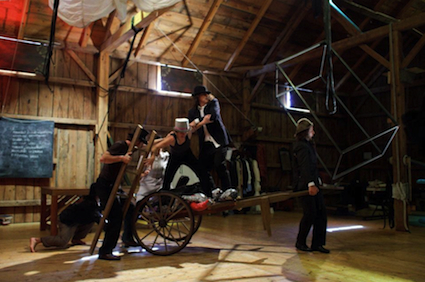
In our Readings series, we offer selections from visual and printed texts that offer perspectives, expand dialogues, and challenge assumptions. Today we feature the photography of Maria Baranova,  from Double Edge Theatre's rehearsals for The Grand Parade (of the Twentieth Century): "an original, multi-disciplinary piece of theatre" that imagines the life and art of Marc Chagall alongside the shifting cultural tides of the last century. The piece is directed by Stacy Klein, with music composed by Alexander Bakshi.
 
Alongside this work, we offer the closing paragraphs of Invisible Cities, the seminal story cycle by Italo Calvino consisting of a series of conversations between Marco Polo and Kublai Khan. Polo's ever-expanding descriptions of magical and diverse cities is revealed, by the close of the book, to be facets of a single place.

••••••••••

The Great Khan's atlas contains also the maps of the promised lands visited in thought but not yet discovered or founded: New Atlantis, Utopia, the City of the Sun, Oceana, TamoƩ, New Harmony, New Lanarck, Icaria.

Kublai asked Marco: "You, who go about exploring and who see signs, can tell me towards which of these futures the favouring winds are driving us." 


"For these ports I could not draw a route on the map or set a date for the landing. At times all I need is a brief glimpse, an opening in the midst of an incongruous landscape, a glint of lights in the fog, the dialogue of two passersby meeting in the crowd, and I think that, setting out from there, I will put together, piece by piece, the perfect city, made of fragments mixed with the rest, of instants separated by intervals, of signals one sends out, not knowing who receives them. If I tell you that the city towards which my journey tends is discontinuous in space and time, now scattered, now more condensed, you must not believe the search for it can stop. Perhaps while we speak, it is rising, scattered, within the confines of your empire; you can search for it, but only in the way I have said."


Already the Great Khan was leafing through his atlas, over the maps of the cities that menace in nightmares and maledictions: Enoch, Babylon, Yahooland, Butua, Brave New World. 


He said: "It is all useless, if the last landing-place can only be the infernal city, and it is there that, in ever-narrowing circles, the current is drawing us."


And Polo said: "The inferno of the living is not something that will be; if there is one, it is what is already here, the inferno where we live every day, that we form by being together. There are two ways to escape suffering it. The first is easy for many: accept the inferno and become such a part of it that you can no longer see it. The second is risky and demands constant vigilance and apprehension: seek and learn to recognise who and what, in the midst of the inferno, are not inferno, then make them endure, give them space."


Related Articles:

Wednesday, April 18, 2012

Readings: The Unreported Arts Recession of 1997 by Dudley Cocke

Dudley Cocke; Imagining America

In our Readings series, we offer selections from visual and printed texts that offer perspectives, expand dialogues, and challenge assumptions. Today we feature the opening paragraphs from "The Unreported Arts Recession of 1997" by Dudley Cocke, the Artistic Director of Roadside Theater at Appalshop

Please find the full text of this essay in Roadside Theater's Reading Room.

••••••••••

In the U.S. community-based arts field, the financial crisis did not occur in 2008, but in 1997. What happened then to those nonprofit arts organizations built for the majority of Americans is an unreported story, the consequences from which the field has not recovered.

The story of the 1997 arts recession begins in 1980 when the right wing, spurred on by Ronald Reagan's election, instigated a campaign to defame the National Endowment for the Arts. The ultimate goal was complete elimination of the federal agency established in 1965 by an act of Congress with the mandate to dedicate itself "to supporting excellence in the arts, both new and established; bringing the arts to all Americans; and providing leadership in arts education." The Reagan administration and Congress tried but failed several times in the 1980s to eliminate the NEA. Then in 1997 the agency's leader at the time, Jane Alexander, knuckled under to right wing political pressure, abolishing all of the NEA's more than a dozen discipline-based divisions (each of which had been armed with its own defense), installing in their place a few generic themes ("creation and presentation" is an example), and limiting organizations to one thematic application a year.


For the community-based arts field, the restriction to only one annual NEA application was especially problematic. Most progressive nonprofit arts organizations preferred competing for public money, because it was the people's tax money -- and they saw their work as public work. Consequently, the more developed community-based arts organizations were receiving support from multiple NEA programs. With the new single application rule, Appalshop, where I work, abruptly lost 90 percent of its federal arts funding, which represented 20 percent of its annual operating budget.

The 1997 restructuring of the NEA delivered a second punch: discipline-based knowledge and expertise -- which had been on a trajectory of becoming broader and deeper -- disappeared from the nonprofit arts discourse. A "dumbing-down" effect took hold. A good example of this regression is the limited opportunity the public now has to see new and experimental plays from different cultures and geographies -- a result of abolishing the NEA Presenting Program. Appalshop's theater wing, Roadside Theater, which I direct, lost 70 percent of its performance fee income with the collapse of the national touring market for new plays, which had been leveraged on NEA support for arts presenting as a discipline. Prior to 1997, Roadside had visited more than 1000 communities in 43 states, never failing to reach an audience reflective of the racial, economic, and cultural diversity of each host community.

••••••••••

"The Unreported Arts Recession of 1997" continues here, in The Roadside Theater Reading Room.

Saturday, April 7, 2012

Idiom and Assimilation: Miles Davis & C.D. Wright

John Coltrane, Cannonball Adderley, Miles Davis, and Bill Evans, recording in 1958

If there is any particular affinity I have for poetry associated with the South, it is with idiom. I credit hill people and African Americans for keeping the language distinct. Poetry should repulse assimilation. Each poet's task is to fight their own language's assimilation. Miles Davis said, "The symphony, man, they got seventy guys all playing one note." He also said, "Those dark Arkansas roads, that is the sound I am after." He had his own sound. He recommended we get ours.
      - C.D. Wright, Cooling Time: An American Poetry Vigil


Related Articles:
Rural Poetry Series: C.D. Wright