Showing posts with label rural diaspora. Show all posts

Monday, May 14, 2012

Farmer of the Future and Harvest Public Media

Photograph by Alison Rose; Forgotonia

This morning the excellent team of reporters and editors at Harvest Public Media began a series, entitled Farmer of the Future, that considers how "technological, cultural and political forces are bringing immense change to those people who commit to building their lives around the land." 

Kathleen Masterson offers the first dispatch, a report considering how the northwest region of Iowa, with its recent population growth and cultural diversity, presents both a model for the future and set of complex questions. Here is the transcript introduction to "Blending of Culture May be Blueprint for Growth:"
Sioux County, in northwest Iowa, is known for its Dutch pastries. The landscape is dotted with Lutheran and reform churches.  But today, Catholic churches and tortillerias are creeping into the landscape — signs of the new residents joining this vibrant community.

In Sioux County, as in a scattering of communities across the Midwest, Hispanic immigrants are working in meat processing plants, dairies, egg-laying facilities and hog barns. In fact, the majority of U.S. farm laborers today were born outside the U.S.

And while some parts of the rural Midwest are hollowing out, areas like Sioux County and its biggest city Sioux Center, are actually growing as immigrant populations move in to take jobs that otherwise employers cannot fill.

Sioux Center’s population has grown 17 percent and the county is up 7 percent over the last decade. Meanwhile, government figures indicate 91 of Iowa’s 99 counties have declined by about 9 percent over the last three decades.

No surprise, Sioux Center looks very different than many other rural communities in Iowa. But although this area may well offer a glimpse of the farming community of the future, the melding of cultures is not always easy.
Masterson continues in her piece to talk with folks from all sides of the Sioux Center community. We find that, for many farmers in the region, the rhetoric of immigrants "stealing American jobs" masks the pressing need for agricultural workers. Furthermore, these new residents are contributing to an expanding local economy, in contrast with other rural regions of the state.

Harvest Public Media also provides, embedded within Masterson's report, an interactive map illustrating the influx of hispanic immigrants within Iowa.

If we consider this news from Sioux Center alongside last week's "Readings" piece on Thomas Hardy's view from rural England -- as workers fled from the fields for industrial centers, in some cases to complete against English agriculture as newly-American farmers -- then we might see this news not as a political "hot-button" issue, but as part of a larger continuum, another element of a broader arc of international rural diaspora across the last two centuries.

Related Articles:

Wednesday, March 14, 2012

David Lee, Carolina Soul & The Paradise of Bachelors Record Label

David Lee with the Washington Sound record shop sign, in front of his storage trailer;  

[Editor's Note: As I am facing numerous writing deadlines, this seems like a good time to give a retrospective glance to the first two years of Art of the Rural. Over these weeks I will feature a few new articles, but also many favorites from the archives. Thanks again to everyone who has read and contributed; what began as a labor of love has become a project far larger, and far more rewarding, than I ever could have anticipated - and I deeply appreciate the readership and participation of such a diverse audience. Starting March 19th, we will offer new articles and share some new projects related to our mission.

David Lee's Carolina Soul was originally published on August 2, 2011.]

********** 

Long-time readers might remember our piece from last year on the Carolina Soul site and the Paradise of Bachelors record label. POB's first release, Said I Had A Vision: Songs & Labels of David Lee 1960 - 1988 was one of our absolute favorite records from 2010--and the release has continued to get some wonderful press, so I'd like to start off the week by sharing some of this information. If we've hit the summer doldrums (August), this record is the best antidote I can imagine. Paradise of Bachelors is now offering a limited edition LP repressing; folks can find the digital download at iTunes or Amazon Music

Here's "You've Been Gone Too Long" by Ann Sexton. As the liner notes explain, "the tune must make any list of curious, 'Jody' genre songs, for its reference to the archetypal male opportunist who, according to Vietnam-era folklore, would latch onto women whose husbands or boyfriends were serving overseas." 


While we are currently in a golden age of reissues and unearthed music, with more and more coming out each week, what sets Said I Had a Vision apart is its combination of context (rural North Carolina, from the civil rights era to the Reagan era), the  quality of its songwriting, and the absolute exuberance of the performances. Many such records have these qualities in unequal parts, but Said I Had A Vision contains songs that exceed the normal obscurity-fetish that similar records often cultivate. After I play this record through, I generally feel like everyone I know needs to hear these songs.

It should be no surprise, then, that the music press has embraced this record and the regional vision behind the Paradise of Bachelors label, which is co-curated by folklorists Jason Perlmutter and Brendan Greaves. I was excited to learn that Wax Poetics had featured Said I Had a Vision in a recent issue; here's Jon Kirby:
A man of faith, [David] Lee's output tended towards the spiritual. And although most benefit from Cleveland County's proximity to Charlotte's Arthur Smith and Reflection Studios, perhaps his most generous offering was recorded on location at Mice Creek Baptist Church, in nearby Gaffney, South Carolina. "On My Way Up" by the Relations Gospel Singers showcases the careening lead of Steve Allen, whose exorcism range leaves church-van tracks through a field of delicate piano and choral support, recalling the fly-on-the-wall intimacy of an Allan Lomax artifact. Much of Lee's color-blind songwriting was realized by the Constellations, a salt-and-pepper ensemble who, during Shelby's annual Art of Sound Festival last October, proved they could still do "The Frog," walking sticks in hand. "They were just like kids to us when they started," revealed wife Nelena of Lee's most allegiant act. "We was just like a big family, rolled up together." With the exception of "northern soul" curiosity Ann Sexton, most on Lee's short-but-sweet roster still reside in Cleveland County, like blue-eyed crooner Bill Allen from nearby Cherryville. "You probably drove past there!" exclaims Lee. "You should have hollered for Bill when you was coming through." 
Further write-ups on the resurgence of interest in Mr. Lee's work has appeared in Our State magazine and The Charlotte Observer. Earlier this year, Mr. Lee was awarded the Brown-Hudson award by the North Carolina Folklore Society, introduced by Mr. Perlmutter and Mr. Greaves. Afterwards, he gave a performance of "I Can't Believe You're Gone" and "I'll Never Get Over Losing You," the latter of which appears on Said I Had a Vision


Paradise of Bachelors will release an LP/download of new material emerging from the South this fall: Poor Moon by the much-loved and critically-acclaimed Hiss Golden Messenger. Also in the works is a release of new and remastered material by Willie French Lowery, a member of the Lumbee Tribe in North Carolina and who has worked previously with the psychedelic bands Plant & See and Lumbee. I'll include a sample of each artist below; you can also follow the latest Paradise of Bachelors news on their Facebook page.


Hiss Golden Messenger from Gianmarco Del Re on Vimeo.


**********

[Discovering Carolina Soul was originally published on September 23, 2010]

The former Washington Sound on Buffalo Street in Shelby, NC; from Carolina Soul

Throughout the sixties and seventies, at least one hundred African-American-owned R&B/Soul record stores thrived in the Carolinas. These retail shops, with their close links to recording studios and local record labels, were on the front lines not only of new musical ideas, but of the civil rights struggle itself. Today, this music's story is being told in a compelling fashion on the Carolina Soul blog/archive, which has spent the last five years locating and documenting the wide array of R&B/Soul music created in North and South Carolina--much of which has never been re-issued since its original release as 45 rpm records.

If you peruse Carolina Soul's extensive discography the material object of the vinyl record begins to stand as a symbol for a kind of rural-urban linkages that revolutionized the last half-century's artforms and its push toward social justice.  This effort to rediscover these recordings, and to tell the stories of these musicians and their communities, is led by Jason Perlmutter (a chemist and local music collector) and Jon Kirby (an associate editor at Wax Poetics). Mr. Perlmutter, in partnership with folklorist Brendan Greaves, has begun the Paradise of Bachelors record label and is currently pressing their first release -- a retrospective of the music released on David Lee's various record labels entitled Said I Had A Vision.

Mr. Lee, who currently resides in Mooresboro, ran the Impel, Washington Sound and SCOP (Soul, Country, Opera, Pop) labels and often contributed his own songs to his musicians. Carolina Soul recently visited Mr. Lee, and, earlier in the year, the folks behind this project spent time talking with some of the artists who worked with him. Here we see the The Constellations, both then and now:


Here, from the Paradise of Bachelors' blog, is a description of the ground-breaking work done by The Constellations:
We spent an illuminating and pleasant afternoon in Mooresboro, North Carolina with the Lees; Harold Allen, Don Camp, William “Butch” Mitchell, and Benjamin and Bryan “Brownie” Guest of the Constellations. Hearing these gentlemen’s stories about unflagging brotherhood, camaraderie, and the timelessness of “love ballads”–in the face of physical threats, racist invective, and a Southern and national climate opposed to their very existence–was truly inspiring. The Constellations were the first mixed-race combo in the area, and they did it as mere kids, getting started in 1958 or 1959 as teenagers and only dissolving upon the departure of members to Vietnam in 1964 and 1965.

In that time, they recorded six energetic sides for David Lee, all of which belie their tender ages, plus two unreleased tracks–”Have You Seen My Baby?” and “I Want to Jerk”–which Mr. Lee sent to Benjamin Guest while he was serving in Vietnam. Those tapes may yet emerge for your delectation…
We can only hope to that some of this music makes its way on to Carolina Soul or onto a newly-pressed piece of vinyl via Paradise of Bachelors.

As a closing note, for those who would like to hear these gentlemen put these songs into a more eloquent context than I can provide, please refer to their interview with Frank Stasio on NPR's The State of Things.

Friday, March 9, 2012

Abner Jay: The Last Southern Black Minstrel Show

Abner Jay, April 8, 1982, San Jose Flea Market; selection of a photo by Jon Sievert

[Editor's Note: As I am facing numerous writing deadlines, this seems like a good time to give a retrospective glance to the first two years of Art of the Rural. Over these weeks I will feature a few new articles, but also many favorites from the archives. Thanks again to everyone who has read and contributed; what began as a labor of love has become a project far larger, and far more rewarding, than I ever could have anticipated - and I deeply appreciate the readership and participation of such a diverse audience. Starting March 19th, we will offer new articles and share some new projects related to our mission.

Abner Jay: The Last Southern Black Minstrel Show was originally published on March 3, 2011.]
 
**********
 
In this post, and the previous post below, we're considering the life and music of Abner Jay--a figure whose art cuts across so many themes central to the American experience: race, class, regionalism, history, and place. Mississippi Records has just released Mr. Jay's final recordings, entitled Last Ole Minstrel Man.

I've heard from a number of folks in the two days since the previous post, readers who have been bowled over the emotion, creativity and cultural import of Mr. Jay's work. Today I'd like to share more information and links. Beyond that, the best thing to do is to sit down with his records, turn off the phone, and just listen.

Abner Jay was born in Fitzgerald, Georgia in 1921, into a family of sharecroppers. Though various internet sites tell the story slightly differently, Mr. Jay's grandfather--and perhaps his father--had been slaves. The legal terminology, however, is of less import than the realities of those early years of his life. Amoeba Records' blog offers a generous transcription (from the current release's liner notes) of Mr. Jay's own recollection of this time period:
"Abner was a slave sixty five years after the slaves were freed, because Abner grandpa and Pa love the slave life. Abner was hired out to white plantation owners when he was at the age of six. Abner worked as a slave side by side with his grandpa, a former slave. Abner could not and did not receive his pay until after he was twenty one years of age. Abner ate and slept in the barn with the mules. The White folk would hand his food out of the back door to him in a pan, mostly left overs and the food the white folk dogs wouldn't eat...

"Abner start singing on the public for the white plantation owner when he was eight. Abner start playing banjo at the age of ten, and became a one man band and bone player at the age of fourteen. Abner would play in the rich homes for the plantation owners when they wanted to entertain."
Mr. Jay later toured with minstrel and vaudeville shows, eventually striking out as a young man on his own--a one man band. Along the way he became friends with Muddy Waters, Chuck Berry, James Brown and, according to some sources, Elvis. He was also the agent and manager to the phenomenal gospel singer Sister Rosetta Tharpe. In the final decades of his life, Mr. Jay traveled from town to town in a mobile home that could convert into a performance stage

Again, Chris Campion so clearly articulates the many attributes of the sound that might surprise attendees of a local fair or flea market:
Jay finger-picked a bittersweet but heartfelt comic blues on a long-necked, six-string banjo that he said had been made in 1748. It had been passed down to him by his grandfather, Louis W Jay, born a slave and later to teach Abner many of the traditions he made it his mission to keep alive.

He was almost certainly the last living exponent of the 'bones' - a musical tradition that involved playing percussive rhythms using various cow and chicken bones that had been dried out and blanched in the sun. Jay claimed to have a repertoire of over 600 songs, which he sung in a bone-shaking basso profundo voice, the legacy of a battle with throat cancer that almost felled him in his twenties.
He would perform field songs, minstrel tunes and Pentecostal hymns interspersed with his own nuggets of homespun philosophy, off-colour yarns and side-splitting one-liners. 'What did Adam and Eve do in the Garden?' runs one. 'Eve wore a fig leaf... and Adam wore a damn hole in it.'

Jay's own compositions were decidedly secular in nature and found him musing on atypical themes such as depression, the Vietnam war and substance abuse. Titles include 'The Reason Why Young People Use Drugs' and 'The Backbone of America is a Mule and Cotton'. 'I crave cocaine,' he moaned during crowd favourite 'Cocaine Blues', exaggerating his diction for comic effect. 'But I can't find nothing here in Atlanta. Cos those hippies dun used it all up... I want sum'tin to pep me up!'
For more information,  The Down Home Radio Show features Eli Smith's interview with Eric Isaacson of Mississippi Records; the two discuss the label's release of The True Story of Abner Jay as well as the true story of the record label itself, which has become a faithful steward of many later Abner Jay re-issues.

Here's a rare gem: an excerpt from Mr. Jay's final performance at the 1993 Grassroots Festival in Trumansburg, New York. We see in this personal rendition of "St. James Infirmary Blues" what Mr. Isaacson means when he says that people called Abner Jay "the black Bob Dylan." Even more forcefully than Dylan, Abner Jay stood with one foot in a lost, folkloric America and the other in the ground of rock 'n' roll, radio, and television. The great achievement of his music is that these contradictions are fused together in ways that can be  both deeply-moving and profoundly unique.  

We learn that he passed away days later, on his way back home.


**********

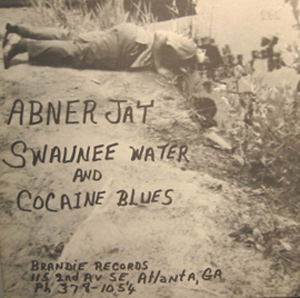
selection from the cover of Mississippi Records' recent Abner Jay release

Folk music is high class music--of course a lot of low class people singin' it. Matter of fact, most so-called folk singers don't even look like folk. Folk songs tell true stories, but terrible stories--'cause folk are terrible. Terrible songs make big songs. Why do you think kids like rock 'n' roll ? Because it's terrible. You think they're gonna listen to the Philadelphia Symphony, 101 Strings? Why do you think I like cocaine?

Tomorrow we will write more extensively about Abner Jay (1921-1996), a multifaceted musician and artist--and the self-proclaimed "last great Southern black minstrel show." His music (and his life story) was complicated and unconventional, but also singularly brilliant. 

Here Chris Campion of the Guardian writes of Mr. Jay:
Rather than cocaine, he used to claim that the secret of his eternal youth and vitality was lying on his belly drinking water scooped out of the Suwannee River in his home state of Georgia. And at least two of his albums (privately-pressed and released on his label Brandie, named after his wife) feature a photograph of him doing just that, along with the tracklisting, which he customarily scrawled over it in marker pen.

Jay was himself born near the source of one of the tributaries of the river in Irwin County, Georgia (in 1921). He started performing in medicine shows at the age of 5. In 1932 he moved on, to the Silas Green show, a travelling minstrel show and vaudeville revue that had also once employed Bessie Smith. Aged 14, he became a one-man band.
Enjoy these two selections from The True Story of Abner Jay, an earlier record re-released by Mississippi Records:


Friday, March 2, 2012

Bob Dylan's Direction Home

[Editor's Note: As I am facing numerous writing deadlines over the second half of February, this seems like a good time to give a retrospective glance to the first two years of Art of the Rural. Over these weeks I will feature a few new articles, but also many favorites from the archives. Thanks again to everyone who has read and contributed; what began as a labor of love has become a project far larger, and far more rewarding, than I ever could have anticipated - and I deeply appreciate the readership and participation of such a diverse audience. In March we will offer new articles and series, and share some new projects related to our mission.

Bob Dylan's Direction Home was originally published on January 25, 2011. His summer tour did not travel through Minnesota.]

**********
City’s just a jungle, more games to play
Trapped in the heart of it, trying to get away.
I was raised in the country, I been working in the town
I been in trouble ever since I set my suitcase down.
     --from "Mississippi"

Last week Aaron, a reader from Ohio, passed along some very interesting news. It appears that Duluth, Minnesota, Bob Dylan's birthplace, is actively working to bring back their estranged native son for a concert on his 70th birthday. The news of these plans has been documented in forums on the encyclopedic Dylan resource Expecting Rain, and was confirmed last month in the Duluth News Tribune, where John Ziegler reported that city officials are currently in talks with Dylan and his management to bring him back to Minnesota on or around his May 24th birthday. 

As with all things Bob Dylan, this story contains a good deal of rumor and apocrypha. For instance, I heard that the small mining town of Hibbing, Minnesota, Dylan's hometown, had originally sought to welcome the musician back on his 70th birthday (Aaron tells me that Dylan last visited for his ten-year high school reunion, where he was roundly ignored by his former classmates), yet Mr. Ziegler reports that Duluth had extended their invitation a full year ahead of schedule, contacting him on his 69th birthday. Regardless, if Dylan accepts this invitation we will see a great deal of media attention focused on his rural Minnesota roots. While there may be a nostalgic whiff to such reflections, it is significant to think of Dylan-the-70-year-old back in Minnesota, over four decades after he recorded his generation-defining howl of "no direction home".

If we put that song--and the long-view of Dylan's legacy--in perspective, then what could also come out of such a birthday in Minnesota could be a reappraisal of a whole generation's relationship to rural place. While Dylan did his best to shirk his "voice of a generation" status, it's clear that his life narrative, captured so eloquently in "Mississippi," is representative of many of his fellow baby boomers: that first wave of the "rural-brain drain," many of whom would later take part in the flight out of America's urban centers and into a suburban life where rolling stones meet their cul-de-sac. 

However, Dylan's last handful of records have embraced the traditional forms of blues and country music just as baby boomers are returning to facets of their own rural upbringing. While the local and organic food phenomenon is part and parcel of this generational trend, many are realizing (as Wendell Berry did so many years ago, in his essay "A Native Hill")  that you can go home again. In my own home region this has been occurring for a few years, as baby-boomers begin to form organizations to preserve our small Ohio Valley town--and to hopefully bring it back to some semblance of its former self. 

Beyond this, the issue becomes one of what "homecoming" means, and how the rural diaspora negotiates this return. As this teenager's video from Hibbing suggests, life never stopped in these communities, and those who stayed both welcome and resent the influence of those who left.

We'll be following the events surrounding this birthday concert; until then, here's a short video produced by the University of Minnesota in conjunction with the UM Press's release of Highway 61 Revisited: Bob Dylan's Road from Minnesota to the World, edited by Colleen J. Sheehy and Thomas Swiss:

Thursday, March 1, 2012

Rural International: Luk Thung & Thai Country Music

The album cover for Luk Thung; Dust-to-Digital

[Editor's Note: As I am facing numerous writing deadlines over the second half of February, this seems like a good time to give a retrospective glance to the first two years of Art of the Rural. Over these weeks I will feature a few new articles, but also many favorites from the archives. Thanks again to everyone who has read and contributed; what began as a labor of love has become a project far larger, and far more rewarding, than I ever could have anticipated - and I deeply appreciate the readership and participation of such a diverse audience. In March we will offer new articles and series, and share some new projects related to our mission.

Rural International: Luk Thung & Thai Country Music was originally published on September 10, 2011.]

**********

A few weeks back, I began an unofficial series of pieces that look to expand what we talk about when we talk about the rural, and today I'd like to discuss a recording that can challenge us to rethink our own categories and boundaries when it comes to rural arts and culture. 

Luk Thung: Classic & Obscure 78s from the Thai Countryside is one of the latest releases from Dust-to-Digital, a record label that has, for over a decade, consistently produced some of the most thorough and thought-provoking reissues of vernacular music and visual art--everything from the southern gospel of their landmark Goodbye, Babylon set to the forthcoming Opika Pende: Africa at 78 RPM, a multi-disc package featuring diverse pan-African music that has never been released on CD. Luk Thung is one of the productions of the "phonographic arm" of Dust-to-Digital, Parlortone, though this music is also available for download. Luk Thung was compiled by record collector David Murray (see his Haji Maji music blog) and the notes were written by Peter Doolan of the Monrakplengthai Thai vernacular music site.

Many of our readers are no doubt familiar with the work of Dust-to-Digital; as both a record label and a kind of cultural sensibility, Lance Ledbetter's project has not only served as a catalyst for the thriving reissue movement, but has pushed an audience to reconsider the deeper dynamics of a place and its people. 

Luk Thung continues in this direction, and provides an opportunity for many of us to expand our own deeper narrative of the rural arts. While many discussions of rural culture fail to consider the role of the rural diaspora, I cannot think of many instances where we've thought of this geographical movement--from the Great Migration to the farm crisis of the 1980s--in an international context. Luk Thung provides such an opportunity. 

Here's Peter Doolan, editor of the Monrakplengthai music site, writing in the introduction to his liner notes:
Luk Thung is known to many as Thailand's "Country Music"; it's a vibrant and syncretic genre of pop song which aims to give voice to a disenfranchised rural population. Its history is intextricably linked to that of the nation at large, and it continues to provide a soundtrack to the political turmoil that abounds in today's Thailand. Despite its commercial nature and its roots in imported music, Luk Thung's use of local Thai melody, instrumentation, rhythm and vocal styling leads many casual listeners to mistake it for a sort of folk music. In any case, Luk Thung may indeed be filling the social gap left by a slowly vanishing traditional culture. 
The term Luk Thung itself, meaning "Children of the Fields," refers to people of rural background, as opposed to Luk Krung, those born and bred in the city. Bangkok, the capitol of the Kingdom of Thailand, is a massive metropolis disproportionate to the rest of the country, and is, without rival, its political, economic and cultural center. The majority of Thailand's population, however, lives in the provinces outside of Bangkok, as has been the case for millenia. But in the 20th century, spurred by the nation's increasing status as a global commercial power, the capitol began to attract significant movement in from the provinces. By mid-century, a steady stream of migrants were making their way into Bangkok, with most joining an urban underclass of menial laborers, pedicab drivers, market vendors or slum dwellers. Some settled permanently in the city, some came and went with the seasons, but all had to cope with enormous changes in their lives. Music became a vital means of maintaining a feeling of connectedness to the world they were leaving.
As Mr. Doolan tells us in his extensive notes, this rural diaspora first met a state-controlled mass media that privileged western culture (everything from dress to dining utensils) and denigrated traditional Thai practices. After World War II, these forms of expression were re-integrated, as pop music blossomed into a complex and kinetic exchange of idioms, instruments, and experiences; in balancing these various sources and influences, these artists created what I've called before a kind of "rural modernism." Consider the breadth of expression Luk Thung incorporated: "Liké street theatre, antiphonal Lamtat field songs, and Klong Yao long-drum troupes," Mr. Doolan writes. "A particular interest was kindled in songs from Isan, the impoverished and drought-stricken Northeast...singers integrated both Isan's Thet Lae preaching style and Lam Klon poetic form into their performances, and many even began including words from Isan's distinct dialect in their lyrics."

From Peter Doolan's extraordinarily helpful notes we see that these musicians were working in a vein not at all that stylistically different than James Joyce or T.S. Eliot, or any of the modernist painters who incorporated a wildly divergent range of materials and images. Further, the span of Luk Thung runs the American timeline from the Great Migration to today, and from the explosion of folk, blues, country and rock music--all fueled in large part by what a rural diaspora brought with them to the city and its airwaves and recording studios. 

Here's Phloen Phromdaen singing "Ruedu Haeng Khwam Rak (Season of Love)." Mr. Phromdaen, who grew up on his family's farm along the border with Cambodia, first encountered Luk Thung on the radio and saved his money to make his own recordings. A rise to stardom followed and was punctuated, Mr. Doolan tells, by his 1966 hit "Chom Thung (In Praise of the Fields)." Phloen Phromdaen is still singing today.


Mr. Phromdaen went on in his career to create a variant of Luk Thung called Pleng Phut, or "talking music," a development which seems to suggest, if we are thinking in terms of a rural diaspora, a comparison with Johnny Cash, or Elvis, or Muddy Waters or any number of other musicians. As Mr. Doolan writes, these musicians attained a level of stardom in their home country commiserate with the likes of their American counterparts. Given the cultural and political backdrop to Luk Thung, we find many similarities to the social commentary within the language of American folk, blues and country--even to the rebellious use of identity and dialect in "hard country," as discussed by Barbara Ching in her essential book-length study Wrong's What I Do Best.

Lastly, what such a vibrant release as Luk Thung can stir in us is the thought that, even within our own home borders, we may live near folks who most likely identify on one level or another as members of a more distant "rural diaspora," be it from Thailand, Mexico, Somalia or elsewhere. We do a disservice to these members of our community--and to ourselves--when we leave them out of a discussion on rural America.

Thursday, February 9, 2012

The Rural America Contemporary Artists: Making Nowhere into Somewhere, Making A Statement

from the Recalcitrant Mimesis installation at the David B. Smith Gallery, Denver; Liz Miller

[Today we are excited to present Brian Frink's curator's statement to the Rural America Contemporary Art show alongside work from the artists included in this exhibit. Please visit the RACA Facebook group for more information, as well as the artist's sites, where larger, high-resolution images are available for viewing.]

Rural America Contemporary Art (RACA) started as a Facebook group.  The idea was to create a forum, a virtual place, where rural artists could connect, share work and promote their various activities.  The name of the group implies a certain irony.  The words “contemporary” and “rural” are not always seen as equivalent concepts.  For a long time progressive ideas moved from urban areas to rural areas.  In early and mid-twentieth century America the term “regionalism” was applied to artists that did not live in urban centers such as New York City.  For many artists the term was a disparaging label.   It usually meant, “behind the times.” 

Archival Structure Five installation, 4Real4Faux exhibit, Truman State University; David Hamlow

Population density in urban areas contributed to this.  More people living in close proximity promoted a rapid exchange of ideas, attitudes, styles and fashions.  The result was innovation based on the mutations these exchanges fostered.  Rural areas are less dense having less frequent random interactions.  So the classic model of innovation in visual art is, progressive ideas form in urban centers of culture then migrate out to rural communities.


Corpus Corvus Corrallary, cast iron, scale model accessories, scenery and pigment; Karl Unnasch

More recently economics, population growth and the advancement of university art education have brought many serious artists to live in rural communities.  The cost of setting up a studio in urban areas has become prohibitive.  The numbers of individuals who define themselves as artists has exploded.  University art departments are now prevalent in even the smallest rural community across America.  These factors have contributed to the incredible growth of rural contemporary art.

Blazer, pencil on paper, 22" x 30"; Brian Frink

Yet, culturally speaking, we still function under the old notion that progressive innovation comes from urban areas migrating outward to rural communities. 

I believe the web and social media has changed this dynamic. 

furnace (first painting of the year), acrylic on panel, 36"  x 24"; Benjamin Gardner

I would like to propose that social media platforms like Facebook allows for a level of interaction and cross-pollination of ideas that might be similar to living in an urban environment.   Trends or theories that in previous generations would have taken years to migrate are now accessed instantly.  For an artist living in relative isolation, there is power in this new dynamic. 

prelude to a claptrap/prussian field, oil on birch, 61" x 97"; Andrew Nordin

These contributing factors may be creating a new paradigm.  A new paradigm where the previous model no longer applies.  Progressive, contemporary ideas, trends and fashions can now move from rural to urban areas.  Artists can live in rural areas and still be progressive and innovative.
    
Seeking Shelter lightbox 23" x 33"; Erik Waterkotte

RACA’s slogan is “Making nowhere into somewhere.”  Of course this motto is also a wry commentary on the fact that those who live in rural America already know it is “somewhere.” So part of the RACA mission is to connect, highlight and validate the immense community of artists that has always sought the solace, inspiration and beauty of rural America.  It is also RACA’s mission to assert that the art made by rural artists is relevant.


held within what hung open and made to lie without escape installation; Gregory Euclide

This first exhibition, curated by the Institute for Rural America Contemporary Art, exemplifies what is going on in our tiny corner of rural America.  The artists collected here are not just creating work that echoes what they see in New York or Los Angeles.  These artists struggle to make highly original and innovative work.  They view themselves as equal voices with their urban peers.  Cognizant and dynamic, their work speculates on the paradoxical nature of life in twenty-first century America.  These artists are Rural America Contemporary Art.   

Brian Frink
Institute for Rural America Contemporary Art


Horizon/Marks #2, mixed media on paper; Lisa Bergh

Tuesday, January 10, 2012

What's The Matter With Iowa: The Oxford Project

Ben Stoker photographed in The Oxford Project; Peter Feldstein 

I love you all. I love Oxford. And I’ll never leave — except in a box.
     - Peter Feldstein, speaking at the book launch for The Oxford Project

While Stephen Bloom's article in The Atlantic, "Observations from 20 years of Iowa Life" has since brought the state into an uproar, sent the professor into hiding, and placed, at the very least, his good standing at the University of Iowa in question, there's a less-reported cause for sadness beneath all of this - and it concerns the small town of Oxford, Iowa.

In 2008 Mr. Bloom contributed interviews to The Oxford Project, a stunning series of photographic portraits by Peter Feldstein that capture the lives of nearly every resident in town on two separate occasions in 1984 and 2004. Mr. Feldstein moved to Oxford in the late 1970's and has since become part of the fabric of the community.

Both the book and exhibition received rave reviews, for what The Washington Post called the glimpse of a people "paired with themselves in an eerie and beautiful reckoning with the past." To complement the intimacy of Mr. Feldstein's work, Stephen Bloom interviewed each subject at length, letting these citizens tell their own stories of their lives and their community. 

Here's the two artists in conversation with Josh Landis of CBS Sunday Morning

Considering the way citizens of Oxford must have let Stephen Bloom into their lives only makes the controversy surrounding his article more tragic. Placed alongside The Oxford Project, "Observations from 20 Years of Iowa Life" comes across as a cavalier and self-serving monologue, a hollow caricature of a far more complex picture.

Certainly no one would understand this better than Peter Feldstein, who has written one of the most powerful rebuttals, published recently in The Des Moines Register. I'll include a few short excerpts alongside a few of his photographs; please visit The Oxford Project and Peter Feldstein's site for larger high-resolution images :

Calvin Colony
I don't know what happened to Bloom between the making of “The Oxford Project” and his online article. What happened to the grit and strength of people attempting to survive the hardships that life presents them?

Hunter Tandy
What happened to the intelligence of people like Oxford’s Kathy Tandy, the wonderful sense of humor of people like Jim Jiras, the generosity of so many of my neighbors like Tonya Stratton Wehrle, the experiences of people who’ve suffered unspeakable horrors like Jim Hoyt and his son, Jim Jr., and the difficult life transitions met with great perseverance by people like Ben and Robin Stoker and grandparents Kathy and Darrell Lindley? What about the incredible and real family values of the Cox, Hennes, Stratton and Stockman families?

Brianne Leckness

Jim Hoyt, Jr.

Friday, January 6, 2012

The Weekly Feed: January Sixth

Sandhill Crane; Dugald Stermer, Los Angeles Times

Here's a partial list of the articles and links we've shared on our Rural Arts and Culture Feed on Facebook while we have been offline for the holidays and for holiday travel. We hope everyone has enjoyed their first week of the new year.

• The Los Angeles Times (as seen above) recently reprinted a number of field guide illustrations by Dugald Stermer, who passed away last month. This is an under-appreciated art form, and one we don't normally put under the wide umbrella of the rural arts, yet these illustrations make perfect sense alongside The Almanac For Moderns or the poetry of Lorine Niedecker.

• 2012 marks the centennial of Woody Guthrie's birth. The Woody Guthrie Centennial Celebration site contains all the information and links to a wide array of events, recordings and publications to mark this birthday. We'll have more information on these festivities as the year progresses.

• We've mentioned on numerous occasions the forthcoming film The Winding Stream: The Carters, The Cashes, And The Course of Country Music - and we were delighted to see this clip of a Carter-inspired song circle that crosses rural-urban lines:


• 2011 was a landmark year for the music and legacy of John Fahey. In the autumn Dust-to-Digital released Your Past Comes Back To Haunt You: The Fonotone Years [1958-1965] to wide critical acclaim, and Fahey's friend and collaborator Glenn Jones (who edited Your Past) released a The Wanting, a solo guitar record that also met with a warm and enthusiastic reception. On New Year's Eve we posted Fahey's later interpretation of "Auld Lang Syne," but here, instead, is a cut from the Fonotone years, with some vocals as well, followed by Jones's "Of It's Own Kind:"


• In thinking about the rural-urban migrations that shaped the modern blues, Howard Reich of The Chicago Tribune recently asked "Is This The Twilight Of Blues Music?"

The Boiled Down Juice has offered a series of diverse pieces recently on Ozark New Year's cuisine, urban farming, and the work of Jimmy Santiago Baco: the poet and advocate for the arts within the prison system.

• Knife-making is another under-appreciated art form, but thanks are due to Rural Missouri Magazine for producing this excellent video on the process and the products of such work. Kyle Spradley also contributes an article from the Ozark Knife Makers classes.


• From an Bedouin village to international literary fame, Egyptian novelist Miral al-Tahawy's story touches on a number of rural-international and rural-urban narratives. Abdalla F. Hassan writes in The New York Times of her journey and her most recent work Brooklyn Heights.

• We were excited to see that Stephanie Ash of mnartists.org recently offered a review of the Rural America Contemporary Artists exhibit. We are going to work in 2012 to focus in-depth on these artists, so please stay tuned. Here's RACA organizer Brian Frink's "Winston," a rural-contemporary complement to the work of Dugald Stermer above:


Friday, October 14, 2011

2011 BIG FEED: A Series Of Links

In anticipation of this weekend's BIG FEED, I'd like to print a series of links related to my rural arts and culture presentation. Many thanks to the M12 for the opportunity to visit Yuma and share the work of The Art of Rural; for folks in attendance, and perhaps even for those just looking to browse some links, I offer this distillation of the artists and organizations mentioned in my talk. With so much extraordinary work out there in the contemporary rural arts, I would like to stress that these links come together as a narrative of shared values and sensibilities, not a definitive "best of."  Please visit our Rural Arts Links page for much more information on the range of artists and organizations at work right now in rural (and urban) America.

M12: Open Space: Derek Grubaugh and Lindsay Kotovsky, in collaboration with Kirsten Stoltz and Vincent Family Farms

Jay-Z and Alan Lomax: Ethan Hein's Music, Technology, Evolution blog 

Dust-to-Digital and Goodbye, Babylon 

Alan Lomax's Southern Journey series and Fred McDowell: The Alan Lomax Recordings 

Nathan Salsburg's Root Hog Or Die 

Ishilan n-Tenere 

Crystal Bridges Museum of American Art

Rural Studio 

Bob Arnold and Longhouse Press 

Lorine Niedecker

The Winding Stream

Don't Forget this Song:David Lasky & Frank Young's comic book project

The Carter Family Project

Where Soldiers Come From

Last of the Pagan Babies

Double Edge Theatre 

North Carolina Farmer Voices

Farmer-Veteran Coalition

The Lexicon of Sustainability

The Art of Regional Change

Appalachia Rising

Southern Foodways Alliance

Western Folklife Center

National Cowboy Poetry Gathering

Deep West Documentaries

Appalshop

Thousand Kites

Roadside Theater

Chris Sauter

Jetsonorama

Thornton Dial
 
Chris Verene

The Quilt Index

Maine Indian Basketmakers Alliance

Amy Stein

David Lundahl

Richard Saxton

M12: The Ornitarium