Monday, February 28, 2011

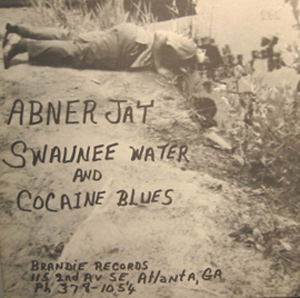
Abner Jay: "I'm So Depressed" & "Cocaine Blues"

selection from the cover of Mississippi Records' recent Abner Jay release

Folk music is high class music--of course a lot of low class people singin' it. Matter of fact, most so-called folk singers don't even look like folk. Folk songs tell true stories, but terrible stories--'cause folk are terrible. Terrible songs make big songs. Why do you think kids like rock 'n' roll ? Because it's terrible. You think they're gonna listen to the Philadelphia Symphony, 101 Strings? Why do you think I like cocaine?

Tomorrow we will write more extensively about Abner Jay (1921-1996), a multifaceted musician and artist--and the self-proclaimed "last great Southern black minstrel show." His music (and his life story) was complicated and unconventional, but also singularly brilliant. 

Here Chris Campion of the Guardian writes of Mr. Jay:
Rather than cocaine, he used to claim that the secret of his eternal youth and vitality was lying on his belly drinking water scooped out of the Suwannee River in his home state of Georgia. And at least two of his albums (privately-pressed and released on his label Brandie, named after his wife) feature a photograph of him doing just that, along with the tracklisting, which he customarily scrawled over it in marker pen.

Jay was himself born near the source of one of the tributaries of the river in Irwin County, Georgia (in 1921). He started performing in medicine shows at the age of 5. In 1932 he moved on, to the Silas Green show, a travelling minstrel show and vaudeville revue that had also once employed Bessie Smith. Aged 14, he became a one-man band.
Enjoy these two selections from The True Story of Abner Jay, an earlier record re-released by Mississippi Records:


Thursday, February 24, 2011

Bred and Buttered: Ozark Women On Screen

film still from Winter's Bone

By Rachel Reynolds Luster, Rural Correspondent

The 83rd Academy Awards will be aired live this Sunday. I’m thankful the one station that we get via our digital converter box at our home in the land that straddles the Missouri and Arkansas line will be carrying the event live. For the first time in my life, I find two pictures nominated for Best Picture that are intimately connected with the rural identity of which I am a student and a share-holder.

True Grit is a film set mainly in Arkansas and the Oklahoma territory. Joel and Ethan Coen adapted Arkansas author Charles Portis’ work, which was originally developed as a serial for the Saturday Evening Post in 1968. At the time, Portis was a reporter for the Arkansas Gazette, the big state newspaper, and the eventual novel and subsequent films depict a somewhat mythic tale of a young headstrong 14-year-old who sets out to avenge her father’s death by employing a renegade U. S. Marshall, Rooster Cogburn, to hunt down the killer, Tom Cheney, and bring him to stand trial and likely hang in Fort Smith, Arkansas. The plucky Mattie Ross insists on accompanying Cogburn, and the drama ensues into the western reaches of the Ouachita Mountains.


Winter’s Bone carries a similar sort of wilderness tale but is set in a modern time frame and entirely in the Missouri Ozarks. The film is based on the 2006 hillbilly noir book of the same title by West Plains, Missouri writer Daniel Woodrell. It follows Ree Dolly as she searches for her father Jessup, who has missed a court date leaving the family home in jeopardy as he listed it as collateral with his bail bondsman. The film explores the culture of the methamphetamine epidemic, which has become the darker side of the fabric of rural life in America.

While the two films offer interesting takes on rural life in two very different time periods, they share one representation, which seems constant over time and space: the depiction of rural women as headstrong, steadfast, able, and self-reliant. Both films offer classic examples of the somewhat romanticized portraits of rural women. The lead female character in each is an intrepid teenager who bravely sets out to simply do what needs to be done. In the case of Mattie Ross, she not only has gone to take care of the business associated with laying her father to rest but also finds it necessary to avenge his murder. For Ree Dolly, she has taken charge of her household including her emotionally and physically disabled mother and two younger siblings in the absence of her father and sets out to find him, dead or alive, to ensure that the family can simply keep a roof over their heads.

One of the most interesting aspects of the representation of women in these two films is the characters’ youth. While self-reliance, even stubbornness, might be prized or expected from mountain women, it is generally not expected from young women, rather it’s more associated with older generations. Certainly in True Grit the impetuous nature of 14-year-old Mattie plays a role in her quest. There is sort of a blind bravery, which seems emblematic of her slight age. The character of Ree Dolly, however, is 17, and one gets the sense that she has had to live as an adult, if not the head of household, for some time and that it hasn’t been easy. She is wise beyond her years. When Ree sets off to find her father, and as she negotiates the violent nature or her journey, she is obviously aware of what faces her. Yet, she persistently endures, which not only brings her answers and proof of the location of her father that she desires, but, in the end, also brings respect from the violent clutch who have been both responsible for the fate of her father and the survival of Ree. While both characters carry strong examples of the self-reliance associated with mountain women, neither Mattie nor Ree are the stereotypical granny woman. They, like true rural women, are far more complicated.

Claudia Gammill, age 89; from Southern Spaces and University of Central Arkansas Archives

I can’t help but think that living a rural life or being from the country continues to gain cache. Just looking at the current zeitgeist of slowness that is seeping into the mainstream, I feel more and more pride in my rural roots than ever. People from urban and suburban areas are flocking to the country to grow and produce something for themselves and live at a slower pace. This, in itself, is not a new phenomenon but it seems that, with this last economic crisis, mainstream book publishers and media outlets have been willing, if not eager, to offer up various vignettes of rural life, which have, for the most part, been positive. Now if we can just encourage those from rural areas to find their places as cool as the folks at Simon and Shuster or the Academy of Motion Picture Arts and Sciences, we’ll really be on to something good.

Frankly, I’ve heard a lot of talk from Ozarkers about how “authentic” the depiction of the region is in Winter’s Bone, and, I don’t really get that. Certainly, meth is a problem here as it is in many other rural (and urban) areas across the country, but none of the people that I’ve heard speak to the film’s authenticity are immersed, or even familiar with the drug culture of here or anyplace else. Certainly, the film is not my Ozarks or the way I view my neighbors. What I do take away from both films as authentic and a source of pride is that rural life, and the ties to the land that dictate and inspire it, have shaped the characters of Ree Dolly and Mattie Ross. These two young women are audacious and unapologetically so. They do what needs to be done. They are self-reliant, “bred and buttered” to quote Ree Dolly.

Such intrepidity is commonly considered a regional characteristic of women from the MOARK hinterlands and one which evokes great reverence among many residents. Self-reliance is a not only a source of regional pride among many but also is engrained within the cultural milieu of rural life in Arkansas and Missouri. Of course, self-reliance means different things to different folks, and I do not mean to imply that there is some sort of consensus on what it means to be a “good” woman in the hills and mountains of Arkansas and Missouri. However, I think that when women, especially, talk of other women from previous generations in their families or communities, those attributes that seem to hold the most worth hinge on all of the things both practical and sentimental that these cultural ancestors did for themselves and the ones they loved. At the same time, I know many an Ozark woman that doesn’t remember what she did before boxed cake mixes, or that prefers to shop rather than to garden, and there are plenty of us that are afraid of snakes and/or hate bugs, especially chiggers. We don’t all hunt or shoot guns, but a lot of us can manage to do what needs to be done, especially in regard to providing safety and comfort to family and friends. The characters of Mattie and Ree are representative of Arkansas’s and Missouri’s rural women in that respect.

I’ll be watching on Sunday and keeping my fingers crossed that one of these fine films takes home the big prize. I’m not sure who I’m rooting for, Mattie or Ree, probably Ree because I also like a good underdog, and Winter’s Bone, while quite brilliant, has some steep competition.

Wednesday, February 23, 2011

Welcome to Hollyrural: Notes Before The Oscars

"Dale Dickey and Jennifer Lawrence shooting Winter's Bone,"  Sebastian Mlynarski

This Sunday millions of viewers around the world will watch the Academy Awards. For the first time in a few years, the "Best Picture" category contains two films with rural roots: Winter's Bone and True Grit. Later this week we will have the chance to hear from Rural Correspondent (and Ozark native) Rachel Reynolds Luster--an artist, musician, and graduate student in Heritage Studies. Ahead of hearing her perspective on these two films, we'd like to offer a list of articles and commentaries that we've recently read. Placed together, we see how both mainstream media outlets and rural writers and critics are considering this recent flowering of rural-themed cinema.

We'll begin with the writing of Lisa Pruitt, a UC-Davis law professor and editor of the excellent Legal Ruralism blog. She has written a number of insightful commentaries on the issues of race, class and gender tangled up in Hollywood's images of rural culture. In "Winter's Bone and the Limits of White Privilege," Dr. Pruitt critiques the intersections of pastoral imagery and the problematic idea of "white trash;" here are two excerpts:
Indeed, one of the very interesting things about reading NYT readers' responses to "Winter's Bone" and its review is the extent to which those from major metro areas — say New York and Toronto--criticized the film maker for the lack of reality and the way she maligned the place by showing junk cars and dogs in people's yards. Film goers and readers from the Ozarks, however, generally agreed that the film was quite authentic in its depiction of people and place, though several of them pointed out that it showed only a particular stratum of that society. These differing views make me wonder if urbanites want to believe that rural life couldn’t be that bad? If they are clinging nostalgically to bucolic rural myths?

.....

So what can we take away from Winter’s Bone regarding white privilege? I see Ree’s life as a reminder that when you get “down” to a certain socioeconomic stratum, there is precious little privilege or material benefit associated with being white. (I’m thinking the film “Monster” also illustrates this point). Another way of stating this is that disadvantages associated with class (e.g., bias against “white trash”) and geography (e.g., scarcity of jobs and opportunities) seriously undermine the white privilege that Ree might enjoy in other settings.
The Center For Rural Affairs and The Daily Yonder each linked to "It's Cool To Be Country" by Adam Tschorn of the Los Angeles Times. Aside from a focus on True Grit, the article offers a wide catalogue of the ways that rural arts and culture are currently being enjoyed in the urban mainstream--through fashion, television, and popular country music icons such as Taylor Swift or Gwyneth Paltrow's Country Strong character:
Even the recent fall/winter menswear runway shows in Milan and Paris found luxury brand collections taking inspiration from both the modern-day Amish (at Louis Vuitton) and the early settlers of the American West (at Dsquared2). Moonshine has become as trendy as absinthe. Canning and raising chickens have become hipster hobbies. And one of the most popular time-wasters on Facebook — played by nearly 55 million people this month alone — is a faux-farmstead game that has people harvesting virtual crops and tending to virtual livestock.
Lisa Pruitt, in "The Popularity of 'True Grit' as a Reflection of Nostalgia for the Rural?" considers a recent provocative editoral by Frank Rich in The New York Times (comparing True Grit and The Social Network) that considers rural space as a mutually-agreeable site for escapism on both sides of the culture war.  To boot, Dr. Pruitt finds in Mattie Ross a parallel to a public images of many of our country's most successful female politicians, from Ann Richards all the way forward to Sarah Palin. She quotes here from Rebecca Traister's "Only Cowgirls Run for Office", originally published in The New York Times Magazine:
What we do have, to serve as the foundational fantasy of female strength and individualism we’ve agreed upon as embodying American power, are cowgirls: Annie Oakley, Calamity Jane, the outlaws, frontier women and pioneers who pushed West, shot sharp, talked tough and sometimes drew blood. Frontier womanhood has emerged as one of the only historically American models of aspirational femininity available to girls — passive princesses and graceful ballerinas not being native to this land — and one of the only blueprints for commanding female comportment in which they are regularly encouraged to invest or to mimic.
The Daily Yonder also published "And The Oscar Ought To Go To..." by Douglas Burns. He makes a compelling argument for Jennifer Lawrence's portrayal of Ree Dolly, and for the ways in which such characters rarely surface in popular cinema:
Poverty in America is often given an urban black face. It’s a stereotype, also visible in any metro area, from Des Moines and Omaha, to Chicago and New York City.

Rural white poverty is very much alive and well, too, although not always easy to spot, as it hides around the mountain or off a country road, in an apparently abandoned trailer that is, surprisingly, a home.
Missy Shelton followed this "country road," reporting on the local response to the Oscar nominations for Winter's Bone for NPR's Morning Edition last week.
"I hope you heard the hillbillies screaming," laughs Beth Domann, one of the local actors featured in the movie, "because it started early. I think everybody's real excited about it."
As a closing link, Rachel Reynolds Luster has recommended this in-depth video interview from Cinema Blend with director Debra Granik; we can hear many of the questions and concerns raised by these previous links addressed by the woman who brought Winter's Bone to life. 

Here are the trailers for each film. The 83rd Academy Awards will be broadcast this Sunday evening on ABC.


Tuesday, February 22, 2011

Rural Poetry Series: Lorine Niedecker

photograph by Bonnie Roub; from the Electronic Poetry Center

The Brontës had their moors, I have my marshes.

Two weeks ago we featured the first of a series of "calendar poems" composed by Lorine Niedecker (1903-1970), a poet from Blackhawk Island, Wisconsin. With the exception of a brief sojourn in New York City in her youth and a move to Milwaukee toward the end of her life, Ms. Niedecker spent the span of her days living, working, and writing along the banks of her native fishing community.

At a moment when American poets increasingly found themselves supported by universities, Ms. Niedecker chose to remain near Blackhawk Island and the neighboring town of Fort Atkinson; she took whatever work the local economy offered: proofreader, cleaning woman, librarian.  Her poetry appeared sporadically throughout her life, despite the support of contemporary figures the likes of William Carlos Williams, Basil Bunting, and Louis Zukofsky--her former lover.

Like the school of Objectivism advocated by Zukofsky, Niedecker treated the poem as an object all to itself, a structure which, in whole, could communicate with precision. As evidenced by the poems below, Niedecker added a local element as well as a gender perspective that enriched the work of these like-minded poets navigating the legacy of modernism. While we find in these poems an adherence to Williams's dictum "no ideas but in things," we also see here another use of "the vernacular," as a rural expertise and a local language is brought to bear on this avant-garde poetics. The results are profoundly, movingly, different than her contemporaries' work:

[Untitled]
Remember my little granite pail? 
The handle of it was blue. 
Think what's got away in my life- 
Was enough to carry me thru.
 
 Poet's Work 
 Grandfather
  advised me:
        Learn a trade
I learned
  to sit at desk
        and condense
No layoff
  from this
        condensery 
 
[Untitled] 
In the great snowfall before the bomb
colored yule tree lights
windows, the only glow for contemplation
along this road. I worked the print shop
right down among em
the folk from whom all poetry flows
and dreadfully much else.

I was Blondie
I carried my bundles of hog feeder price lists
down by Larry the Lug,
I'd never get anywhere
because I'd never had suction,
pull, you know, favor, drag,
well-oiled protection.

I heard their rehashed radio barbs--
more barbarous among hirelings
as higher-ups grow more corrupt.
But what vitality! The women hold jobs--
clean house, cook, raise children, bowl
and go to church.

What would they say if they knew
I sit for two months on six lines
of poetry?
There has been a groundswell of interest in Ms. Niedecker's poetry in the last decade, highlighted most beautifully in Jenny Penberthy's edition of Lorine Niedecker: Collected Works. For further information, turn to the Friends of Lorine Niedecker, an organization based in Fort Atkinson; each year they host a poetry festival in honor of Ms. Niedecker that attracts poets and critics from across the country. The town also houses her archives in The Hoard Historical Museum and The Dwight Foster Public Library.

The internet also offers a number of ways to engage with Ms. Niedecker's work. The Electronic Poetry center at SUNY-Buffalo features a useful page of Niedecker links, complete with a rare 16 minute audio recording. Karl Young's website offers this online facsimile of Paean to Place, one of Ms. Niedecker's finest long poems. Milwaukee Public Radio's Lake Effect program is also streaming a segment produced to coincide with the first Lorine Niedecker Wisconsin Poetry Festival in 2009.

Lastly, folks may be very interested in viewing Cathy C. Cook's lyrical documentary Immortal Cupboard: In Search of Lorine Niedecker.  Contained below is a brief clip from the film;  a half-hour  interview with Ms. Cook from Wisconsin Public Television's Director's Cut can be found here.

Tuesday, February 15, 2011

The M12: A New Vision For The High Plains

The Black Hornet racecar at the I-76 Speedway; designed by the M12

Last week we discussed Richard Saxton, a Colorado-based artist whose work considers the intersections of artistic and community practice across a number of mediums: design, architecture, photography and sculpture. Today we'd like to continue to investigate the idea of "the vernacular" in  modern art by focusing on the M12, a collective of artists who emerged from The Municipal Workshop group Mr. Saxton helped to organize. 

Here's how this "community resource for evolutionary thinking" describes its place within rural America and contemporary art:
The mission of M12 is to plan and execute new projects in the realm of contemporary public art, to facilitate creative research regarding public art making, and to promote and facilitate public art as a vehicle for exploring community identity, contemporary issues, and the creative process. We seek to engage communities and individuals in the exploration of art through exhibitions, residency programs, educational programming, and collaborative visual arts projects. M12 has a particular interest in the rural landscape and the agrarian tradition, and often develops projects that engage, celebrate, and explore the value of these often under-represented communities.
What's profoundly inspiring about the work of the M12 is the way in which these artists are able to merge both a responsibility to local communities and a responsibility to their medium While locating much of their work in areas outside of urban attention, these artists are still pushing at the conventional assumptions of what public art can articulate and achieve.

The collective's site contains many examples of this kind of innovative thinking, as seen above in the Black Hornet project, a racecar the M12 developed to "engage the regional landscape and community of the Eastern Colorado High Plains;" the car raced every Saturday of the season at the I-76 Speedway in Fort Morgan, Colorado. While many visual artists can depict NASCAR and American motor sports from a critical (and often ironic) distance, the M12 has actually engaged with this community.


The Campito is another exciting project that goes onto a terrain that many contemporary artists only consider from a distance. Here, the group has redesigned the traditional sheep wagon of the West, and--still within an condensed space--offered a portable living quarters that contains solar panels, a composting toilet and a portable garden (among many other features). The M12 sees in this commonplace structure an opportunity to assess a region's connections both to their place and their history:
The project as a whole looks to stimulate community dialogue about the campito and larger subjects inherently tied to its present day reality; heritage of the American West, contemporary agriculture and food production, globalization, immigration, workers rights, and federal policies and practices. The project fuses contemporary, historical and geographical knowledge with the intention of putting it to use on the future Western American landscape.
This fusion of "contemporary, historical and geographical knowledge" can be viewed in much greater detail on the M12's website, which is also featuring their Prairie Module--a gorgeous geometric public art structure that is powered by solar panels. Currently installed in Indianapolis, the M12 tells us these Module is "the first public art installation to return solar power to the electrical grid."

Friday, February 11, 2011

Wendell Berry Joins Sit-In in Kentucky Governor's Office


At this hour Wendell Berry has joined a group of about 20 Kentuckians, who are engaging in a non-violent sit-in, requesting a meeting with Kentucky governor Steve Beshear. Kentuckians for the Commonwealth  is offering this site with a live video stream, and also with near minute-by-minute updates via Twitter. Mr. Berry is refusing to leave until their group has been granted a conversation with the governor. 

The group's press release is below. The Louisville Courier-Journal has coverage here; Jeff Biggers has an article here about the sit-in and the "Kentucky Rising." Also refer to the always-wonderful Mr. Wendell Berry of Kentucky for more information.
Press Release: Group of Kentuckians Demand End to Mountaintop Removal Mining in Governor’s Office Sit-In
11 February 2011
Contact: Silas House/Jason Howard 606.224.1208
FRANKFORT – A group of twenty Kentuckians has gathered at the state Capitol in an attempt to meet with Gov. Steve Beshear to discuss the issue of mountaintop removal mining. They plan to remain in his office until the governor agrees to stop the poisoning of Kentucky’s land, water, and people by mountaintop removal; or until he chooses to have the citizens physically removed.
Among the group are Wendell Berry, 76, the acclaimed writer who has decried mining abuses for the past fifty years; Beverly May, 52, a nurse practitioner from Floyd County; Erik Reece, 43, who has written extensively about the coal industry; Patty Wallace, 80, a grandmother and long-time activist from Louisa; Mickey McCoy, 55, former educator and mayor of Inez; Teri Blanton, 54, a grassroots activist from Harlan County; Stanley Sturgill, 65, a former underground coal miner of Harlan County; Rick Handshoe, 50, a retired Kentucky State Police radio technician of Floyd County; John Hennen, 59, a history professor at Morehead State University; and Martin Mudd, 28, an environmental activist.
While these Kentuckians realize they are risking arrest by refusing to leave the governor’s office, they say they have repeatedly petitioned Gov. Beshear for help, yet their pleas have been ignored. This action is a last resort to seek protections for their health, land, and water.
In a letter to Gov. Beshear, the citizens expressed their desire to communicate “respectfully and effectively” with the governor about the urgent need to stop the destruction of mountaintop removal mining. Among their requests were the following:
§  Accept a long-standing invitation to view the devastation in eastern Kentucky caused by mountaintop removal mining
§  Foster a sincere, public discussion about the urgent need for a sustainable economic transition for coal workers and mountain communities
§  Withdraw from the October 2010 lawsuit against the Environmental Protection Agency, in which the Beshear administration partnered with the coal industry to oppose the EPA’s efforts to protect the health and water of coalfield residents
“The office of the governor must be held accountable,” they citizens explained in a joint statement.

Wednesday, February 9, 2011

A Rye Whiskey Rural Arts Metaphor?

Templeton's home-grown rye crop; from the distillery's blog

We occasionally like to dwell on issues of food culture and the culinary arts that have a particular rural connection (see the search function on the sidebar for Ian Halbert's excellent series of articles), and today we've found a controversy that has developed across the state of Iowa that may be of interest to our readers.  

The story involves Templeton Rye, a small-batch rye whiskey distilled in Templeton, Iowa. With the exception of liquor connoisseurs, most folks outside of Iowa--even most folks in the midwest--probably have never heard of Templeton, despite the fact that it is one of the most sought-after whiskeys in the United States. It's also a whiskey with a compelling local and historical legacy. Here's a brief introduction from the distillery's site:
When Prohibition outlawed the manufacture and sale of alcoholic beverages in 1920, many enterprising residents of a small town in Iowa chose to become outlaws – producing a high caliber and much sought-after whiskey known as Templeton Rye.

Based on its extremely smooth finish, the American rye whiskey earned the nickname of “The Good Stuff” and quickly brought a certain degree of fame to the doorsteps of Templeton (pop. 350). As the premium brand of the era, Templeton Rye fetched an impressive $5.50 per gallon – or approximately $70 by today’s standards.

Over the course of its storied history, Templeton Rye became Al Capone’s whiskey of choice, quickly finding its way to the center of his bootlegging empire. Hundreds of kegs per month were supplied to Capone’s gang who in turn filled the demand of speakeasies throughout Chicago, New York and as far west as San Francisco.

Capone was eventually convicted on charges of tax evasion and sent to prison. Later legends suggest that a few bottles even found their way inside the walls of Alcatraz to the cell of prisoner AZ-85.
Although most American whiskeys ceased production after prohibition ended, Templeton Rye continued to be produced illegally in small quantities for loyal patrons. More than eighty-five years later, the infamous small batch rye whiskey finally returned – made available legally for the first time ever in 2006.
While the Capone connection may be enough to tempt a taste, the product's history is far from a gimmick; this is one of the finest, and most unique, rye whiskeys that money can buy. Beyond the connection to Prohibition and Alacatraz, this is no doubt also related to the local elements of this product's creation, to the care that the distillers--and the town itself--has put into each bottle. As their blog indicates, this distillery is intricately linked to its home region.

The Templeton controversy, however, has emerged at the convergence of all the wonderful attributes contained in the previous paragraph. Iowans want to purchase a quality drink with an Iowa connection,  stores in the state wish to stock this local gem, and--to confound this seemingly simple example of supply and demand--a huge number of urban, coastal connoisseurs are desperate to also enjoy a sip. Extraordinarily limited quantities of Templeton Rye can be found in upscale liquor stores in New York City, San Francisco and Chicago, often at considerably higher prices. Even within Iowa, it is very hard to find the product; often local stores will only receive 2-4 bottles a month. People turn to Facebook and Twitter (#TRspottings) to report when and where they have found "the good stuff."

Ironically, then, a product which began as a contraband item has, through different circumstances, become again a subject of hush-hush conjecture. This has led, within the state of Iowa and no doubt through internet chatter, to the perception that the scarcity of Templeton Rye was linked to a single likely cause: Templeton was shipping a larger proportion of its product to distant cities. As the video below and the site's allotment data indicate, this was only a perception. The vast majority of Templeton Rye stays within the Iowa border.

Herein lies a multifaceted metaphor. We see in this story those ever-present tensions between the local and the cosmopolitan, between the rural and the urban; we also see here the point at which a fantastically successful rural, regional business reaches a challenge that has less to do with profit-margins than with the community on which the entire enterprise is rooted. As a culinary art form, this is a kind of instructive tale for artists working within other mediums.

Also, looking more broadly at the well-earned success story in Templeton, we have an aspirational model for the rural arts. It's a sort of material and aesthetic challenge for contemporary rural artists in all mediums, how to balance the desires of rural and urban audiences--and how to reach one's local audience in such a way that they take the kind of ownership over their region's work that Templeton's Iowa base has exerted. While this controversy has been a challenge to the distillery, it's an envious one for most rural artists. Imagine if the words "Templeton Rye" and "Batch 4" were interchanged in the video below with any number of other words: "our recent series of paintings", "our recent book of poems", "our current recording":