Monday, February 6, 2012

The Rural America Contemporary Art Group

if i was the river i was only projecting; Gregory Euclide

In the two years since The Art of the Rural began, we've seen how rapid changes in new media have enabled rural artists to not only share their work, but to create networks and movements that transcend the easy boundaries that might define "rural arts and culture."

The emergence of the Rural America Contemporary Art group (RACA) is a significant addition to this groundswell of interest in the process and products of art-marking outside of the cities. As with complementary movements in vernacular music and socially-engaged architecture and design, the work of RACA suggests how aesthetics, composition and social (and spatial) awareness can be successfully integrated - and how the end result can produce something that, as with Gregory Euclide's relief work above, refuses to be confined to traditional dimensions.

RACA's slogan, "Making somewhere out of nowhere," speaks to the group's directive. Writing in mnartists.org, Stephanie Ash recently sat down with artist and Minnesota State University-Mankato art professor Brian Frink to learn about the origins of the group and its robust Facbebook open group:
MSU art professor and contemporary painter Brian Frink didn't start it. He just named it and collected it in one place. Bouncy, good-natured, and a bit of a schemer (he convinced his wife they should buy an abandoned poor farm south of Mankato -- and then raise their kids there), Frink started to notice something peculiar in his students: The drive to leave home and strike out for New York or other large "art cities" to embark on a career seems to be dissipating.

And he noticed something else: Artists he knew were connecting with each other, with audiences, and even with paying customers via Facebook.

The two, he believed, must be related. Unlike Brooklyn in the '80s, where Frink rented a 2,000-square-foot loft/studio for $150 a month, today's young artists are priced out of the famous art cities. What young person can afford studio space in San Francisco, New York, even Chicago? Most of them can't even afford to rent an apartment there. Plus, the critical interaction and cross-pollination of ideas on which contemporary art relies -- once the domain of big urban populations -- makes its home on social media now, and can be hosted by anyone with a domain name. 
Late last year the Facebook conversations jumped from the computer screen to the white walls of The Arts Center of St. Peter, for the first group show. The exhibit featured the work of fourteen artists, many of whom hail from the upper Midwest; as the group's Facebook page suggests, further RACA shows and publications will be forthcoming shortly. We look to feature additional information on RACA and its artists soon. 

The cultural imperative behind such a movement was heralded two years ago by Chris Sauter in his prescient work as curator of an ArtLies special feature on rural contemporary art; his introduction, "Wandering The Back Forty: Some Ideas About A Rural Avant-Garde," looks ahead to the advances and collaborations made possible by two more years of developments in new media platforms:
Contemporary art is seeing a surge of interest in what I call “the rural.” I’m sure there are many reasons for this, but one decisive factor appears to be a shared reaction to anxiety. I am reminded of Regionalist painter Grant Wood’s essay Revolt Against the City (1935) where he quotes Carl Van Doren, asserting that any society—American society in particular—tends to re-evaluate itself every thirty years or so in response to some kind of outside trauma. We are currently facing compound concerns on a pandemic level: political unrest (9/11, wars in Iraq and Afghanistan, terrorism, partisanship), social unrest (gay marriage, nationalism, immigration), environmental concerns (global warming, genetic engineering, carbon footprints), economic meltdown…the list goes on and on. To alleviate a perceived loss of control, individuals search for a sense of grounding. In my opinion, a return to the rural seems to be the latest form of such introspection, and as a result, artists are looking back to traditional—and perhaps more stable—ways of life. We are witnessing a preponderance of agricultural/community gardening projects, references to rodeos, cowboys, taxidermy, hunting, an interest in vernacular architecture, etc. 
In another figure of how this work is pushing against rural stereotypes, Sauter notes that "the rural in contemporary art is happening in various parts of the world," and one can easily see how RACA and the artists contained in the ArtLies edition find commerce and community across political and geographic lines. Sauter expresses the potential for such exchanges with eloquence:
Having grown up on my grandparents’ ranch, the rural, for me, is tied up with identity. Although most people now live in and around cities, many practicing artists are not native to urban areas. Embracing their roots is a way of acknowledging and clarifying identity—of mining their personal, formative experiences to produce work that is at once contemporary and local. I am again reminded of Grant Wood’s Revolt. His ideas seem particularly interesting now, as technology has performed a major role in creating global homogenization while at the same time making it possible to share remotely generated ideas on a global scale. Art that reflects non-urban sensibilities not only adds to the rich texture of contemporary art but points to possible connections between seemingly disparate cultures.  
Below we offer the list of artists included in the first Rural America Contemporary Arts show. The work which follows on these sites also presents powerful visual evidence to one of Sauter's other assertions - that rural artists are offering a new perspective to common notions of modernism's legacy (urban, rootless, and disassociated with the past). 

It's hard not to get excited after a visit to these artists' portfolios - this group has built a movement that promises to not only challenge our academic and disciplinary definitions, but also to inspire audiences both in rural and urban areas to think for themselves about the place of the rural arts in our broader cultural landscape.

Please visit these artists' sites for large, high-resolution image galleries; many are also active contributors to the discussions on the RACA Facebook group:

Saturday, February 4, 2012

Saturday Song: R.L. Burnside At The Juke Joint

Here's legendary Mississippi bluesman R.L. Burnside performing "Dust My Broom" at Junior Kimbrough's Juke Joint. We found this footage, from the early 1990's, via the excellent Deep Blues site:


Related Articles:
Open Invitation To A Piedmont Blues Party
Weekend Song: Napolian Strickland
John Dee Holman
Abner Jay: The Last Southern Black Minstrel Show

Friday, February 3, 2012

New Work From Places: Rural Studio, Cotton Farmers, The Sound of Music, And Our Natural Space

Bloom, 2010; Michael Lundgren 

One of the most valuable resources for considering how the arts intersect with and enliven the rural-urban exchange can be found in Places, "an interdisciplinary journal of contemporary architecture, landscape and urbanism, with particular emphasis on the public realm as physical place and social ideal."

Today we would like to offer links to some recent work from Places that expands conversations and ideas we've shared with our readers and collaborators. Below we will feature a brief selection from each piece followed by links to the larger, visually-rich articles:

Samuel Mockbee of Rural Studio

Lessons From The Front Lines Of Social Design is an essay by Will Holman that charts this designer's time spent at the Arcosanti urban laboratory, YouthBuild, and Rural Studio - while also touching on projects we've also discussed: Epicenter and Studio H

Below is an excerpt from Mr. Holman's time at Rural Studio:
The Rural Studio was founded in 1993 by architects Samuel Mockbee and D.K. Ruth, around the same time I was dreaming away afternoons in my elementary school library. Both professors at Auburn University, Mockbee and Ruth set up shop in Newbern, Alabama, three hours away from the main campus. Greensboro, ten miles north, along with nearby Moundville and Tuscaloosa, were at the center of James Agee and Walker Evan’s Depression-era study of sharecroppers, Let Us Now Praise Famous Men [10]. Mockbee and Ruth hoped to expose students to three things usually missing from modern architectural education: construction, clients and social engagement. “Rural Studio is what architecture should be about, not what it should theoretically be about,” said Danny Wicke, a former instructor and student. “Engaging in practice makes school real and gives it context.” [11] Mockbee died in 2001, and Ruth in 2009, but not before the Rural Studio earned Mockbee a MacArthur “genius” grant and a wave of positive press from around the world. Now directed by British transplant Andrew Freear, the studio has concentrated on raising standards of professionalism and building larger civic projects. “I want to get students to dream about our society,” says Freear. “Architects are not just playthings of the rich.”


The Hills Are Alive is an interdisciplinary and wide-ranging essay by Michael P. Branch, a Professor of Literature and Environment at the University of Nevada, Reno and a columnist for The High Country News

In this piece Dr. Branch takes a moment of family history - his daughter's performing a version of Julie Andrews' revelry on their Nevada hillside far -and transforms the memory into the groundwork for a meditation on romantic and ecological landscapes. Here's his introduction:
My grandmother’s highest compliment for a natural landscape was to say that it was “pretty as a picture.” Even as a kid I remember thinking that this aesthetic was somehow upside-down, that the beauty of art should be judged according to the inimitable standard of natural beauty rather than the other way around. During the late 18th and early 19th centuries, well-heeled European travelers toured the countryside looking for views that would be as pretty as a picture — or, to be more precise, as pretty as a painting. And because they had a certain kind of painting in mind as embodying their standard of natural beauty, these early ecotourists often carried with them a small, convex, tinted mirror known as a “Claude glass,” after the 17th-century landscape painter Claude Lorrain. When a picturesque landscape was encountered — say, the snow-capped Alps — the tourists would turn their backs to the mountains and whip out their Claude glass, holding it up to frame the mountains, which were not only reflected but also color-shifted to a tonal range that made them appear more painterly. And voila! The rugged Alps become not only pretty as a picture, but become a picture, as the pleased ecotourists admired not the mountains but rather the image they had created. But must we turn our backs on the land to see it as aesthetically pleasing? Why do we so often love our representations of the world more dearly than we love the world itself? 
a selection from a photograph from Kathleen Robbin's project

We also highly recommend visiting Places to view Cotton Farmers: Photographs from the American South, a collaboration between Kathleen Robbins and writer Mary Carol Miller. Ms. Robbins, whose grandfather was a third-generation cotton farmer, recently returned to her family farm for an intensive five weeks of photography and interviews, alongside Ms. Miller. (NPR also provides more of the context here.)

The Places slideshow captures the breathtaking sweep of the land, yet also communicates the physical and mental hardship of continuing these practices. Below, Mary Carol Miller's prose speaks to this situation:
We found a handful of men and women who remain where their fathers and mothers and grandfathers and grandmothers planted their flags. Each spring, they weigh the odds and walk the land, recognizing every turnrow and low point and subtle rise over a thousand or two thousand or even eleven thousand acres. And, once again, as their parents and grandparents and great-grandparents did, they will buy the seed and the fertilizer and service the tractors and the combines and hire the cropdusters and begin the daily prayers for more rain or no rain and sunshine and cool nights and no tropical storms in September and no frost in early October. And their children, muttering about the social challenges of being way out there and never having a next-door neighbor, will slowly, slowly find their own souls tied to that dirt.
Untitled, 2010; Michael Lundgren

Last week Places published a collaboration that speaks to the concerns delineated across these pieces. If There Be Such a Place is a slideshow of work by two photographers with divergent visions of the American West: Aaron Rothman and Michael Lundgren. Poet and Places Assistant Editor Josh Wallaert offers an introduction not only to their work, but to the problems of aesthetic representation in natural space. As a whole, this is an intellectually complex and visually stunning presentation, and we highly recommend it - the techniques and ideas here can find application across the American landscape. Here is a selection from Mr. Wallaert's introduction; please follow the links to larger, high-resolution examples of the photographs:
By sundown in this Western town, you’ve met an artist, likely an environmental artist, a role synonymous these days with a kind of citizen interpreter of landscape. This is a golden age for geography in art, and its artifacts range from embarrassing to inspired. We embroider birds on pillows and use historical maps for découpage; we also write gorgeous poems whose lines re-enact processes of geological transformation, engineer mobile apps that enable hikers to identify the Latin names of plants, and exhibit photographs of altered landscapes that challenge old notions about the dichotomy of built and natural environment. The artist invites the audience to participate in an active reading and interpretation of landscape. We all want to read the world these days, or, more often, have the world read to us.

These exchanges are thrilling, yes, but also dazzling — as in, they can make you go blind. An afternoon hike with a naturalist friend can feel like immersion in a hypertextual, augmented reality, where the names of wildflowers hang, shimmering, in the desert air. It’s exhausting. I have often longed for the mute world I knew as a child: where a rock was a rock and a tree was a tree, and none of it spoke to me, except through direct perception and experience. Nature offers this still, if we are willing to accept it: the blank, unreadable, unbeautiful, apolitical moment. There have been times, when I found myself staring at exposed rock on the side of a hill, that I have known something about its formation; and times when I was accompanied by a scientist or artist who was obliged to translate. But there have been many more unreadable moments, when I could comprehend nothing in that open face of the world but its presence, when I had only the desire to climb the wall or poke at it with a sharp stick.

Wednesday, February 1, 2012

M12 Collective: Ornitarium

Ornitarium photograph by Richard Saxton

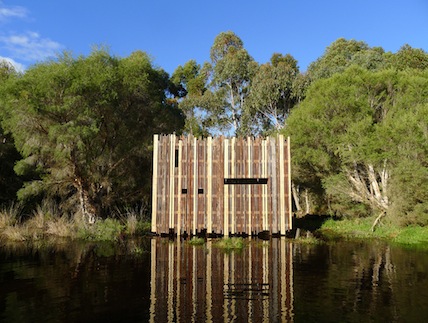
Next week sees the opening of Spaced - Art Out Of Place, the International Biennial of Socially Engaged Art. Members of the M12 collective will join the exhibition and its related symposium to speak about the installation they designed and implemented in Denmark, Australia: The Ornitarium.

This aesthetically elegant structure serves as a bird hide, a place of rest, and a site for art and contemplation - while welcoming local residents to consider the ecological and cultural landscape

The Ornitarium is housed at the Wetlands Education Centre and is operated by the group Green Skills.  Below, the M12 collective elaborates on the ideas behind this structure and its relationship to place. For more information, and larger high-resolution images, please visit here

This project has been inspired by “local knowledge” found in Southwestern Australia – specifically knowledge related to birds that populate the regions wetlands areas, regional timber types, and building methods. The work is designed and built as a bird hide and as a social space. The Ornitarium has a large front wall that stands as the dividing line between human habitat and wetland habitat, and a platform that invites visitors to spend time around the structure; encouraging learning and providing a catalyst for developing a deeper connection to the local environment and community.

The structure explores duality, and binds built space with environment—the inside expresses notions of the private, contemplative, communal, and reflective, and the outside wall stands to camouflage human engagement and reinforce fragmentation, and instinctive habitats such as nests and forests.
UPDATE: Here's Naomi Millet of The West Australian writing on the Spaced - Art Out Of Place installations: 
Towns such as Narrogin, Leonora, Northam and Mukinbudin are practical places. You might expect to see farmers there, and wheat bins, or sheep trucks, road trains and specialist machinery.

In the town centre, there might be a couple of granite and bronze memorials to founding pioneers but, apart from that, you wouldn't have very high hopes of encountering much sculpture, painting, multimedia or art in these often stark environments.

This perception is set to change dramatically with the emergence of Spaced: Art Out of Place, an ambitious biennial project featuring a collective of international and Australian artists which not only breaks new ground but also covers a vast amount of it.

Friday, January 27, 2012

White House Rural Conversation: #WHChat

Folks, we've been slow with articles and correspondence this week due to another series of technical issues. We'll be back to normal form this weekend.

Importantly, today one of President Obama's senior advisors is presiding over a Twitter discussion on rural issues this morning at 10am EST [#WHChat]. More information can be found on The Daily Yonder

Let's share our voices and our perspectives!

Wednesday, January 25, 2012

Update: The Black Hills Are Not For Sale

Mural Installation on Melrose Avenue in Los Angeles; Honor The Treaties Facebook Page

Last year we discussed Honor The Treaties, a promising collaboration between photographer Aaron Huey, the Pine Ridge Reservation in South Dakota, and a host of urban and indigenous street artists. 

Today we have more information on the latest developments in this project which crosses all kinds of generational, regional, and rural-urban lines. Here's video the recent Shepard Fairey installation on Melrose Avenue in Los Angeles, followed by Mr. Huey's brief summary of the project:


The Black Hills Are Not For Sale from sinuhe xavier on Vimeo.
“The Black Hills are not for sale!”  is a common rallying cry for Treaty rights on the Pine Ridge Indian Reservation.

In 1980 The longest running court case in U.S. history, the Sioux Nation v. the United States, was ruled upon by the U.S. Supreme Court.The court determined that, when the Sioux were resettled onto reservations and seven million acres of their land were opened up to prospectors and homesteaders, the terms of the second Fort Laramie treaty had been violated. The court stated that the Black Hills were illegally taken and that the initial offering price plus interest should be paid to the Sioux Nation. As payment for the Black Hills, the court awarded only 106 million dollars to the Sioux Nation. The Sioux refused the money with the rallying cry, “The Black Hills are not for sale.”

The United States continues on a daily basis to violate the terms of the 1851 and 1868 Fort Laramie treaties with the Lakota. The call to action I offer today is this: Honor the treaties.  Give back the Black Hills.  It’s not our business what they do with them.

My goal is to amplify the voices of my many Lakota friends and family on Pine Ridge, all of whom have advised me on this campaign.

Thanks!
Aaron Huey
Ernesto Yerena signing copies of his contributions to the project

More information, as well as downloadable images for wheat pasting, can be found at Honor The Treaties. The organization also hosts a Facebook page (where many more images and videos can be found), as well as a tumblr page.

Related Articles:

Monday, January 23, 2012

Almanac For Moderns: Rejoicing In The Noon Mercy


[More information on our Almanac For Moderns project and the work of Donald Culross Peattie can be found here.]

January Twenty-First

I wonder how much of fatality has come to the birds in the past week that I have been house-bound, while storm after storm swept the fields and woods, with alternate thaws followed cruelly by sleet. The papers tell of airplanes brought down with their fuselage ice-incrusted. It is not the cold that kills the birds, and somewhere, somehow, they always manage to find forage; it is winter rains that ground them too. For the titmouse that I come on stone dead in the woods, how many more small winged creatures are lying for the hawks and weasels to find, in the hills and on the fields!

Yet today, when I trudge abroad, just breaking through the stubborn crust at each tiring step, I hear the brave whistling and clinking notes of many little birds rejoicing in the noon mercy - though the mercury is below zero. I turn this way and that, trying to see them, but wherever I look the intolerable glare of the crusted snow, of the trees glittering in the silver mail, parries my sight like a cutting sword I cannot look into the eye of this ice-armored day; I can only bow my head and listen attentively, to the small indomitable voices of tree sparrows, white-throats and chickadees, ringing as bright and delicate as frost crystals become audible on the tingling air.