Friday, March 30, 2012

Is Your Child A Farmer? Know The Warning Signs.

Image from the Face Your Farmer Facebook page

This image from Face Your Farmer caught my attention yesterday. It seems that many rural groups and the artists associated with them have been less willing to use détournement, or its many web-based versions, in visual media campaigns. The term, "a negation of the value of the previous organization of expression," originated with with the Situationists and their leader Guy Debord in post-war France, though their techniques have become widespread -- now incorporated into political campaigns and advertising (the very things the Situationists critiqued) as well as thousands of internet memes. Indeed, the image above mirrors the framework from this arts ad campaign created by Team Detroit.

The Face Your Farmer project, and their Facebook community, have been generating an avalanche of such images - some of which are irreverent, as above, but others that are more pointed.

In conjunction with a number of media partners, Face Your Farmer follows "the journey of an organic farmer and a farm-shy tech enthusiast across 5 Canadian provinces and countless rural and urban communities." These two individuals, as the image above would suggest, present these  concerns in an approachable and, at times, lighthearted manner. Here's further information on their project:
‘Face Your Farmer’ connects people in cities to those in rural areas who are our Farmers. We strive to build communities without borders and remove the veil of mystery that separates people from farms.

In this age we face seemingly insurmountable problems with food security, food freedom and awareness around how food gets from farm to table. With a dwindling oil supply, local economies are becoming a necessity. We explore this new economic reality.

Wednesday, March 28, 2012

Rural Poetry Series: Paul Muldoon


Paul Muldoon was born in the countryside of Northern Ireland, between counties Armagh and Tyrone in Northern Ireland, in 1951. In his poem "Mixed Marriage," he alludes not only to the sectarian violence of the Troubles, but also to a state of cultural transition that would be familiar to many rural artists on either side of the Atlantic:
My father was a servant-boy.
When he left school at eight or nine
He took up billhook and loy
To win the ground he would never own.

My mother was the school-mistress,
The world of Castor and Pollux.
There were twins in her own class.
She could never tell which was which.

She had read one volume of Proust,
He knew the cure for farcy.
I flitted between a hole in the hedge
And a room in the Latin Quarter.
Muldoon himself has flitted between a number of categories. In the thirty years from the poems in Why Brownlee Left (1980) to Maggot (2010), this poet has made great art out of the chaos of modern life; his work confuses the lines between poetry and fiction (and our expectations of those genres) while also troubling easy cultural distinctions such as "Irish" or "American." Muldoon has lived in the United States since the late 1980's, and has served for many years as a professor at Princeton University and Chair of its Lewis Center for the Arts. For the last five years he has also served as Poetry Editor for the The New Yorker, guiding the most visible outlet for poetry published in America.

Despite this prestigious curriculum vitae, Muldoon remains a humble and open-minded figure on the literary landscape. In his more recent work, notably 2002's Moy Sand and Gravel, the poet has returned with new intensity to consider the history, culture, and language of his birthplace along the border. We see Muldoon demonstrate his gift for balancing this knowledge of the rural with his encyclopedic grasp of modern literature in this excellent interview piece for Wunderkammer Magazine:


Five Dialogues, Paul Muldoon from Wunderkammer Magazine on Vimeo.

The Moy that Muldoon returns to in his 2002 collection is one conscious of its place alongside many borders -- those between traditional and modern culture, the rural and the urban, and between a deep, almost archeological, past and a fluid present tense. In his poem "The Misfits," which places a viewing of that famous film written by Arthur Miller (with the last on-screen appearances by Clark Gable and Marilyn Monroe) alongside his childhood duties on the farm, where he mines a row of potatoes, "what would surely seem / to any nine- or ten-year-old an inexhaustible seam."

This pun on visual representation and human creation finds succinct and powerful articulation in the title poem, "Moy Sand and Gravel." Paul Muldoon's website offers a reading of the poem here; please find the text below:
To come out of the Olympic Cinema and be taken aback
by how, in the time it took a dolly to travel
along its little track
to the point where two movies stars' heads
had come together smackety-smack
and their kiss filled the whole screen,

those two great towers directly across the road
at Moy Sand and Gravel
had already washed, at least once, what had flowed
or been dredged from the Blackwater's bed
and were washing it again, load by load,
as if washing might make it clean.

Related Articles:
Rural Poetry Series: Patrick Kavanagh
Rural Poetry Series archives

Monday, March 26, 2012

The Affrilachian Artist Project

Remembering China Sparrow; Lynn Marshall-Linnemeier

We would like to start off this week with news of a effort that seeks to expand both cultural and artistic awareness: The Affrilachian Artist Project.  In addition to their mission, this project is also in the final stages of a Kickstarter campaign to raise funds to begin to film and document the work of some of the group's senior members. 

The Affrilachian Artist Project is seeking to establish "a sustainable community-building platform for artists of color from and inspired by the Appalachian region." As director Marie T. Cochran notes in the group's introduction, the term "Affrilachia" came about originally through the work of Frank X Walker, Nikky Finney and the vibrant Affrilachian Poets group that emerged in the early 1990's. Cochran originally presented work from the visual artists at the Affrilichian Poets' 20th anniversary celebration last year; during her time at that symposium, however, she realized that part of the larger narrative was missing:
Through an array of fragments, a pattern revealed itself. The Affrilachian Poets were the WORD, the Carolina Chocolate Drops were the SONG; yet sustained attention has not been given to the visual artists who create the OBJECTS and IMAGES of the people and the places evoked by similar life experiences. A third harvest should flourish in this fertile soil.


This harvest has already begun, first with an exhibit at the August Wilson Center for African American Culture entitled Affrilachia! Where I'm From, and, building upon that popular and critical interest, with an effort to begin filming, documenting, and sharing this work. These artists range in style from the environmentally-minded installations of DeWayne Barton to the mixed-media storytelling of Lynn Marshall-Linnemeier, from the socially-conscious assemblages of Kyle and Kelly Phelps to the dance between abstraction and representation in the paintings of Valeria Watson-Doost. There's much more work to explore on the project's artists page.

As Cochran mentions in on the project's Kickstarter page, The Affrilachian Artist Project adds to "recent efforts celebrating the history of Appalachia [that] reveal the fact that the region’s inhabitants are as diverse as its terrain." Organizations such as Appalshop and The Hillville have expanded our understanding of this landscape; below, Cochran offers the four misconceptions about Appalachia illuminated in Jeff Biggers' book The United States of Appalachia:
Biggers identifies four paradoxical images that have persisted about the region. The pristine Appalachia, though it is touted a vacationer’s playground according to slick promotional brochures, it is a battleground of fierce clashes between environmentalists and commercial interests over timber, coal and a number of natural resources; Anglo-Saxon Appalachia, once defined by Merriam-Webster’s Collegiate Dictionary as mountain region of “white natives,” despite its role as a crossroads of indigenous cultures as well as vast immigrant and African American migrations for centuries; backwater Appalachia, a “strange land of peculiar people” caricatured in thousands of popular culture formats from comic books to feature films, though the region has produced some of the most important thinkers and creators in the nation (including African Americans like Carter G. Woodson who established the first official celebration of Black History, Booker T. Washington, Bessie Smith, Nina Simone, Bill Withers, Nikki Giovanni and Henry Louis Gates to name a few) and pitiful Appalachia, the poster region of rural poverty, regardless of the tremendous revenue generated by its mineral resources, timber and labor force in the mines, mills and factories, and today’s tourist industry.
The Affrilachian Artist Project promises to help replace these "paradoxical images" with paintings, collages, and sculptures that speak from authentic experience and artistic practice. Please find the video for the project's Kickstarter campaign, which enters its final week today:

Thursday, March 22, 2012

Changing A Food Desert, One Metro Stop At A Time

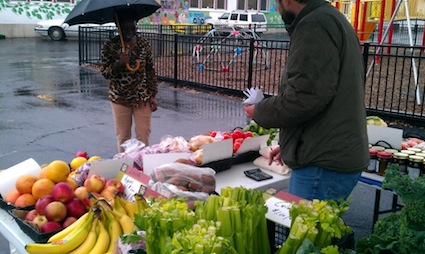
One of Farm to Family's Mobile Markets in Saint Louis

Despite its place amid some of the midwest's most fertile soil, Saint Louis is plagued by large food deserts - both a testament to suburban migration begun in the 1960's, but also to racially-motivated zoning and business models that survived in the city well past the Jim Crow era. [The BBC has recently discussed this history, in this excellent television report.]

The Sappington Farmers Market, a cooperative between Missouri small family farmers and rural entrepreneurs, has acted to help combat the scourge of urban food deserts by opening a series of Farm To Family mobile markets that will sell fresh produce and local goods at four bus/train stations. The Saint Louis Metro is allowing the markets to use the space free of charge, without asking for a share of the profits. STLToday offers further information, interviews, and photographs. 

What is so encouraging about this effort is its panoramic vision of local food's place in an urban locale; while Farm To Family also offers opportunities for weekly shares in a CSA program, and while they are connected with the successful Sappington Farmers Market, they are also branching out from the comfortable confines of the traditional local foods movement.

The farmers following this philosophy are an inspiration, and an example of thinking about "the whole horse," as Wendell Berry would write, in an essay of the same name:
We can say, without much fear of oversimplifying, that the aim of producers is to sell as much as possible and that the aim of consumers is to buy as much as possible.

But experience seems increasingly to be driving us out of the categories of producer and consumer and into the categories of citizen, family member, and community member, in all of which we have an inescapable interest in making things last.
Folks can follow these individuals' mission here; many thanks to City Farmer for leading us to this story.

Wednesday, March 21, 2012

Hiss Golden Messenger Takes To The Air

MC Taylor of Hiss Golden Messenger; Abigail Martin

As we catch up on news we were unable to cover over the last few weeks, we wanted to share this: Frank Stasio of NPR's The State of Things, in conversation with MC Taylor of Hiss Golden Messenger.

As we've written previously, HGM's Poor Moon was one of the most extraordinary records of 2011, and it's wonderful to hear Stasio and Taylor talk through so many of the ideas that inform the music: folklore, place, and family. Taylor also performs two tracks live in studio, "Call Him Daylight" and "Bad Debt," and concludes by offering a new song, "Busted Note."

In other exciting HGM news, Poor Moon will be available on CD courtesy of the excellent Tompkins Square label on April 17th -- with a new LP run offered by Paradise of Bachelors.

Hiss Golden Messenger "Poor Moon" - out April 17th by TompkinsSquare

Double Edge Theatre and The Grand Parade

photograph from The Grand Parade rehearsals; Double Edge Theatre

The Arena Stage at the Mead Center for American Theater has just announced that Double Edge Theatre will offer the world premiere of The Grand Parade (of the Twentieth Century) February 6-10 in Washington, DC. Inspired by Marc Chagall's paintings,  this piece offers a narrative of the twentieth century that The Arena Stage has described as "an emotionally stunning journey through the 20th century with the use of aerial flight, puppetry and music."

As we've written previously, Double Edge is a one-of-a-kind theatre company that lives, trains, and farms in Ashfield, Massachusetts. Not only are they one of the most powerful examples of "laboratory theater" in this country, but they also focus on the idea of "living culture," consistently asking how themselves how they can engage with local communities. This documentary excerpt begins to tell the story. 

Here is more information from the Arena Stage's press release:
The Grand Parade is conceived and directed by Double Edge Theatre Founder and Artistic Director Stacy Klein and is created with Carlos Uriona, Matthew Glassman, Hayley Brown, Jeremy Louise Eaton, Adam Bright and Milena Dabova. The show is realized with a collaborative team of artists from the United States, Argentina and Russia and features original compositions by Alexander Bakshi of Russia.

The Grand Parade
creates a mythology of the American century and its Russian counterpart, from the story of Evelyn Nesbit in the 1900s to the fall of the Wall to the Supreme Court Gore v. Bush decision in 2000. This imaginative, kaleidoscopic mashup of the century echoes Chagall’s life, which spanned from 1887 to 1985, and summons the artist’s sensibilities and personal memories.

“Work on The Grand Parade has been a wild and revelatory experience, from learning that women are still facing the same century long struggle, and that lessons of war and economy have gone unheeded, to the amazement and sheer fun of peoples’ continued attempts to fly, to invent, and to laugh in spite of it all,” says Klein. “With Chagall as our muse, we have dared our way through the century’s chaos, trying to find our own thousand ways to fly.”
More coverage of The Grand Parade is forthcoming; until then, many gorgeous photographs from the rehearsals in Ashfield can be found on Double Edge's Facebook page, along with recent news of their upcoming training intensive and their critically-acclaimed summer spectacles on the farm.

Related Articles:

Tuesday, March 20, 2012

Returning To The Art Of The Rural

Untitled, 1960; Ralph Eugene Meatyard

As folks may have noticed, over the last month The Art of the Rural conducted a retrospective of its first two years of articles and features. I appreciate everyone's patience, as we had to delay presenting new material during this period. This was particularly hard, because there was a great deal of art and ideas that we shared on our Rural Arts and Culture Feed but could not follow-up on in greater detail.

During this period I was progressing through an important phase of my dissertation work at Washington University in Saint Louis. The idea of a site like The Art of the Rural emerged at the start of my dissertation project - by looking, and not finding, adequate information and commentary on the rural arts. It's been a great joy to see how my time editing this site, and my engagement with so many readers and artists, had led me to re-think my critical work as well. 

Though writing a dissertation is often described as a solitary exercise, my experience has been quite different. The communities that have gathered here, at The Daily Yonder, The Rural Blog, and at a host of other arts groups and organizations, speak to a cultural imperative at work- a zeitgeist, as Brian Frink of Rural America Contemporary Artists would say. I'm hoping to share elements of my own critical work that can help to expand this conversation.

Thanks again to everyone who has contributed their time and enthusiasm to The Art of the Rural