Monday, April 30, 2012

The Tree That Bursts Through The Silo

Tree In Silo; Ken Wolf

Many thanks to María Arambula for sharing on our Arts and Culture Feed A.G. Sulzberger's latest rural dispatch for The New York Times, "Amid Rural Decay, Trees Take Root in Silos." The image of these trees bursting from disused farm structures unifies an arc of how the last century has dealt with rural place as an aesthetic ideal.

To begin, here's Mr. Sulzberger discussing this phenomenon across Kansas and Missouri:
The empty structures catch seeds, then protect fragile saplings from the prairie winds and reserve a window of sunlight overhead like a target. In time, without tending by human hands, the trees have grown so high that lush canopies of branches now rise from the structures and top them like leafy umbrellas. 

Across a region laden with leaning, crumbling reminders of more vibrant days, some residents have found comfort in their unlikely profiles. 

“It just struck me as, I don’t know, a symbol of something,” said Ken Wolf, who has spent many days of his retirement searching the area for what he calls, simply, silo trees, photographing dozens along the way. “I see it as a kind of passing.” 
Mr. Wolf's photographs present these tree-silos are a kind of vernacular architecture, not consciously assembled structures -- though they suggest this aesthetic through neglect and abandonment. As the photographer surmises, we're in the presence of a symbol heavy with historical and cultural weight.

It's jarring, then, to consider the image of this tree just one hundred year's ago, in the poetry of William Butler Yeats. In "Upon A House Shaken By The Land Agitation," Yeats laments the passing of the Anglo-Irish Ascendency who even, before the Easter Rising, were seeing their large estates broken up into smaller holdings and dispersed to local farmers. Yeats's position on the matter would be akin to many modernists, who envisioned their art free from the demands of (or condescensions to) popular audiences; the Nobel laureate saw in the destruction of an estate's "big house" a metaphor for the loss of what he would call (in another poem featuring a tree-symbol): "custom and ceremony." After decades connecting rural folklore to national literature, Yeats displays the anxieties of his class and his cultural standing -- worrying if these same people, so often portrayed by him as the spirit of the nation, would really be careful stewards of the land and its culture. He laments what is lost by allowing a tree to flourish in the place of a symbol of high cultural wealth. 

In Mr. Wolf's phtography we find a drastically different situation but, nonetheless, a structure in ruin and a landscape in transition. What is contested is what narrative we ascribe to the branches breaking free from the silo's concrete hold; is this a reclamation or a commentary on industrial agriculture, a scene of "rural decay" or something that transcends economics and cultural cliches? Is this a preface or a postscript?

Upon A House Shaken By The Land Agitation

How should the world be luckier if this house, 
Where passion and precision have been one 
Time out of mind, became too ruinous 
To breed the lidless eye that loves the sun? 
And the sweet laughing eagle thoughts that grow        
Where wings have memory of wings, and all 
That comes of the best knit to the best?
Although  Mean roof-trees were the sturdier for its fall,
How should their luck run high enough to reach
The gifts that govern men, and after these 
To gradual Time’s last gift, a written speech 
Wrought of high laughter, loveliness and ease?


Silo With Tree; Ken Wolf

Friday, April 27, 2012

Rural Tracks: Daughn Gibson's Country Noir


If folks are familiar with the rich, hallowed ground of country music that deals with trucking and the open road, then these new contributions by Daughn Gibson will come as a surprise.

His first record, All Hell, has been available for a few weeks, with interest in Gibson's unique musical-collages steadily gathering steam in the music press. Here's Larry Fitzmaurice, writing in his Pitchfork feature on the artist:
There are moments of genuine noise and terror on singer-songwriter Daughn Gibson's debut solo LP, All Hellbut not of the devil's-horns kind. Instead, the 31-year-old Carlisle, Penn., resident fashions ghostly, haunting country-ish ballads out of Christian gospel samples and looping audio software while his rich baritone narrates small-town tragedy.

Gibson's affinity for country music-- as well as the genre's cherished storytelling tradition-- began when he started driving trucks for a living nearly a decade ago. "I started listening to country when there was nothing else to listen to on the radio when I was driving," he says. "I started liking the stories, no matter how absurd they sounded. I liked that they were portrayals of people, or scenarios, or nostalgia." To this day, he's stillworking in the trucking industry, as an HR representative.


I have been recently been reading, and re-reading, Collage Culture, a collaboration between poet Mandy Kahn, filmmaker/curator Aaron Rose, and designer Brian Roettinger. Across these essays, they give an impassioned argument for artists, writers, and musicians to move beyond collage as an end-in-itself, and they offer a thoughtful critique of how an admixture of styles, references, and cultural debris liberally scattered together (like a Google image search) negates all the history, ideology, and human experience contained in each discrete element of a collage. Though this publication emanates from Los Angeles, and is entirely concerned with urban art forms, I sense that its thesis would be enthusiastically received by many of our readers and collaborators.

No genre is more complicit in "collage culture" than electronic music, which brings us back to Daughn Gibson. The compelling, catchy, and, at times, unsettling effects of the songs on All Hell seem to transcend the pitfalls of Collage Culture and sample-based music. Is this because Gibson is working with country music material that emerges from his lived, placed, experience? Does the style and texture of these songs also emanate a kind of spatial sense of the open road, the rural interstates of Pennsylvania, the quality of constantly traveling between points on a map? 

It may be a challenge to not to contextualize, or even romanticize, some elements of this music's creation. Please feel welcome to offer your own takes of this on our Arts and Culture Feed

Included below is another song from All Hell, "Tiffany Lou," followed by a video trailer for Collage Culture directed by Aaron Rose:


Tuesday, April 24, 2012

Wendell Berry's Jefferson Lecture: "It All Turns On Affection"


On Monday night Wendell Berry delivered "It All Turns on Affection," the 2012 Jefferson Lecture at the Kennedy Center. Each year the National Endowment for the Humanities offers this lectureship, "the highest honor the federal government bestows for distinguished intellectual and public achievement in the humanities." 

Mr. Berry's talk covers an extraordinary amount of ground -- from an epigraph from Howards End, to memories of his grandfather's struggles with the economies set in place by the American Tobacco Company, and to many locales and texts in between. Well-versed readers of Mr. Berry's prose and poetry will no doubt share my sense that this essay revisits (and re-contextualizes) many of the concerns of his work -- closing some circles, but opening up new ones as well. 

There is much to quote and discuss within "It All Turns on Affection," yet, in this brief piece, I'll include these two paragraphs, moving in how they call on all citizens -- rural and urban -- to return to first principles to find their relationship to place and practice:
I will say, from my own belief and experience, that imagination thrives on contact, on tangible connection. For humans to have a responsible relationship to the world, they must imagine their places in it. To have a place, to live and belong in a place, to live from a place without destroying it, we must imagine it. By imagination we see it illuminated by its own unique character and by our love for it. By imagination we recognize with sympathy the fellow members, human and nonhuman, with whom we share our place. By that local experience we see the need to grant a sort of preemptive sympathy to all the fellow members, the neighbors, with whom we share the world. As imagination enables sympathy, sympathy enables affection. And it is in affection that we find the possibility of a neighborly, kind, and conserving economy.

Obviously there is some risk in making affection the pivot of an argument about economy. The charge will be made that affection is an emotion, merely “subjective,” and therefore that all affections are more or less equal: people may have affection for their children and their automobiles, their neighbors and their weapons. But the risk, I think, is only that affection is personal. If it is not personal, it is nothing; we don’t, at least, have to worry about governmental or corporate affection. And one of the endeavors of human cultures, from the beginning, has been to qualify and direct the influence of emotion. The word “affection” and the terms of value that cluster around it—love, care, sympathy, mercy, forbearance, respect, reverence—have histories and meanings that raise the issue of worth. We should, as our culture has warned us over and over again, give our affection to things that are true, just, and beautiful. When we give affection to things that are destructive, we are wrong. A large machine in a large, toxic, eroded cornfield is not, properly speaking, an object or a sign of affection.
Folks can find a transcription of the lecture here, along with an interview and further information on past Jefferson Lectures. Below we will offer video of Mr. Berry's talk, which is preceded by remarks by Jim Leach, the chairman of the NEH, and Bobbie Ann Mason, who reads from Mr. Berry's poem "Leavings." If the embedded video does not properly play on your browser, please find the permanent link here:

[video removed due to formatting problems; please visit the link above]

Also, as a fitting epilogue to the lecture, Mark Bittman has written an extraordinary piece today in The New York Times about his recent visit with Mr. Berry in Port Royal. Mr. Bittman receives a call three hours after leaving the farm from Mr. Berry, with this addendum:
“Mark,” he says. “I’ve been thinking about that question about what city people can do. The main thing is to realize that country people can’t invent a better agriculture by ourselves. Industrial agriculture wasn’t invented by us, and we can’t uninvent it. We’ll need some help with that.”

Photographing Rural Maine, Beyond The Vacationland

Gregory Gives his Cousin Lori a Rose, 1983; Steven Rubin

This month TIME Magazine's Lightbox photography section highlights the work of Steven Rubin and his 30 year project in Somerset County, Maine -- the fruits of which are currently on view at the drkrm gallery in Los Angeles. 

Tara Godvin, writing in Lightbox, outlines the dimesions of this extended meditation on place and culture which began with a hitchiking ride to rural Maine in 1982: 
A graduate from Reed College with a degree in sociology, Rubin had originally come out to the East Coast from Oregon to enroll at the then Maine Photographic Workshops (now the Maine Media Workshops) in Rockport. After documenting the effects of the early 1980s recession on families nearby, he wanted to see how the economic downturn was being handled by locals far from the highways, historic lighthouses and second homes of the Maine coast. On a tip from a friend, Rubin headed inland and settled upon an abandoned shack as his home base and a schedule of hitching four to eight hours between the countryside to take pictures and Rockport to develop them.

Taking prints back to his subjects as a thank-you for their time and trust, Rubin was eventually let into the lives of local families—as well as some of their homes to crash on floors and couches—as he continued his work throughout Central Maine.

What he has witnessed is a part of the country largely unbuffeted by the usual economic ups and downs seen elsewhere. For many in the area times are always tough. According to the U.S. Bureau of Economic Analysis, per capita income has been increasing in Somerset County but has ranked at or near the bottom among Maine’s 16 counties throughout the many years of Rubin’s project. Residents get by through resourcefully cobbling together seasonal and part-time jobs, hunting, fix-it know-how and the support of their communities.

“When I met some of these families, I was completely in awe of them in many ways,” said Rubin, now an assistant professor of art in the Photography Program at Penn State University. “I think as an outsider and someone who didn’t have the background that they did, I was really quite taken by how they survived, by their strength, by their resourcefulness.”
Please find Tara Godvin's full article, with a generous slideshow of Steven Rubin's work, at TIME Lightbox. Many thanks to Alyce Ornella of the Spindleworks Art Center in Brunswick, Maine for leading us to this work

Monday, April 23, 2012

TONIGHT: Live Broadcast of Wendell Berry's Jefferson Lecture


Here's further news on tonight's live stream, from Ivy Brashear of The Rural Blog:
Poet, essayist, novelist, farmer and conservationist Wendell Berry will deliver the 2012 Jefferson Lecture in the Humanities tonight at 7:30 at the John F. Kennedy Center for the Performing Arts in Washington, D.C. The National Endowment for the Humanities will be video-streaming the lecture live. The annual lecture is the most prestigious honor the federal government bestows for intellectual achievement in the humanities.
Ivy Brashear's article continues here

Readings: A Route on the Map: Italo Calvino and Double Edge Theatre

Photographs of The Grand Parade; Maria Baranova

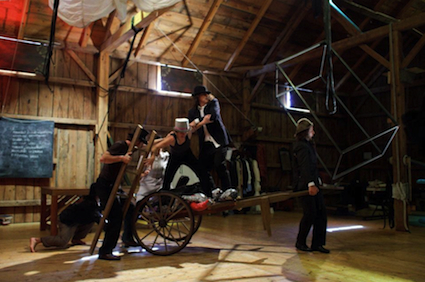
In our Readings series, we offer selections from visual and printed texts that offer perspectives, expand dialogues, and challenge assumptions. Today we feature the photography of Maria Baranova,  from Double Edge Theatre's rehearsals for The Grand Parade (of the Twentieth Century): "an original, multi-disciplinary piece of theatre" that imagines the life and art of Marc Chagall alongside the shifting cultural tides of the last century. The piece is directed by Stacy Klein, with music composed by Alexander Bakshi.
 
Alongside this work, we offer the closing paragraphs of Invisible Cities, the seminal story cycle by Italo Calvino consisting of a series of conversations between Marco Polo and Kublai Khan. Polo's ever-expanding descriptions of magical and diverse cities is revealed, by the close of the book, to be facets of a single place.

••••••••••

The Great Khan's atlas contains also the maps of the promised lands visited in thought but not yet discovered or founded: New Atlantis, Utopia, the City of the Sun, Oceana, Tamoé, New Harmony, New Lanarck, Icaria.

Kublai asked Marco: "You, who go about exploring and who see signs, can tell me towards which of these futures the favouring winds are driving us." 


"For these ports I could not draw a route on the map or set a date for the landing. At times all I need is a brief glimpse, an opening in the midst of an incongruous landscape, a glint of lights in the fog, the dialogue of two passersby meeting in the crowd, and I think that, setting out from there, I will put together, piece by piece, the perfect city, made of fragments mixed with the rest, of instants separated by intervals, of signals one sends out, not knowing who receives them. If I tell you that the city towards which my journey tends is discontinuous in space and time, now scattered, now more condensed, you must not believe the search for it can stop. Perhaps while we speak, it is rising, scattered, within the confines of your empire; you can search for it, but only in the way I have said."


Already the Great Khan was leafing through his atlas, over the maps of the cities that menace in nightmares and maledictions: Enoch, Babylon, Yahooland, Butua, Brave New World. 


He said: "It is all useless, if the last landing-place can only be the infernal city, and it is there that, in ever-narrowing circles, the current is drawing us."


And Polo said: "The inferno of the living is not something that will be; if there is one, it is what is already here, the inferno where we live every day, that we form by being together. There are two ways to escape suffering it. The first is easy for many: accept the inferno and become such a part of it that you can no longer see it. The second is risky and demands constant vigilance and apprehension: seek and learn to recognise who and what, in the midst of the inferno, are not inferno, then make them endure, give them space."


Related Articles:

Wednesday, April 18, 2012

Readings: The Unreported Arts Recession of 1997 by Dudley Cocke

Dudley Cocke; Imagining America

In our Readings series, we offer selections from visual and printed texts that offer perspectives, expand dialogues, and challenge assumptions. Today we feature the opening paragraphs from "The Unreported Arts Recession of 1997" by Dudley Cocke, the Artistic Director of Roadside Theater at Appalshop

Please find the full text of this essay in Roadside Theater's Reading Room.

••••••••••

In the U.S. community-based arts field, the financial crisis did not occur in 2008, but in 1997. What happened then to those nonprofit arts organizations built for the majority of Americans is an unreported story, the consequences from which the field has not recovered.

The story of the 1997 arts recession begins in 1980 when the right wing, spurred on by Ronald Reagan's election, instigated a campaign to defame the National Endowment for the Arts. The ultimate goal was complete elimination of the federal agency established in 1965 by an act of Congress with the mandate to dedicate itself "to supporting excellence in the arts, both new and established; bringing the arts to all Americans; and providing leadership in arts education." The Reagan administration and Congress tried but failed several times in the 1980s to eliminate the NEA. Then in 1997 the agency's leader at the time, Jane Alexander, knuckled under to right wing political pressure, abolishing all of the NEA's more than a dozen discipline-based divisions (each of which had been armed with its own defense), installing in their place a few generic themes ("creation and presentation" is an example), and limiting organizations to one thematic application a year.


For the community-based arts field, the restriction to only one annual NEA application was especially problematic. Most progressive nonprofit arts organizations preferred competing for public money, because it was the people's tax money -- and they saw their work as public work. Consequently, the more developed community-based arts organizations were receiving support from multiple NEA programs. With the new single application rule, Appalshop, where I work, abruptly lost 90 percent of its federal arts funding, which represented 20 percent of its annual operating budget.

The 1997 restructuring of the NEA delivered a second punch: discipline-based knowledge and expertise -- which had been on a trajectory of becoming broader and deeper -- disappeared from the nonprofit arts discourse. A "dumbing-down" effect took hold. A good example of this regression is the limited opportunity the public now has to see new and experimental plays from different cultures and geographies -- a result of abolishing the NEA Presenting Program. Appalshop's theater wing, Roadside Theater, which I direct, lost 70 percent of its performance fee income with the collapse of the national touring market for new plays, which had been leveraged on NEA support for arts presenting as a discipline. Prior to 1997, Roadside had visited more than 1000 communities in 43 states, never failing to reach an audience reflective of the racial, economic, and cultural diversity of each host community.

••••••••••

"The Unreported Arts Recession of 1997" continues here, in The Roadside Theater Reading Room.