Friday, February 11, 2011

Wendell Berry Joins Sit-In in Kentucky Governor's Office


At this hour Wendell Berry has joined a group of about 20 Kentuckians, who are engaging in a non-violent sit-in, requesting a meeting with Kentucky governor Steve Beshear. Kentuckians for the Commonwealth  is offering this site with a live video stream, and also with near minute-by-minute updates via Twitter. Mr. Berry is refusing to leave until their group has been granted a conversation with the governor. 

The group's press release is below. The Louisville Courier-Journal has coverage here; Jeff Biggers has an article here about the sit-in and the "Kentucky Rising." Also refer to the always-wonderful Mr. Wendell Berry of Kentucky for more information.
Press Release: Group of Kentuckians Demand End to Mountaintop Removal Mining in Governor’s Office Sit-In
11 February 2011
Contact: Silas House/Jason Howard 606.224.1208
FRANKFORT – A group of twenty Kentuckians has gathered at the state Capitol in an attempt to meet with Gov. Steve Beshear to discuss the issue of mountaintop removal mining. They plan to remain in his office until the governor agrees to stop the poisoning of Kentucky’s land, water, and people by mountaintop removal; or until he chooses to have the citizens physically removed.
Among the group are Wendell Berry, 76, the acclaimed writer who has decried mining abuses for the past fifty years; Beverly May, 52, a nurse practitioner from Floyd County; Erik Reece, 43, who has written extensively about the coal industry; Patty Wallace, 80, a grandmother and long-time activist from Louisa; Mickey McCoy, 55, former educator and mayor of Inez; Teri Blanton, 54, a grassroots activist from Harlan County; Stanley Sturgill, 65, a former underground coal miner of Harlan County; Rick Handshoe, 50, a retired Kentucky State Police radio technician of Floyd County; John Hennen, 59, a history professor at Morehead State University; and Martin Mudd, 28, an environmental activist.
While these Kentuckians realize they are risking arrest by refusing to leave the governor’s office, they say they have repeatedly petitioned Gov. Beshear for help, yet their pleas have been ignored. This action is a last resort to seek protections for their health, land, and water.
In a letter to Gov. Beshear, the citizens expressed their desire to communicate “respectfully and effectively” with the governor about the urgent need to stop the destruction of mountaintop removal mining. Among their requests were the following:
§  Accept a long-standing invitation to view the devastation in eastern Kentucky caused by mountaintop removal mining
§  Foster a sincere, public discussion about the urgent need for a sustainable economic transition for coal workers and mountain communities
§  Withdraw from the October 2010 lawsuit against the Environmental Protection Agency, in which the Beshear administration partnered with the coal industry to oppose the EPA’s efforts to protect the health and water of coalfield residents
“The office of the governor must be held accountable,” they citizens explained in a joint statement.

Wednesday, February 9, 2011

A Rye Whiskey Rural Arts Metaphor?

Templeton's home-grown rye crop; from the distillery's blog

We occasionally like to dwell on issues of food culture and the culinary arts that have a particular rural connection (see the search function on the sidebar for Ian Halbert's excellent series of articles), and today we've found a controversy that has developed across the state of Iowa that may be of interest to our readers.  

The story involves Templeton Rye, a small-batch rye whiskey distilled in Templeton, Iowa. With the exception of liquor connoisseurs, most folks outside of Iowa--even most folks in the midwest--probably have never heard of Templeton, despite the fact that it is one of the most sought-after whiskeys in the United States. It's also a whiskey with a compelling local and historical legacy. Here's a brief introduction from the distillery's site:
When Prohibition outlawed the manufacture and sale of alcoholic beverages in 1920, many enterprising residents of a small town in Iowa chose to become outlaws – producing a high caliber and much sought-after whiskey known as Templeton Rye.

Based on its extremely smooth finish, the American rye whiskey earned the nickname of “The Good Stuff” and quickly brought a certain degree of fame to the doorsteps of Templeton (pop. 350). As the premium brand of the era, Templeton Rye fetched an impressive $5.50 per gallon – or approximately $70 by today’s standards.

Over the course of its storied history, Templeton Rye became Al Capone’s whiskey of choice, quickly finding its way to the center of his bootlegging empire. Hundreds of kegs per month were supplied to Capone’s gang who in turn filled the demand of speakeasies throughout Chicago, New York and as far west as San Francisco.

Capone was eventually convicted on charges of tax evasion and sent to prison. Later legends suggest that a few bottles even found their way inside the walls of Alcatraz to the cell of prisoner AZ-85.
Although most American whiskeys ceased production after prohibition ended, Templeton Rye continued to be produced illegally in small quantities for loyal patrons. More than eighty-five years later, the infamous small batch rye whiskey finally returned – made available legally for the first time ever in 2006.
While the Capone connection may be enough to tempt a taste, the product's history is far from a gimmick; this is one of the finest, and most unique, rye whiskeys that money can buy. Beyond the connection to Prohibition and Alacatraz, this is no doubt also related to the local elements of this product's creation, to the care that the distillers--and the town itself--has put into each bottle. As their blog indicates, this distillery is intricately linked to its home region.

The Templeton controversy, however, has emerged at the convergence of all the wonderful attributes contained in the previous paragraph. Iowans want to purchase a quality drink with an Iowa connection,  stores in the state wish to stock this local gem, and--to confound this seemingly simple example of supply and demand--a huge number of urban, coastal connoisseurs are desperate to also enjoy a sip. Extraordinarily limited quantities of Templeton Rye can be found in upscale liquor stores in New York City, San Francisco and Chicago, often at considerably higher prices. Even within Iowa, it is very hard to find the product; often local stores will only receive 2-4 bottles a month. People turn to Facebook and Twitter (#TRspottings) to report when and where they have found "the good stuff."

Ironically, then, a product which began as a contraband item has, through different circumstances, become again a subject of hush-hush conjecture. This has led, within the state of Iowa and no doubt through internet chatter, to the perception that the scarcity of Templeton Rye was linked to a single likely cause: Templeton was shipping a larger proportion of its product to distant cities. As the video below and the site's allotment data indicate, this was only a perception. The vast majority of Templeton Rye stays within the Iowa border.

Herein lies a multifaceted metaphor. We see in this story those ever-present tensions between the local and the cosmopolitan, between the rural and the urban; we also see here the point at which a fantastically successful rural, regional business reaches a challenge that has less to do with profit-margins than with the community on which the entire enterprise is rooted. As a culinary art form, this is a kind of instructive tale for artists working within other mediums.

Also, looking more broadly at the well-earned success story in Templeton, we have an aspirational model for the rural arts. It's a sort of material and aesthetic challenge for contemporary rural artists in all mediums, how to balance the desires of rural and urban audiences--and how to reach one's local audience in such a way that they take the kind of ownership over their region's work that Templeton's Iowa base has exerted. While this controversy has been a challenge to the distillery, it's an envious one for most rural artists. Imagine if the words "Templeton Rye" and "Batch 4" were interchanged in the video below with any number of other words: "our recent series of paintings", "our recent book of poems", "our current recording":

Tuesday, February 8, 2011

Almanac For Moderns: The Frayed End of Winter


February Fifth

The month of February has many fine points, and not the least of them that it is soonest over. Some months had to be distinctly shorter than the others, since twelve does not divide equally into the solar year of three hundred and sixty-five days, five hours, forty-eight minutes and forty-five seconds and fifty-one hundredths of a second. The rectification of the calendar has required not only leap years but an elaborate centenarian system of skipping leap years to split this knotty fraction. The only odd thing is that men should have chosen the second month to bear the irregularities. 

The fact is, of course, that February was the last month in the English calendar until 1752, and so it took of the year what was left over. I still think the old calendar was more satisfying. New Year resolutions die notoriously young, because the frayed end of winter wears down our souls. The gods have done what they could for February by putting in Washington's and Lincoln's birthdays, and St. Valentine's day, and so many birthdays of famous naturalists that the maker of this almanac is embarrassed by the wealth of his material, for secretly the sap is rising, hard little buds are forming, and his mind will be coaxed from the past as the days lighten.

For it is in the nature of things that the lowest ebb of the living year is also the most prescient and significant; it is, for the year, the instant of conception, that moment when forces fundamentally abstract determine what it is that shall be born alive when spring is at the full.


February Sixth

Winter is a guest that stays beyond its welcome and I am not complaining merely of cold and thaw, thaw and cold. I dislike the loneliness of winter, the flowerlessness of the ground. I miss the birds.

To those who honestly prefer a titmouse or a junco to mockingbirds and mourning doves, I have nothing to answer save that it raises my spirits mightily to remember that somewhere, throbbing on summery air, there are hummingbirds. The gorgeous whistling oriole, the scarlet tanager, the indigo bird, the wood thrush and the bobolink--they are all there in the south and in the tropics, waiting the appointed hour of return or perhaps already taking off. 

Before I sleep I close my eyes and try to think of them. I see the map of the continents outspread, in a bird's eye view, snow-wrapt at the north, brown still or faintly greening in the half-sleeping Carolinas, with palm-tipped Florida reaching out into the Gulf. From the West Indies slumbering in the Carribean, from the jungles of Orinoco and the pampas of Argentine, our own will return to us. It is long and long before their coming; the skies still ache for them. Yet they are astir, upon the move, dauntless, and forgiving us our trespasses against them.


More information on our Almanac For Moderns project and the work of Donald Culross Peattie can be found here.

Monday, February 7, 2011

Richard Saxton's Vernacular Landscapes

from The Research Archive; 5.5” x 8.5”

A number of recent posts have dealt with various concepts of "the vernacular" across the arts of poetry, music and photography; today I'd like to bring into the discussion a visual artist whose body of work is intimately concerned with both the aesthetic questions tied up in vernacular art and as well as the ways in which this kind of art can both challenge and sustain rural communities. 

Richard Saxton is an artist and educator based in Denver. He and his work has traveled across the country and across the world in an effort to present audiences with an art that is, in Mr. Saxton's words, "interdisciplinary, blurring the boundaries of social practice, sculpture, architecture, design, and image-based research." As with previous discussions of Chris Sauter and the rural avant-garde, what we see in much of Mr. Saxton's work is an aesthetic that is deeply contemporary--yet the visual style of these pieces is not an end in itself, not a distant, theoretical veneer.

Instead, when we encounter the "social practice" of this work we are placed on a surprising terrain, and our traditional notions of what it means to be an audience for a piece of art radically changes: a rural gas station, perhaps like one in our own community, is defamiliarized by way of Mr. Saxton's lens. With that spark of recognition, the gas station in the photograph and our  own local gas station, along with our perspective on that building and all the other structures surrounding it, is transformed. We begin to see these structures--physical and social--as works of art constantly in the process of being created. And we realize that all of us are a part of this composition.

In this respect, the term "vernacular art" seems to have many provocative parallels to what many of us would recognize in the folk tradition as how a song--by interacting with an audience--is altered, updated and made local, contemporary. Out of seemingly disparate materials, we're back at a point where the traditional and the modern have a great deal to share with each other.

This phenomenon is present across many of Mr. Saxton's projects. The image above is a representative from The Research Archive, a collection of over 500 photographs the artist has taken of unconventional or improvised architecture in rural America. "The archive is a celebration of freedom and autonomy in building," Mr. Saxton tells us, "and is a testament to chance, resourcefulness, simplicity, unpredictability, and everyday ingenuity."

Also housed on the artist's site is the Models and Drawings collection; these pieces "explore an interest in the poetics of the everyday vernacular landscape," and, in considering local materials and local conditions, they offer a glimpse into the artist's process of composition. In the two selections below, we see how figurative models are linked--through this vernacular, "in-process" quality--to abstract renderings:


It may not surprise folks who remember our previous coverage of The Rural Studio that Mr. Saxton served as an artist-in-residence at the Studio a few years ago. After that residency, Mr. Saxton joined in bringing a "rural renaissance" to the small town of York, Alabama. Here's the Birmingham Black and White reporting on his project:
sculptor Richard Saxton was busy renovating an old bank building to create studios and living quarters for two more artists-in-residence that The Coleman Center will support. He previously worked at [Samuel] Mockbee's Rural Studio and now directs The Municipal Workshop, described as a contemporary public art laboratory that works in conjunction with municipalities and communities to foster a more creative approach to living. One of their recent projects is Utility Now!, in which local artists work to solve the Department of Public Works' lack of transportation by redesigning old tricycles and bicycles to make them useful for routine city maintenance, yet aesthetically interesting.
The Municipal Workshop created public art projects with local communities from 2002-2007, and its work is thoroughly documented on the Workshop website. Their many creations range from a Music Integrated Kiosk Environment (MIKE) produced for the Kohler Arts Center in Sheboygan, Wisconsin to the AutoTour Vehicle built for the Center for Land Use Interpretation in Wendover, Utah. This work led from the Workshop to the formation of the M12, a collective of artists doing some very exciting work in rural America, and beyond. We will conclude this week with a separate article on the M12, as their work deserves ample space.

Until then, we recommend returning to the fantastic Art Lies issue that considered the state of the contemporary arts in rural America; contained within is "Cool Pastoral Splendor," a collaboration between Richard Saxton and Kurt Wagner, a poet and the creative center of the band Lambchop.

Saturday, February 5, 2011

Following the Texas Mountain Trail

Sunrise in Van Horn, Texas; Texas Mountain Trail's  Facebook page

Yesterday we welcomed Beth Nobles onto our site as one of what we're calling our Rural Correspondents--folks who are working on the ground level to foster the arts in our rural communities. Beth is a visual artist and the executive Director of the Texas Mountain Trail, a non-profit organization working on community development and tourism marketing for Far West Texas.

Especially after considering the argument for regional collaboration within Grant Wood's essay Revolt Against the City, the Texas Mountain Trail organization seems to have their finger on a vision of the kinds of partnerships for which a number of rural regions could avail themselves. All of the pieces are here: broad cooperation amongst businesses, organizations and artists--and, importantly, an attractive and informative website with a social media component. As a sidebar on the site tells us, The Texas Mountain Trail is connected, through a program of the Texas Historical Commission, to the nine other Heritage Trail Regions of the state.

One feature of the site that fascinated us was the story of Van Horn's Clark Hotel, which hosts, every five years, an all-town reunion. Photographers were on hand at the last gathering to document, in portraiture, all of the returning families--a visual model of a town's family tree. 

A collection of 500 photographs contained in the Clark Hotel has also been digitized and included on the University of North Texas's Portal to Texas History archive. Just as our site is beginning to consider forms of vernacular architecture and art, this is a wonderful discovery, and it's in keeping with other such archives we've discussed at the Library of Congress and the Florida Memory Archives.

Here's one of our favorites: Costumed Ladies. Though the photograph contains no information on the occasion for such costuming, we are informed that the participants consist of "Clara Bean, Neva Harrell, Mrs. Wylie, Pansy Durrill Cleg, Mrs. D.B. Jackson, Mrs. Daisy Rowe, Mrs. Jack Price:"


Friday, February 4, 2011

The Texas Crossroads Cowboy Gathering

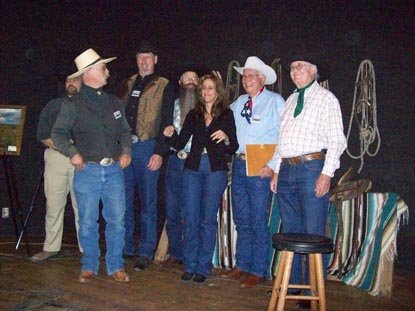
photograph from a recent Texas Crossroads Cowboy Gathering

By Beth Nobles, Art of the Rural Correspondent

There’s no question about Bob Kinford’s occupation when you meet the founder and organizer of the Texas Crossroads Cowboy Gathering--this is a man who works horses and cattle.  Even in the heart of Far West Texas’ Chihuahuan desert, he gets noticed when he enters a room.  Sporting a wide-brimmed hat, well-worn cowboy boots, and his neck tied with a wild rag, this cowboy is a horse trainer and a specialist in herd behavior and natural reduced-stress cattle handling; as well as a poet, storyteller, cook, and publisher.
Just as the Edinburgh Fringe Festival developed as an alternative venue in Scotland, Bob Kinford organized the Texas Crossroads Cowboy Gathering three years ago as an option for performers trying to break into the cowboy poetry circuit.
“Cowboy anthologies, stories and poetry are not considered an actual genre by the publishing industry, and gatherings are the only practical way to market the work,” said Bob recently.  “It seemed that gatherings I attended kept hiring the same people and were not hiring out of the open mic performers.”
“We are filling a niche for up-and-coming entertainers, as well as those who are trying to expand out to different areas of the country. As far as I know, we are the only gathering that live-streams video of all shows to the internet. This is allowing us to fulfill our goal of getting the genre out to a whole new audience, not just in the United States, but also internationally. The average person has never heard of cowboy poetry or music. Those who have not actually heard it before assume that it is just a bunch of hicks with no talent.”
Now, in anticipation of the Crossroads Cowboy Gathering’s third year (in Van Horn, Texas, February 3-6), Bob has planned outreach events in area schools.  For example, “We’ve got 27 performers this year, and all are either currently involved in agriculture or have their roots in it. Many are ranchers or retired ranchers. I would like to make Crossroads not just an entertainment venue, but educational as well,” said Bob.   Tiny Valentine, Texas (approximate population 250) “will host Crossroad’s performers Evelyn Roper, Bob Atkins and Tony Argento at their elementary school.  They will sing and recite poetry, as well as giving the kids a chance to ask them questions about their art or agriculture.”
As a rural festival organizer, Bob shares some of the same challenges with organizers anywhere, “getting through the politics of having other events hire from our pool of entertainers, and drawing an audience with a very limited budget.”  However, this audition venue for aspiring cowboy poets and performers seems to be a survivor.  Already, plans are underway for a February 2-5, 2012 Texas Crossroads Cowboy Gathering in Van Horn, Texas.
Information about attending this year’s festival in person or through live-streaming video is available at the Gathering’s website.

Thursday, February 3, 2011

The Calendar Poems of Lorine Niedecker


Wade all life
backward to its
source which
runs too far
ahead

Between digging out from our massive Midwestern storm, I'd like to offer this entry from Lorine Niedecker (1903-1970), a poet from Blackhawk Island, Wisconsin whose influence on contemporary poetry has come to far exceed the boundaries of her river road. There will be much more on Ms. Niedecker soon; her work falls into conversation with a number of other upcoming posts that consider what's at stake in the concept of the "vernacular" in photography, architecture and visual art. The above poem is the first entry in a series entitled Next Year or I Fly My Rounds Tempestuous; it was a portion of a calendar book she gifted to the Objectivist poet Louis Zukofsky in December of 1934.

Until then, there is much more of Ms. Niedecker's work to be enjoyed in Jenny Penberthy's excellent Lorine Niedecker: Collected Works, and more information by Ms. Penberthy on the calendar series can be found here.  The Poetry Foundation also offers this concise biography, with poems; information on the the lyrical documentary Immortal Cupboard, complete with excerpts, can be viewed by following this link.